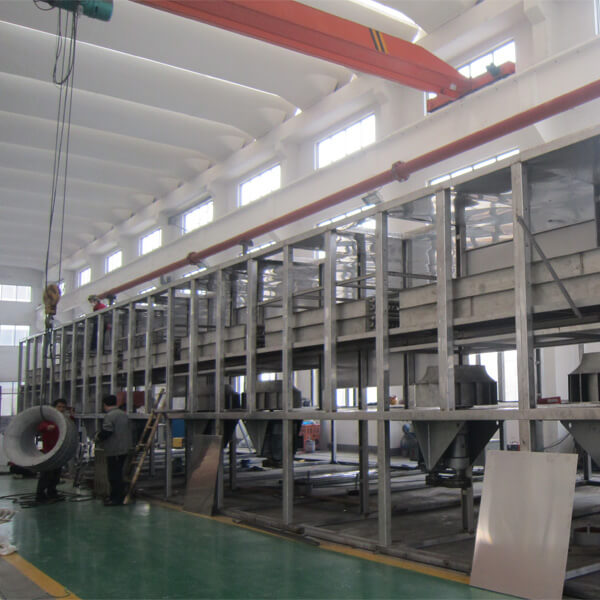
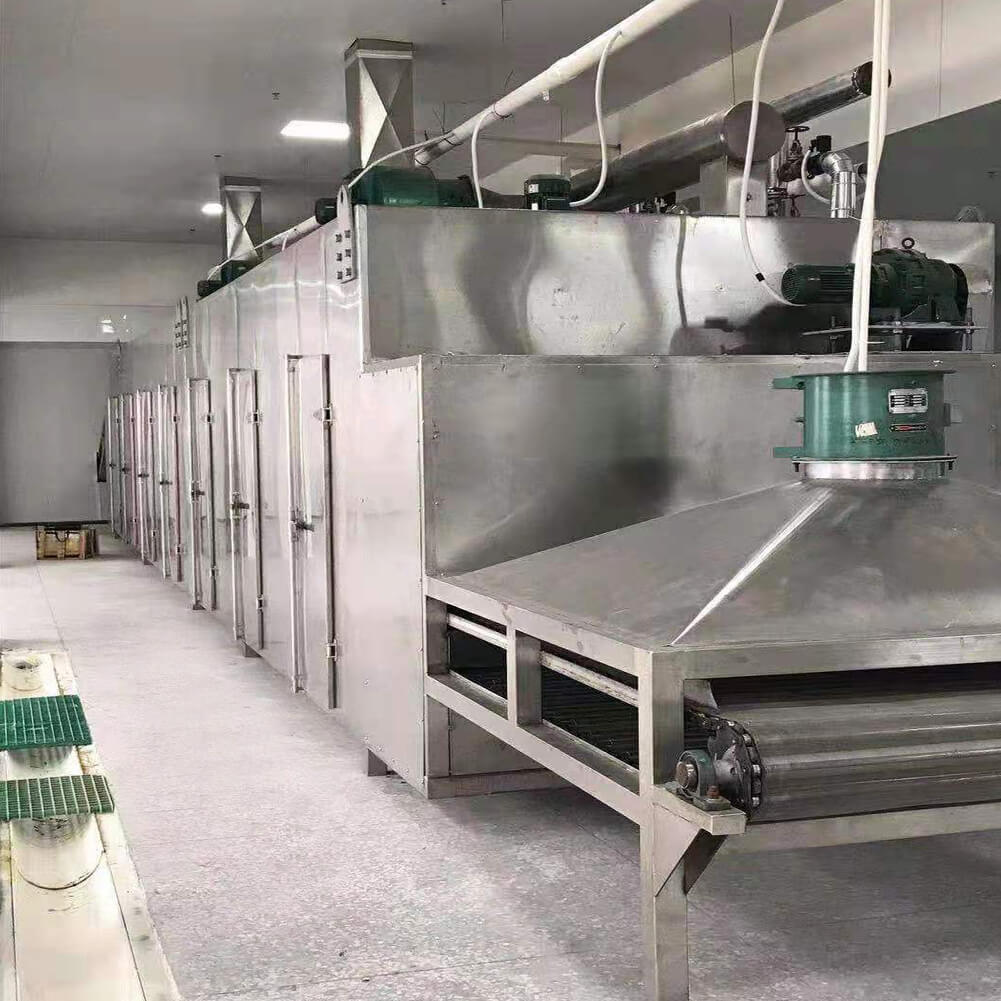
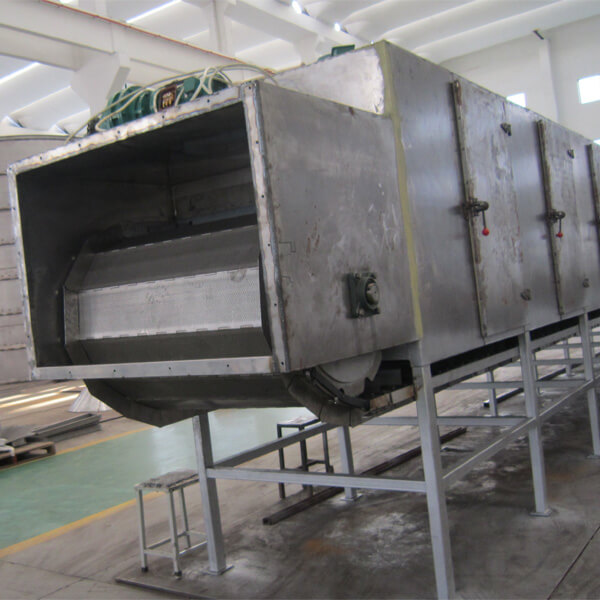
Working Principle
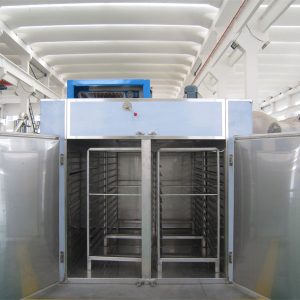
The mesh belt dryer is a continuous production drying equipment. The main heating methods are electric heating, steam heating and hot air heating. The main principle is to spread the material evenly on the mesh belt. The mesh belt is made of 12-60 steel mesh belt, which is dragged by the transmission device to move back and forth in the dryer. The drying machine is discharged from the moisture exhaust hole to achieve the purpose of drying. The length of the box is composed of standard sections. In order to save space, the dryer can be made into a multi-layer type. 6-40m, effective width 0.6-3.0m.
The whole equipment consists of feeding system, hot air system, discharge system, and moisture discharge system.
The charging system makes the materials evenly dispersed on the screen plate and conveyed to the drying section at a uniform speed. The hot air system is to provide the heat source required for drying, providing 80~120℃ hot air to the drying chamber. When the conveyor belt passes through, the hot air passes through the materials on the conveyor belt from top to bottom or from bottom to top so that the materials can be dried evenly and finally discharged by the discharge system.
Applications
Conveyor mesh belt dryer is a commonly used continuous drying equipment, which can be widely used in chemical, food, medicine, building materials, electronics and other industries, especially suitable for drying sheet, strip and granular materials with good ventilation. Paste-like materials such as filter cakes can also be dried after being formed by a granulator or an extruder.
Technical Parameters
| Model | DW-1.2-8A | DE-1.2-10A | DW-2.0-8A | DW-2.0-10A |
| Quantity of unit | 4 | 5 | 4 | 5 |
| Length of the drying section | 8M | 10M | 8M | 10M |
| Operation temperature | 50-140℃ | |||
| Steam pressure | 0.2-0.8Mpa | |||
| Steam consumption | 120-300kg/h | 150-375kg/h | 180-500kg/h | 225-600kg/h |
| Drying time | 0.2-1.2h | 0.25-1.5h | 0.2-1.2h | 0.25-1.5h |
| Drying strength | 6-30kg.h2o/㎡.h | |||
| Power | 11.4kw | 13.6kw | 12.5kw | 14.7kw |
| Model | DW3-1.2-8B | DW3-1.2-10B | DW3-2.0-8B | DW3-2.0-10B |
| Quantity of unit | 8 | 10 | 8 | 10 |
| Length of the drying section | 24M | 30M | 24M | 30M |
| Operation temperature | 50-140℃ | |||
| Steam pressure | 0.2-0.8Mpa | |||
| Steam consumption | 240-550kg/h | 300-750kg/h | 350-1000kg/h | 400-1200kg/h |
| Drying time | 0.2-1.2h | 0.25-1.5h | 0.2-1.2h | 0.25-1.5h |
| Drying strength | 6-30kg.h2o/㎡.h | |||
| Power | 21.7kw | 26.1kw | 29.2kw | 35.2kw |
Mesh Belt Dryer Reference Calculations (Vegetable & Seaweed)
I: Reference Calculation for Vegetable Dehydration
Customer's Material & Related Parameters | |
Material | Vegetable |
Initial Moisture w1 | 70~80% |
Final Moisture w2 | 12% |
Capacity | 1200Kg/h |
Bulk density of wet materials | ρ=800kg/m3 |
Material Specific Heat | 0.5Kcal/kg-℃ |
Material Temperature t0 | 20℃ |
Heating Method | Electric heating / charcoal |
Drying Temperature t1 | 80~120℃ |
Drainage Temperature t2 | 60℃ |
1. Mesh Belt Dryer Model Selection for Vegetable Dehydration
Heat balance calculation: Take the average local temperature as t0=20℃, air moisture content as d0=0.01Kg/Kg dry air.
- Required dry moisture: W=600×(80-3)/(100-80)=2310kg/h.
- Heat required for moisture evaporation: Q1=W (595+0.45t2- t0)=1392000Kcal/h.
- Heat required for material warming: Q2= W2 [0.5(1- w2) + w2](t2- t0) = 47600Kcal/h.
- Heat required for system loss: Q3= (0.15 ~ 0.2) × (Q1+ Q2) = 220,000Kcal/h.
- Mass flow rate of drying hot air: M=( Q1+ Q2+ Q3) ÷ [(0.24+0.45 d0)( t1- t2)-0.1×0.24(t2- t0)] ≈ 121,000Kg/h.
- Provide total heat: Q0=M(0.24+0.45 d0)(t1- t0)=2958450K cal/h.
- Check the reasonableness of the set exhaust air temperature: Exhaust air moisture content: d2 = d1 + W water / G = 0.01 + 2310/121000 = 0.03kg water / kg dry gas, check the air enthalpy wet diagram can be found in the corresponding dew point temperature t dew = 31.64 ℃, then t2 – t dew = 28 ℃ > 20 ℃, to ensure that the exhaust air does not condense.
For this reference calculation, the selected configuration is a DW5-2.25X20 five-layer mesh belt dryer (each layer is 20m long and 2.25m wide).
2. Fan Selection
- Circulating fan: 4-72-6c-11kw Air volume: 18000m3/h Air pressure: 1200pa.
- Dehumidification fan: 4-72-8C-30kw Air volume: 30000m3/h Wind pressure: 900pa.
3. Equipment Introduction
- Equipment material: The whole equipment adopts steel frame structure, the outer wall is made of stainless steel plate and the inner wall is stainless steel. The 1, 2, 3, 4 and 5 layers of mesh belts are made of stainless steel. The spreader bar and protective cover of the mesh belt are all stainless steel. The chain, sprocket, track, circulating fan and moisture exhaust fan of the mesh belt are made of carbon steel.
- Feeding method: The screw conveyor is used to lift the material to the first layer.
- Heating method: steam heating, heat exchange by carbon steel column fin radiator, the temperature of each unit can be set and controlled independently.
- Transmission device: The transmission device has a large reduction ratio, so that the drying time can be controlled in 2~3 hours to improve the applicable range of the equipment.
4. Parameters of DW5-2.25X20 Mesh Belt Dryer for Vegetables Dehydration
DW5-2.25X20 Mesh Belt Dryer Technical Parameters | |
Drying Material | Vegetable |
Machine Model | DW5-2.25X20 |
Machine Number | 1 set |
Mesh Belt Width | 2.25m |
Layers of Mesh Belt | 5 |
length of Drying Section | 100m |
Number of Drying Units | 10 |
Effective Drying Area | 225 m2 |
Inlet Air Temperature | 80~120℃ |
Exhaust Temperature | 60℃ |
Drying Time | 2 hours |
Machine Power | 217Kw |
Dimension of Main Machine | 24400X3165X4750mm |
II: Reference Calculation for Seaweed (carrageenan)
Customer's Material & Related Parameters | |
Material | Seaweed |
Initial Moisture w1 | 90% |
Final Moisture w2 | 12~ 14% |
Capability | 100~200 kg/h (200kg/h for design) |
Heating Method | Steam |
Steam Pressure | 0.5MPA |
Drying Temperature t1 | 110~120℃ (115°C for design) |
Drainage Temperature t2 | 70~80℃ (75°C for design) |
1. Mesh Belt Dryer Model Selection for Seaweed Drying
Heat balance calculation: Take the average local temperature as t0=20℃, air moisture content as d0=0.01Kg/Kg dry air.
- Required dry moisture: W=200×(90%-12%)/(1-12%)=178kg/h.
- Heat required for evaporation of moisture: Q1=178×(595+0.45×75-20)≈10.8×10⁴Kcal/h.
- Heat required for material warming: Q2=200×(0.4×(1-15%)+15%)×(60-20)≈0.4×10⁴Kcal/h.
- Heat required for system loss: Q3=0.15×(10.8+0.4)×104≈1.68×10⁴Kcal/h.
- Required air volume of the system: LG=(Q1+Q2+Q3)/[(0.24+0.45×0.011)(115-75)-0.1×0.24(75-20)]=11162kg/h.
- Total heat provided by heat source: Q0=11162×(0.24+0.45×0.011)(115-20)≈26×104Kcal/h.
Exhaust emission verification: With the machine exhaust moisture tail gas moisture content Hs: Hs = 0.011 + 178/11162 ≈ 0.026Kg/Kg dry air. According to the above parameters to check the air enthalpy and humidity diagram: air moisture content of 0.026Kg/kg dry air; dry bulb temperature of 75 ℃; air relative humidity of 3.53%; wet bulb temperature of 42 ℃; dew point of 27 ℃; dry, wet bulb temperature difference Δt = 75-42 = 33 ℃ > 20 ℃, regarded as a reasonable temperature setting for moisture discharge.
The retained reference calculation uses an average drying intensity of 10-15Kg water/m2.h. The design is taken as 12Kg water/m2-h, then the effective area of drying required A: A=178/12≈15m2. Combined with the above calculation, DW1.5×10 belt dryer is selected in this reference calculation.
2. Parameters of DW1.5×10 Mesh Belt Dryer for Seaweed Drying
DW1.5×10 Mesh Belt Dryer Technical Parameters | |
Drying Material | Seaweed (carrageenan) |
Machine Model | DW1.5×10 |
Machine Number | 1 set |
Mesh Belt Width | 1.5m |
length of Drying Section | 10m |
Effective Drying Area | 15 m2 |
Inlet Air Temperature | 110~120℃ |
Dehumidification Temperature | 70~80℃ |
Equipment Weight | 6 tons/set |
Dimension of Main Machine | 12000X2100X2800mm |
CONVEYOR DRYING SELECTION
Mesh Belt Dryer Selection Requirements
A continuous belt drying system should be configured from the actual material layer, airflow resistance, moisture duty and residence time. The vegetable and seaweed calculations on this page are application references and should not be reused without a new material and heat balance review. For broader process context, review the industrial vegetable drying equipment and industrial food drying equipment application pages.
Material and Belt Loading
Product form, size, bulk density, permeability, stickiness, fragility, loading depth and risk of material passing through the mesh.
Moisture and Residence Time
Feed rate, initial and target moisture, allowable temperature, belt speed and required time in each drying zone.
Airflow and Heating Zones
Top-down or bottom-up airflow, zone temperatures, recirculation, humidity removal, heat source and exhaust treatment.
Layout and Hygiene
Single or multi-layer arrangement, spreading and discharge, belt material, cleanability, access, footprint and utilities.
Why Material Layer Uniformity Matters
Uneven loading changes local airflow resistance and residence time. The feeding and spreading system should be evaluated together with belt permeability, airflow direction and zone control.
Request a Mesh Belt Drying Review
Send material, moisture, capacity, temperature and available layout data for an application-specific review.
Before equipment selection, use the belt-dryer project data checklist to prepare material form, loading depth, feed and target moisture, temperature limit, throughput, heat source and available layout.
TECHNICAL QUESTIONS
Mesh Belt Dryer FAQs
What materials can be evaluated in a mesh belt dryer?
Mesh belt drying can be evaluated for suitable pieces, slices, granules, pellets or formed wet material that can be spread and conveyed on a permeable belt. Bed permeability, stickiness, fragility, shrinkage and tendency to fall through the mesh must be reviewed.
How are single-layer and multi-layer belt dryers selected?
A single-layer layout offers a simpler material path and access, while a multi-layer layout can provide more belt area within a shorter footprint. Product transfer, allowable breakage, residence time, building height, cleaning and maintenance access affect the choice.
Can the vegetable and seaweed calculations be used for another product?
No. The heat balances, airflow, drying area, temperatures and equipment sizes describe specific reference cases. A new material requires confirmation of moisture duty, equilibrium behavior, loading depth, belt speed, airflow and product quality.
What information is needed for a mesh belt dryer proposal?
Provide material name and form, piece or particle size, bulk density, feed rate, initial and target moisture, allowable temperature, loading depth, residence time, heat source, cleaning requirements, utilities, footprint and installation country.