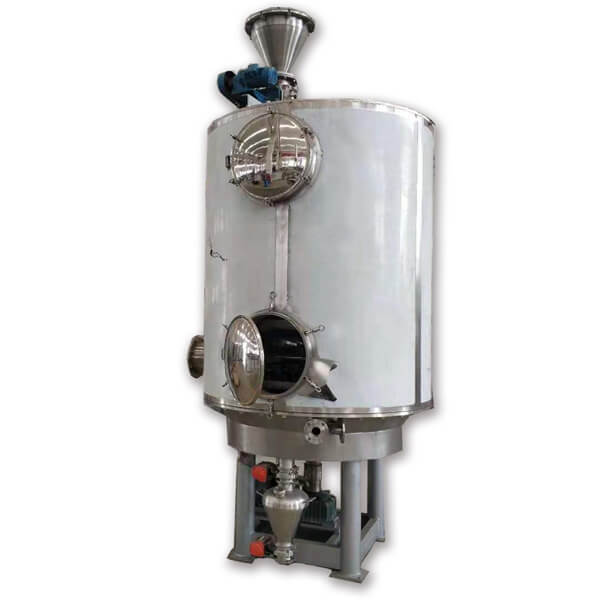
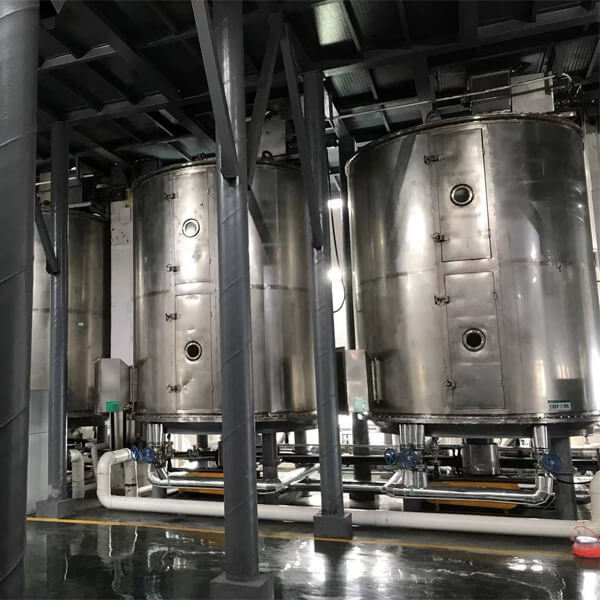
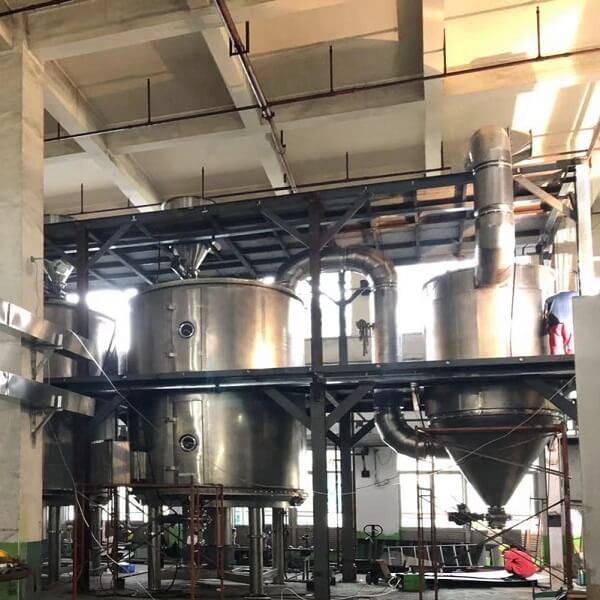
5 Improvements of Our Vertical Disc Dryer
1. Improvements to The Rake Arm
We use 38×5mm thick-walled steel pipe, and insert round steel into the pipe, so that the load-bearing capacity of the rake arm reaches 800kg, thus avoiding the phenomenon of bending deformation.
2. Improvement of The Uneven Surface Of The Disc
The outer retaining ring on the large disc and the inner blanking ring on the small disc is formed by the one-time drum pressing of steel plates. The outer edge of the large disc is pressed into an arc, and the lower surface of the small disc is pressed into an arc, which greatly strengthens the rigidity of the disc and also makes it flatter.
3. The Improvement of The Residual Material on The Disc Surface & Unclean Scraping
It is made of a thick steel plate by hand welding, and the vertical disc surface is punched and looped on the rake arm, and the rotation is more flexible. The middle of the two steel plates is supported by round steel, and the arc transition of the blade surface is highly consistent with the disc surface, thus solving the problem of the material on the disc.
4. Heat Source In/Out
Our company designs the heat source of the disc dryer to be double-in and double-out so that the heat source is distributed more uniformly in and out, and the material on the disc is more fully absorbed, which greatly improves thermal efficiency.
5. Bearing Protection
A hoop-shaped conical pagoda seat is added in the middle of each layer of the material disc, so that when the material on the upper disc surface falls, it slides smoothly along the cone into the lower disc , avoiding the phenomenon that the material falls out of the lower disc and falls into the bottom layer. The design also facilitates maintenance. Bearing protection adopts double-layer sealing of labyrinth and packing, which prevents the occurrence of micro powder damage to the bearing.
Data Overview for Drying Materials with Disc Dryer
Raw Material Name | Resin | Organic Matter | Drug | Activated Carbon | Sulfur | Granulated Sugar |
Volatile Matter | Solvent | Acetone or Moisture | Moisture | Moisture | Moisture | Moisture |
Capacity (kg/h) | 840 | 168 | 650 | 140 | 150 | 1600 |
Raw Material Moisture Content (%) | 60 | 30 | 3 | 70 | 20 | 3 |
Final Product Moisture Content (%) | 3 | 10 | 0.1 | 3 | 0.5 | 0.12 |
Raw Material Particle Size (mm) | 0.2~0.3 | 0.8 | 0.02~0.03 | 0.5~3 | 2~5 | 0.2~1 |
Raw Material Bulk Density (t/m3) | 0.5 | 0.5 | 0.9 | N/A | N/A | N/A |
Final Product Bulk Density (t/m3) | 0.3 | 0.6 | N/A | N/A | N/A | N/A |
Tray Surface Temperature (℃) | 130 | 65 | 100 | 150 | 125 | 110 |
Drying Time (min) | 60 | 35 | 45 | 29 | 30~45 | 1520 |
Number of Drying Trays | 35 | 11 | 17 | 11 | 11 | 11 |
Total Drying Area (m2) | 88.2 | 27.6 | 42.8 | 27.6 | 27.6 | 27.6 |
Outer Cylinder Shape | Round | Octahedral | Octahedral | Octahedral | Octahedral | Octahedral |
Outer Cylinder Diameter (m) | 2.1 | 2.1 | 2.1 | 2.1 | 2.1 | 2.1 |
Height of Outer Cylinder (m) | 5.7 | 1.9 | 2.8 | 1.9 | 1.9 | 1.9 |
Spindle Speed (r/min) | 2.97~11.9 | 1.5~6.2 | 0.5~6 | 0.58~2.6 | 0.58~2.6 | 0.58~2.6 |
Motor Power (kw) | 5.5 | 2.2 | 3.7 | 2.2 | 2.2 | 2.2 |
Our PLG-φ1500×10 Disc Dryer Drying Applications (e.g. Na2[SiF6])
1. Customer Materials & Requirements | |||
Material Name | Na2[SiF6] | Heat Source | Steam |
Capacity | 150kg/h | Dust Removal System | Bag dust collector |
Initial Humidity | ~30% | Equipment Material | Stainless steel |
Final Moisture | <5% | Installation Site | Indoor |
2. Tray Dryer Technical Parameters | |||
Model | PLG-φ1500×10 | Total Power | 11kw |
Heat Transfer Area | 24m2 | Main Engine Speed | 3~6rpm |
Total Heat Transfer Area | 27m2 | Residence Time | 60 to 90 Minutes |
Cooling Area | 3m2 | Host Heating Method | Steam Heating |
Chassis Cooling Method | ≤20℃ Circulating Water | Total Heat Consumption | ~2×10⁴kcal/h |
Dimensions | 1.8×1.8×6m (length×width×height) | ||
CONDUCTIVE DRYING
How a Vertical Disc Dryer Handles Material
Material enters the upper section and is moved across successive heated discs by rotating rake arms. At each level, the material follows the configured path toward the transfer opening and drops to the next disc. Disc temperature, rake arrangement and shaft speed are coordinated to provide the required residence time and heat-transfer profile.
Feed and Spread
The feed system and rake layout distribute material into a controlled layer on the upper disc.
Conductive Heating
Heating medium inside the discs transfers energy through the disc surface into the moving material layer.
Stage Residence Time
Disc arrangement, rake configuration and shaft speed influence the path and time through the dryer.
Optional Cooling and Discharge
Selected lower zones may be evaluated for cooling before the product leaves the equipment.
ENGINEERING SELECTION
Vertical Disc Dryer Selection Requirements
Material Movement
Particle size, bulk density, flowability, stickiness, abrasion, fragility and interaction with the rake and disc surfaces.
Heat and Moisture Duty
Feed rate, initial and target moisture, heat-transfer requirement, temperature limit and desired residence time.
Vapor and Containment
Moisture or solvent identity, vapor load, dust behavior, enclosure, recovery or treatment and site safety requirements.
Mechanical and Plant Data
Disc area, heating and cooling media, contact materials, drive control, cleaning access, utilities and installation space.
Request a Vertical Disc Drying Review
Send solids, moisture, heat-source and residence-time requirements for an application-specific review.
TECHNICAL QUESTIONS
Vertical Disc Dryer FAQs
What materials can be evaluated in a vertical disc dryer?
A vertical disc dryer can be evaluated for suitable powders and granules that can move across heated trays under the action of the rake system. Flowability, stickiness, abrasion, particle fragility, heat sensitivity and vapor behavior must be reviewed.
How does a vertical disc dryer transfer heat?
Heat is transferred mainly by conduction from the heated disc surfaces into the material layer. The rake arrangement moves material across each disc and through the dryer, while disc temperatures and residence time are configured for the required drying or cooling profile.
Can the material table and Na2SiF6 project data be reused?
No. The table and PLG project describe reference conditions. Heat-transfer area, disc temperature, residence time, shaft speed, construction material, vapor handling and utilities must be recalculated or confirmed for a new material.
What information is needed for a vertical disc dryer proposal?
Provide material name, particle size, bulk density, flowability and stickiness, feed rate, initial and target moisture, volatile or solvent data, temperature limit, residence-time target, heat source, cooling need, dust or vapor treatment and installation country.