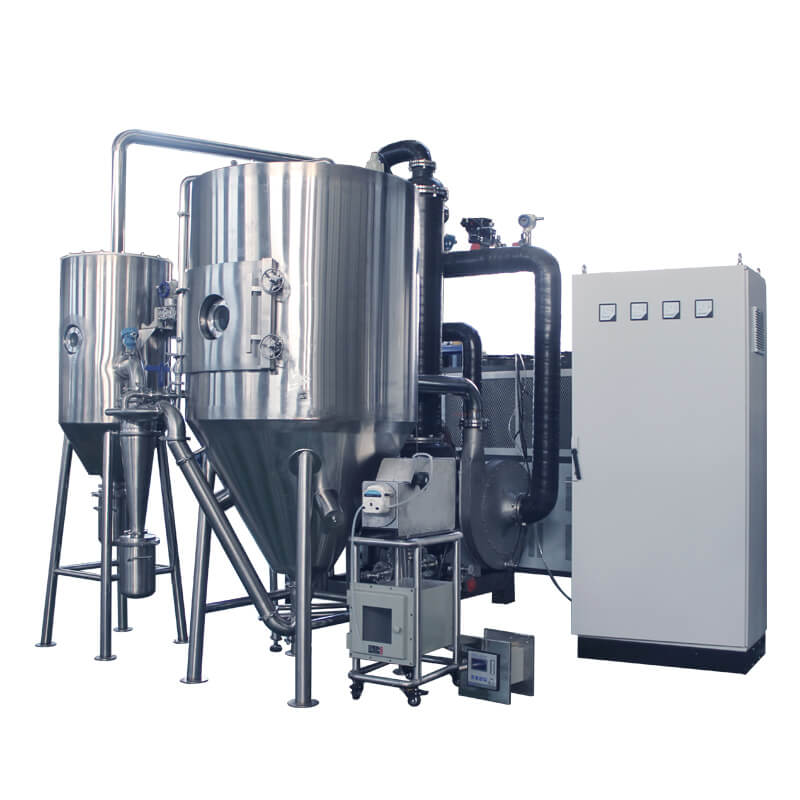
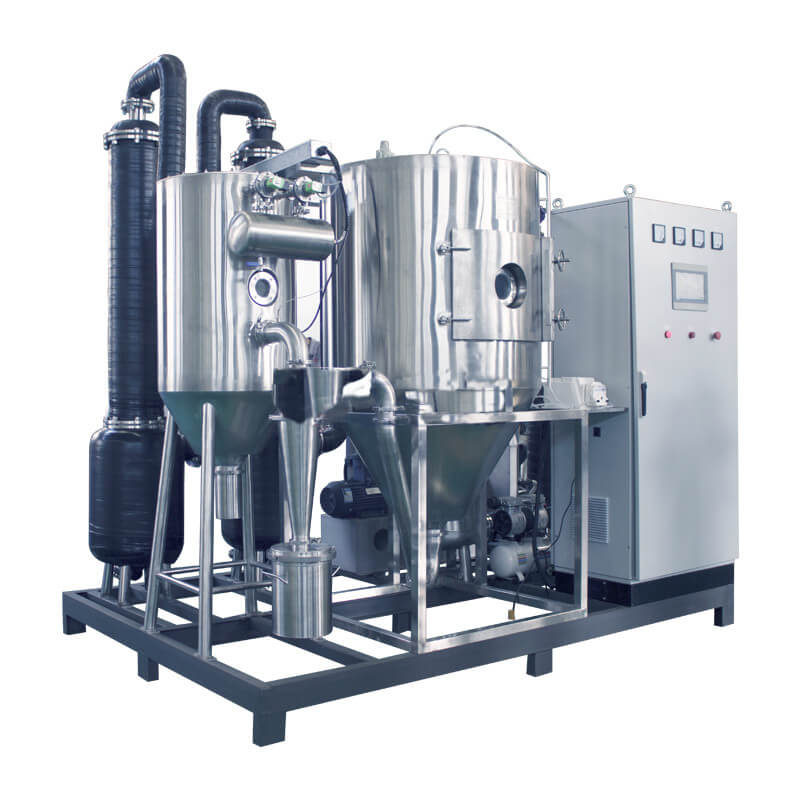
Drying Solution for XLPG-50 Closed Cycle Spray Dryer (e.g. LiFePO4)
1. Customer Requirements | |||
Material Name | LiFePO4 | Feeding Temperature | 35℃ |
Raw Material Solid content | 10~15 % | Dust Removal Method | Cyclone + Bag dust collector |
Heating Source | Electricity | Equipment Material Requirement | Inner 316L Outer 304 stainless steel |
Inlet Air Temperature | 140~180℃ | Operation Mode | Continuous |
Outlet Air Temperature | 70~110℃ | Drying Medium | Nitrogen |
Water Evaporation Volume | 50Kg/h | Condenser Outlet Temperature | -15℃ |
Drying Residence Time | 25-30S | Preheater Outlet Temperature | 15~25℃ |
2. Equipment Configuration List | ||||
ID | Equipment Name | Models | Material | QTY |
2.1 Air System | ||||
1 | Nitrogen Inlet Device | Dg15 | 304 | 1 |
2 | Blower | 11kw JWT | 304 | 1 |
4 | Blower Inverter | 11kw | 1 | |
5 | Inlet Air Duct | DN250, flange, 6kg/cm2 | 316L | 1 |
6 | Venting Device | 316L | 1 | |
7 | Inlet Air RTD | 0~350 | 304 | 1 |
8 | Electric Heating Device | 180kw | 316L | 1 |
2.2 Drying Tower | ||||
1 | Atomizer | 316L | 1 | |
2 | Nitrogen Pressure Stabilization Device | 1 | ||
3 | Drying Tower | Φ1600, 2kg/cm2 | 316L | 1 |
4 | Air Hammer | SUS304 | 2 | |
5 | Air Hammer Controller | 1 | ||
6 | Main Tower Pressure Transmitter | 1 | ||
7 | Explosion-proof Membrane | Φ300, Burst pressure +26000pa | 316L, PTFE | 1 |
8 | Explosion-proof Pipe | Φ300 | 316L | 1 |
9 | Main Tower Thermomete | 0~350℃ | 1 | |
10 | Air Hammer Solenoid Valve | 24V | 8 | |
2.3 Dust Removal System | ||||
1 | Exhaust Air Duct | φ200 | 316L | 1 |
2 | Cyclone Separator | φ650 | 316L | 1 |
3 | Bag Dust Collector | MC-60 | 316L | 1 |
4 | Fabric Bag | φ120 | 60 | |
5 | Pulse Metal Hose | 1 inch | 316L | 3 |
6 | Ball Valve | φ50 | 304 | 1 |
7 | Oxygen Detection Controller | 1 | ||
8 | Condenser | 50㎡ | 316L | 1 |
9 | Exhaust Air Thermal Resistance | 0~350 | 1 | |
10 | After Condensation Heat Resistance | -20~350 | 1 | |
11 | Bag Filter Controller | 1 | ||
12 | Pulse Valve | 3 | ||
13 | Differential Pressure Transmitter | 2 | ||
14 | Pressure Transmitter | 1 | ||
2.4 Liquid Supply System | ||||
1 | Mixing Drum | 200L | 316L | 1 |
2 | Hose Pump | XY25A | 1 | |
3 | Feeding Pipe | Sanitary Pipe | 1 | |
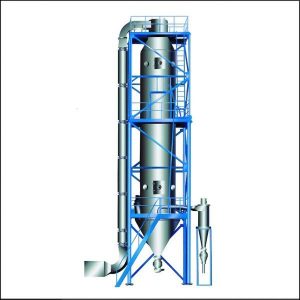
CLOSED-CIRCUIT PROCESS
How a Closed Loop Spray Dryer Works
In a closed-circuit system, the selected drying gas is circulated instead of continuously discharged as once-through process air. The liquid feed is atomized into the drying chamber, powder is separated from the gas stream, condensable vapor is removed in the recovery stage, and the conditioned gas returns to the heater and dryer.
This arrangement may be considered for solvent-containing feeds, oxidation-sensitive products or processes requiring contained gas circulation. The exact process design depends on solvent properties, oxygen limits, powder behavior, recovery target and applicable site requirements.
1. Atomize and Dry
The feed is atomized into a controlled circulating gas stream and dried to the required powder condition.
2. Separate Powder
Cyclone and filtration stages are selected from powder size, loading, recovery and containment requirements.
3. Condense Vapor
The vapor load and solvent properties determine condensation temperature, duty and recovery arrangement.
4. Condition and Recycle Gas
The circulating gas is reheated and returned while oxygen, pressure, temperature and flow are monitored as required.
ENGINEERING INPUTS
Closed Loop Spray Dryer Selection Requirements
Feed and Solvent
Composition, solvent identity and concentration, solids content, viscosity, density, stability and feed rate.
Powder Target
Final moisture, particle size, bulk density, temperature limit, recovery and containment requirements.
Gas and Recovery
Drying medium, oxygen limit, vapor load, condenser duty, purge strategy and required solvent recovery.
Site and Safety
Hazard data, area classification, relief or protection philosophy, utilities, local requirements and installation country.
Request a Closed Loop Spray Drying Review
Send feed, solvent, powder target and site data for an application-specific review.
TECHNICAL QUESTIONS
Closed Loop Spray Dryer FAQs
When should a closed loop spray dryer be evaluated?
A closed loop spray dryer may be evaluated when a feed contains an organic solvent, when oxidation exposure must be limited, or when the drying medium and solvent should be contained and recovered. Suitability depends on the complete material and safety assessment.
How does a closed loop spray drying system work?
The drying gas circulates through atomization, drying, powder separation, condensation and reheating stages before returning to the dryer. Make-up gas, purge strategy, oxygen monitoring and pressure control are engineered for the selected process.
Can the LiFePO4 project data be used for another material?
No. The listed XLPG-50 conditions describe a specific reference project. Gas flow, oxygen limit, temperature, solvent load, condenser duty, materials of construction and protection measures must be recalculated or confirmed for each new feed.
What information is needed for a closed loop spray dryer proposal?
Provide feed composition, solvent name and concentration, solids content, viscosity, density, feed rate, target powder properties, temperature limits, flammability and toxicity data, required recovery, utilities, site classification and installation country.