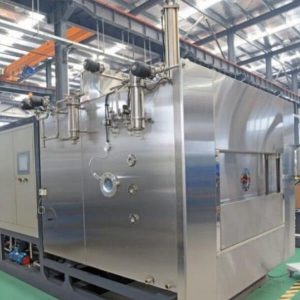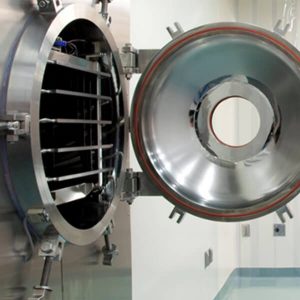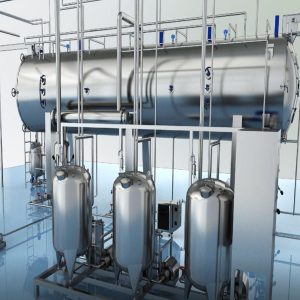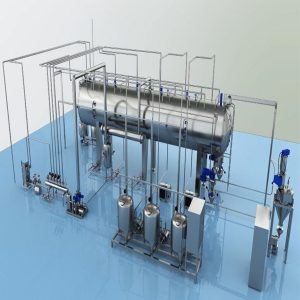
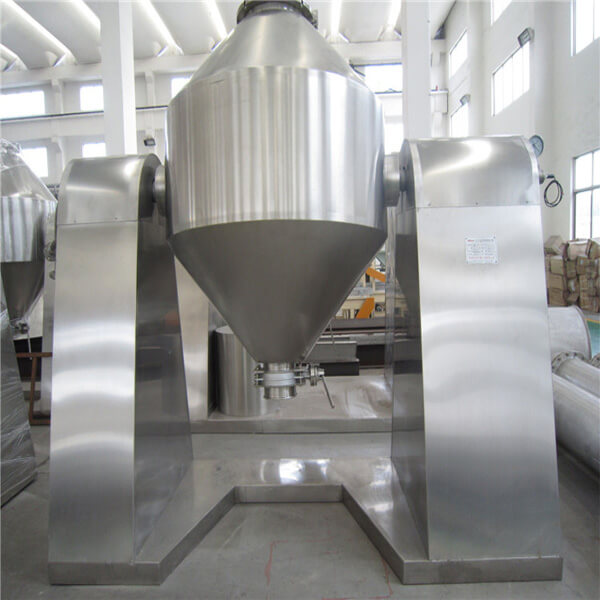
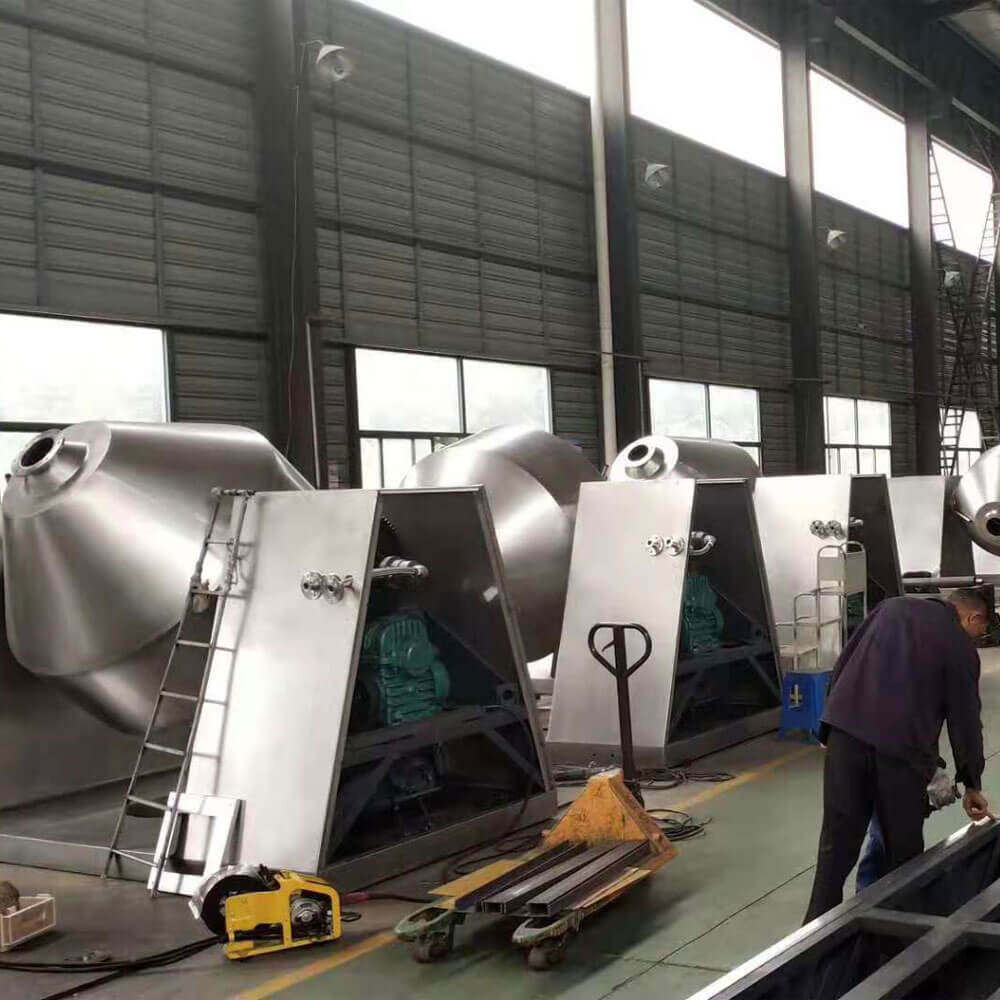
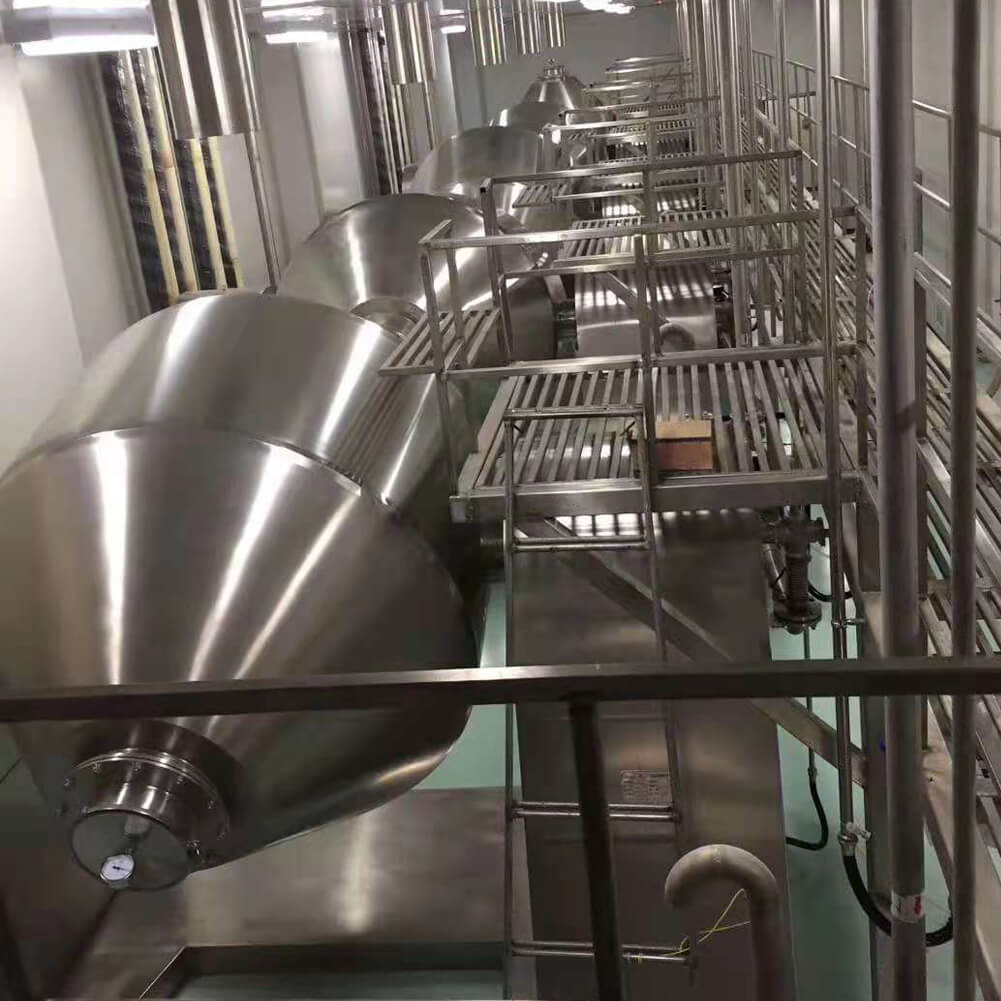
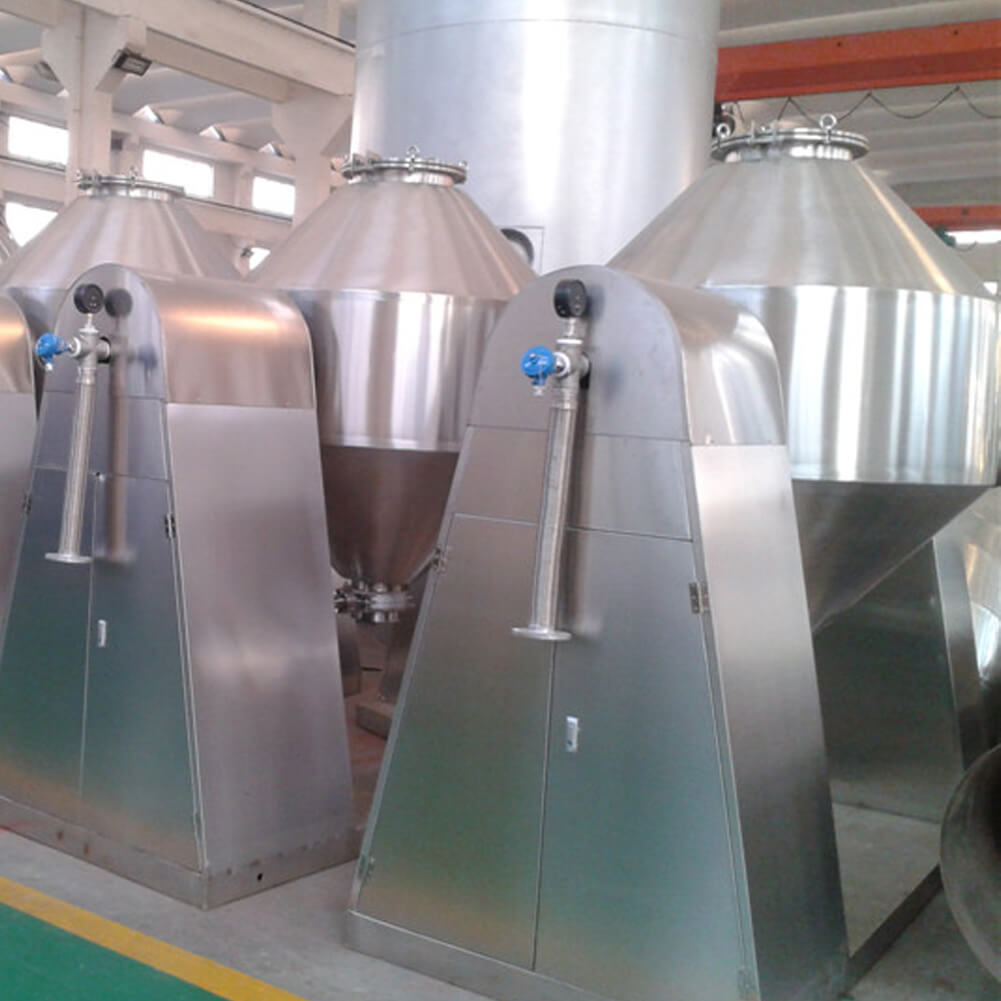
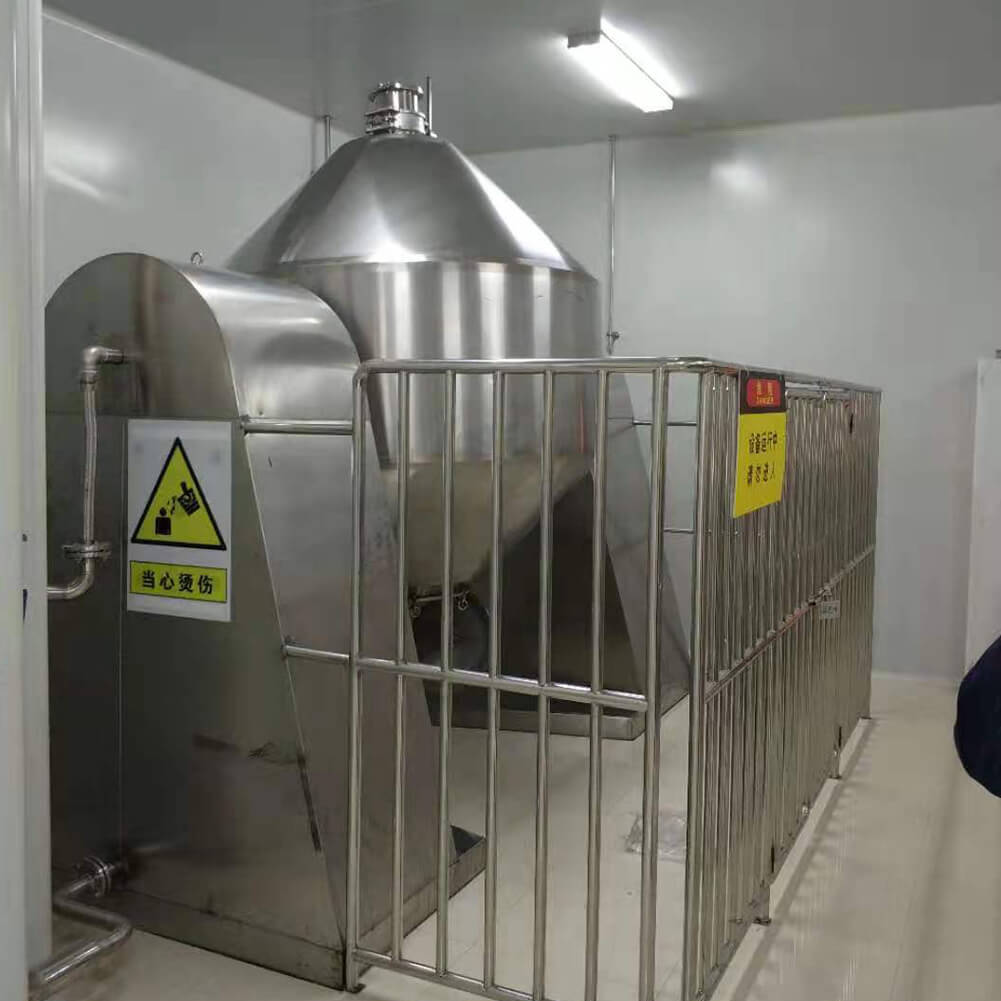
The middle of the dryer tank is cylindrical, the two ends are conical, and the top of the cone is provided with inlet and outlet. The inside and outside of the tank are divided into three layers, and the heating medium of the middle jacket adopts circulating hot water; the insulating layer is an aluminum silicate, which consumes very little energy; the inner layer is filled with materials.
Rotary drying under vacuum conditions, the material gets heat through the wall while turning, and accelerates drying, which not only avoids the phenomenon that the surface of heat-sensitive materials turns yellow when drying, but also greatly shortens the drying time of materials. The drying time in the oven is about 2/3, which greatly improves labor productivity.
This equipment is especially suitable for drying easily oxidizable and flammable, explosive, toxic materials and heat-sensitive materials. It can show its superiority when it is applied to materials that require no damage to the shape, materials that strictly limit metal ions, and materials that require the discharge of volatiles (or toxic substances) to be recovered (or to destroy toxicity).
Applicable Materials
- Heat-sensitive materials that cannot withstand high temperatures;
- Materials that are easily oxidized and dangerous;
- Materials that do not allow damage to crystals;
- Materials that need to recover the steam discharged during drying;
- Materials that need to recover solvents and toxic gases;
- Materials with extremely low residual volatile content are required.
Technical Parameters
| Tank volume (L) | 100 | 350 | 500 | 750 | 1000 | 1500 | 2000 | 3500 | 4500 | 5000 | ||||||||
| Loading volume (L) | ≤50 | ≤175 | ≤250 | ≤375 | ≤500 | ≤750 | ≤1000 | ≤1750 | ≤2250 | ≤2500 | ||||||||
| Speed (rpm) | 3~13 | 4 | ||||||||||||||||
| Motor power (kW) | 0.75 | 1.1 | 1.5 | 2.2 | 3 | 4 | 5.5 | 7.5 | 11 | 15 | ||||||||
| Floor area L×W (mm) | 2160× 800 |
2260× 800 |
2350× 800 |
2560× 1000 |
2860× 1300 |
3060× 1300 |
3260× 1400 |
3760× 1800 |
3960× 2000 |
4400x 2500 |
||||||||
| Swing height (h) | 1750 | 2100 | 2250 | 2490 | 2800 | 2940 | 2990 | 3490 | 4100 | 4200 | ||||||||
| Design pressure in the tank (MPa) | -0.1~0.15 | -0.1~0.15 | ||||||||||||||||
| When using a condenser, vacuum pump model, power (kW) | 2X-15A 2kw |
2X-15A 2kw |
2X-30A 3kw |
2X-30A 3kw |
2X-70A 5.5kw |
JZJX300-8 7kw |
JZJX300-4 9.5kw |
JZJX600-8 11kw |
JZJX600-4 20.5kw |
JZJX600-4 20.5kw |
||||||||
| Without condenser, vacuum pump model, power (kW) | SK-0.4 1.5kw |
SK-0.4 1.5kw |
SK-0.8 2.2kw |
SK-2.7B 4kw |
SK-2.7B 4KW |
SK-3 5.5KW |
SK-6 11KW |
SK-6 11KW |
SK-9 15KW |
SK-1218.5KW | ||||||||
| Weight (kg) | 800 | 1100 | 1200 | 1500 | 2800 | 3300 | 3600 | 6400 | 7500 | 8600 | ||||||||
Double Cone Vacuum Dryer Configuration List | ||||
ID | Equipment Name | Models & Specifications | Material | Quantity |
1 | Insulating layer | Aluminum silicate | 1 | |
2 | Charging door | Φ400 | SUS304,16mm | 1 |
3 | Vacuum Head | 304 | 1 | |
4 | Heat conservation layer | 75mm Aluminum Silicate | 1 | |
5 | Machine Frame | brushed exterior | Frame Q235-A. | |
6 | Rotary Joints | Combination parts | 2 | |
7 | Motor | 7.5Kw, variable frequency speed regulation | Combination parts | 1 |
8 | Speed Reducer | WPA | Combination parts | 1 |
9 | Discharge Butterfly Valve | DN200 | The material passes through SUS304 | 1 |
10 | Electrical Control System | 1 | ||
11 | Thermometer | PT100 | 1 | |
12 | Vacuum Gauge | -0.1~0.0 | SUS304 | 2 |
13 | Inverter | 7.5Kw | 1 | |
14 | Hot Water Tank | 1000L | SUS304 | 1 |
15 | Hot Water Circulation Pump | WYR50-32 | Combination parts | 1 |
16 | Vacuum Pump | 2BV-7.5KW | Combination parts | 1 |
BATCH VACUUM DRYING
How a Double Cone Vacuum Dryer Processes a Batch
The batch is loaded into the double-cone vessel, which rotates to renew material contact with the heated wall. Jacket heat supplies the drying duty while the vacuum system removes vapor. Where recovery is required, the condenser and receiver are selected from the actual volatile load and process conditions.
1. Load the Batch
Batch mass and fill volume are checked against bulk density, flowability and the required free space for tumbling.
2. Rotate and Heat
Vessel speed, jacket medium and wall temperature are selected for heat transfer without unacceptable attrition or adhesion.
3. Remove and Recover Vapor
Vacuum level, vapor piping, condenser duty and receiver arrangement are based on the moisture or solvent load.
4. Cool and Discharge
Cooling, inerting, containment and discharge method are confirmed from product and site requirements.
ENGINEERING SELECTION
Double Cone Vacuum Dryer Selection Requirements
Batch and Fill Volume
Batch mass, bulk density, working volume, free space, feed and discharge method and required changeover.
Material Movement
Particle size, flowability, agglomeration, wall adhesion, attrition limit and sensitivity to tumbling.
Thermal and Vacuum Duty
Initial and target moisture, solvent or volatile identity, temperature limit, jacket medium, vacuum level and condenser load.
Containment and Site Safety
Oxygen or inerting needs, dust and solvent hazards, construction materials, seals, cleaning, utilities and site classification.
Request a Double Cone Vacuum Drying Review
Send batch, solids, volatile, temperature and site-safety data for an application-specific review.
TECHNICAL QUESTIONS
Double Cone Vacuum Dryer FAQs
What materials can be evaluated in a double cone vacuum dryer?
A double cone vacuum dryer can be evaluated for suitable free-flowing powders, granules or crystals that benefit from batch tumbling and reduced-pressure drying. Flowability, attrition, agglomeration, wall adhesion, thermal sensitivity and vapor behavior must be reviewed.
How does a double cone vacuum dryer heat and mix material?
The rotating vessel gently moves the batch while heat transfers through the jacketed wall. Reduced pressure lowers the boiling temperature of the volatile component, and the vacuum and condensation system removes vapor under the confirmed process conditions.
Can a standard double cone dryer be used for flammable or toxic materials?
Not without a material-specific engineering and process hazard assessment. Solvent properties, dust hazards, oxygen control, ignition sources, containment, condensation, vacuum equipment, relief or protection measures, site classification and local requirements must be addressed.
What information is needed for a double cone vacuum dryer proposal?
Provide material name, particle size, bulk density, batch mass and fill volume, initial and target moisture, solvent or volatile data, temperature limit, allowable attrition, residence-time target, heating and cooling media, containment needs, utilities and installation country.