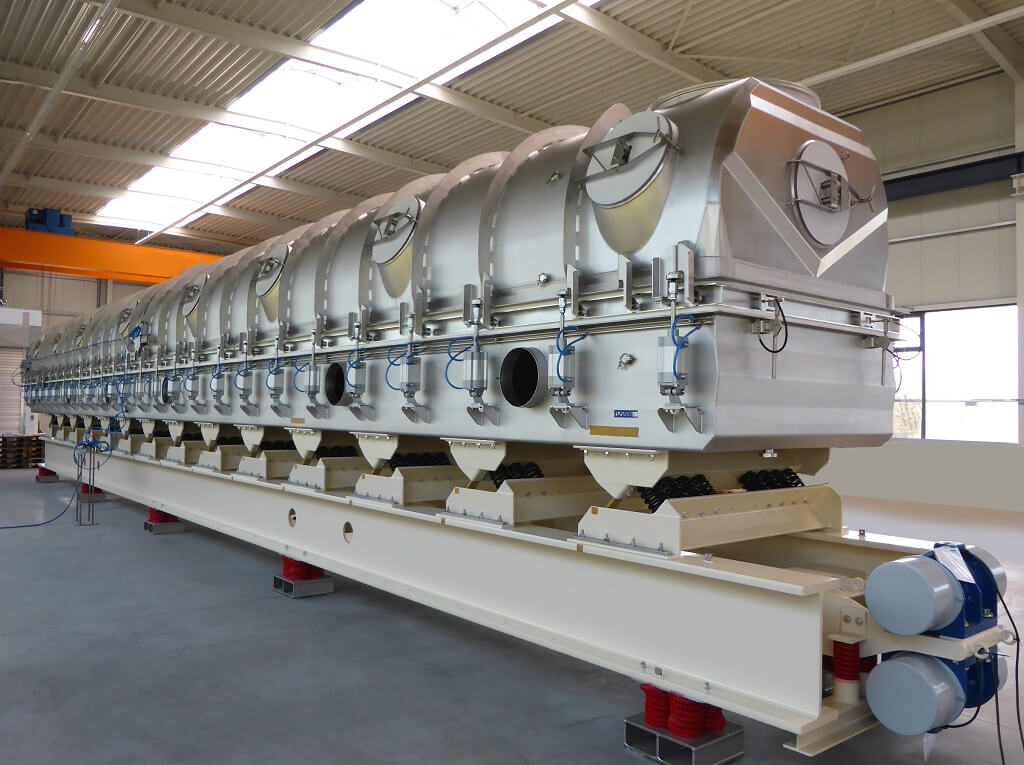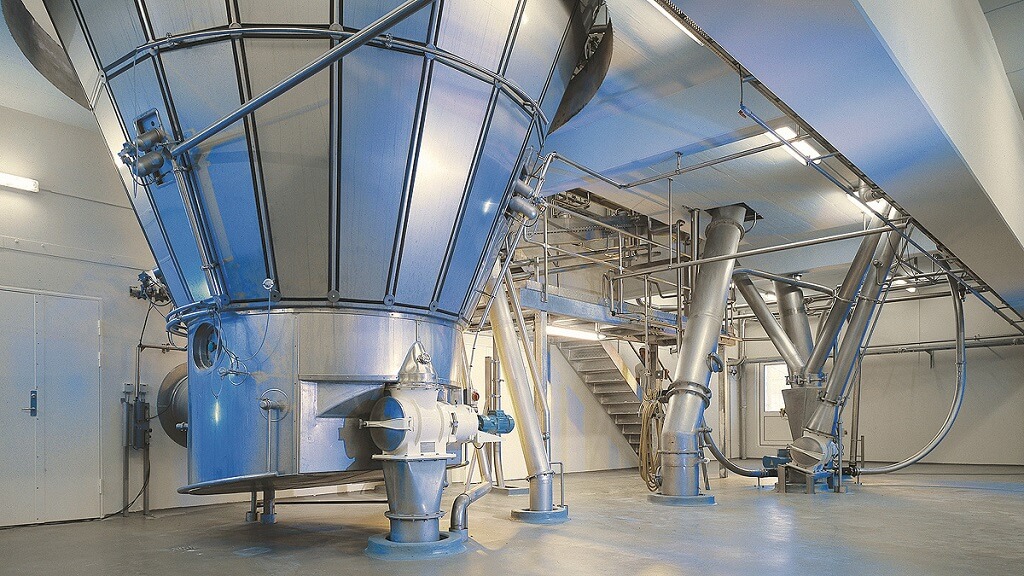
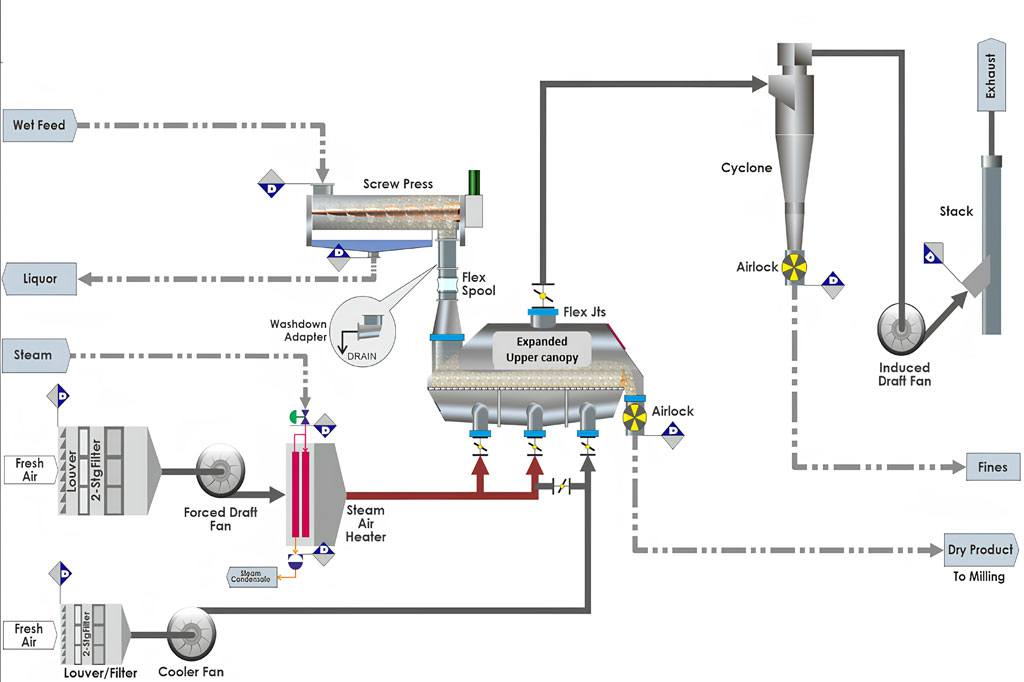
The working principle of a fluid bed dryer is based on the concept of fluidization, a process in which solid particles behave like a fluid when subjected to an upward flow of gas or air.
1. Airflow Generation and Distribution
The process begins with the generation of heated air using a blower and heating system. Air enters from beneath the drying chamber and is evenly dispersed through a perforated distributor plate.
This plate ensures uniform air distribution across the entire bed of material, preventing channeling or uneven drying.
2. Fluidization of Particles
With increasing air velocity, a point is reached where the drag force balances gravity—referred to as the minimum fluidization velocity—allowing particles to become suspended and behave like a fluid.
In this condition:
- Particles move freely and mix continuously
- Voids are created between particles, allowing air to pass through
- The bed expands and behaves like a boiling liquid
This fluidized state is essential for maximizing the contact between hot air and material surfaces.
3. Heat Transfer Mechanism
Heat transfer in a fluid bed dryer occurs primarily through convection. The hot air transfers thermal energy directly to the surface of each particle. Due to the constant movement and mixing of particles, heat distribution is highly uniform throughout the bed.
The high surface area exposure ensures that:
- Each particle receives consistent heat
- Temperature gradients within the bed are minimized
- Drying efficiency is significantly enhanced
4. Moisture Evaporation Process
As heat is transferred to the particles, moisture within the material begins to evaporate. The evaporation occurs in two main stages:
- Surface evaporation: Moisture on the outer surface vaporizes quickly due to direct contact with hot air
- Internal diffusion: Moisture from the interior migrates to the surface and continues to evaporate
The continuous airflow carries away the moisture-laden air, maintaining a low humidity environment that supports further drying.
5. Mass Transfer and Moisture Removal
The removal of moisture is governed by mass transfer principles. Moisture removal is driven by the vapor pressure difference between the wet material and the surrounding air, allowing water to migrate into the airflow.
Efficient mass transfer is achieved due to:
- High turbulence within the fluidized bed
- Constant renewal of air around each particle
- Large interfacial area between solid and gas phases
The exhaust system removes humid air and replaces it with fresh heated air, sustaining the drying process.
6. Particle Movement and Mixing
The fluidized condition ensures continuous and random movement of particles. This dynamic motion eliminates dead zones and prevents localized overheating or over-drying.
The mixing effect results in:
- Uniform moisture content across all particles
- Consistent product quality
- Reduced drying time
7. Temperature and Drying Control
The working principle also involves precise control of operating parameters, including:
- Inlet air temperature
- Airflow velocity
- Residence time of particles
By adjusting these variables, the drying rate can be controlled to suit different materials and moisture levels.
8. Exhaust and Fine Particle Separation
As the air exits the drying chamber, it carries fine particles along with moisture vapor. These particles are typically captured using filters, cyclones, or bag collectors to prevent material loss and maintain system efficiency.
9. End Point of Drying
The drying operation continues until the material reaches the specified moisture level. At this point:
- Heat transfer decreases as less moisture remains
- Particle temperature begins to approach the inlet air temperature
- The system reaches equilibrium
The dried product is then discharged from the system.
PROCESS REVIEW
Confirm Fluidization Before Defining the Drying Duty
Efficient contact between air and particles depends on the actual material forming a stable, controllable bed. Particle distribution, density, cohesion, moisture and fines can change both fluidization and product movement.
Particle and bed behavior
- Particle-size distribution, bulk density, flowability and fines content
- Cohesion, agglomeration, attrition and change in behavior as moisture is removed
- Minimum and maximum batch quantity or continuous bed-loading range
Drying or cooling duty
- Initial and target moisture, feed and discharge temperature
- Required capacity, operating schedule and allowable product exposure
- Drying, cooling or combined sections and the target product condition
Air, collection and plant interfaces
- Heat source, airflow, distributor and pressure behavior
- Fines carryover, filter or cyclone, exhaust and emission requirements
- Feed, discharge, conveying, cleaning, controls and site utilities
Working-principle boundary: This page explains general fluid-bed behavior and does not guarantee fluidization, capacity, final moisture, temperature or residence time for a particular material. Final selection requires representative data, calculations, project utilities and safety review; testing may be required for uncertain materials.
Related Fluid Bed Dryer Resources
- Fluid Bed Dryer Systems
- Fluid Bed Dryer Diagram
- Suitable Materials for Fluid Bed Drying
- Fluid Bed Drying Problems and Solutions
Discuss a Fluid Bed Drying Duty
Send the particle and moisture data, capacity, drying or cooling target, temperature limits, fines behavior, utilities and installation constraints.
Fluid Bed Dryer Working Principle FAQs
What makes a particle bed fluidize?
Upward air must interact with the particles within a suitable range. Particle size, density, cohesion, moisture and bed loading influence the behavior.
Why can fluidization change during drying?
Moisture removal can change particle mass, surface condition, cohesion, agglomeration and fines generation, so bed behavior may change through the process.
Can a fluid bed dryer also cool product?
Cooling or combined drying/cooling may be evaluated when the material behavior, product target, airflow and heat-transfer duty support the configuration.
What information should be included in an inquiry?
Provide particle distribution, bulk density, feed form, initial and target moisture, capacity, temperature limits, fines or dust data and site requirements.