Project summary: Griffin engineered and manufactured an integrated tunnel belt drying and cooling line for a French industrial customer. The project combined controlled electric heating, continuous conveying, forced-air cooling, Siemens automation, and factory acceptance testing (FAT) before shipment.
This case study explains the design decisions, verified FAT data, and the engineering checks used to prepare the line for operation in France.
Customer requirement
The customer needed a continuous system that could heat and dry formed industrial material, then reduce its temperature before downstream handling. The process required a stable residence time, stainless-steel product-contact surfaces, adjustable belt speed, automatic temperature control, and a dedicated cooling stage.
Because the equipment was manufactured in China for delivery to France, the project also required a documented FAT covering mechanical construction, conveying speed, heating response, electrical controls, safety items, labeling, documentation, and corrective actions before shipment.
Engineered drying and cooling solution
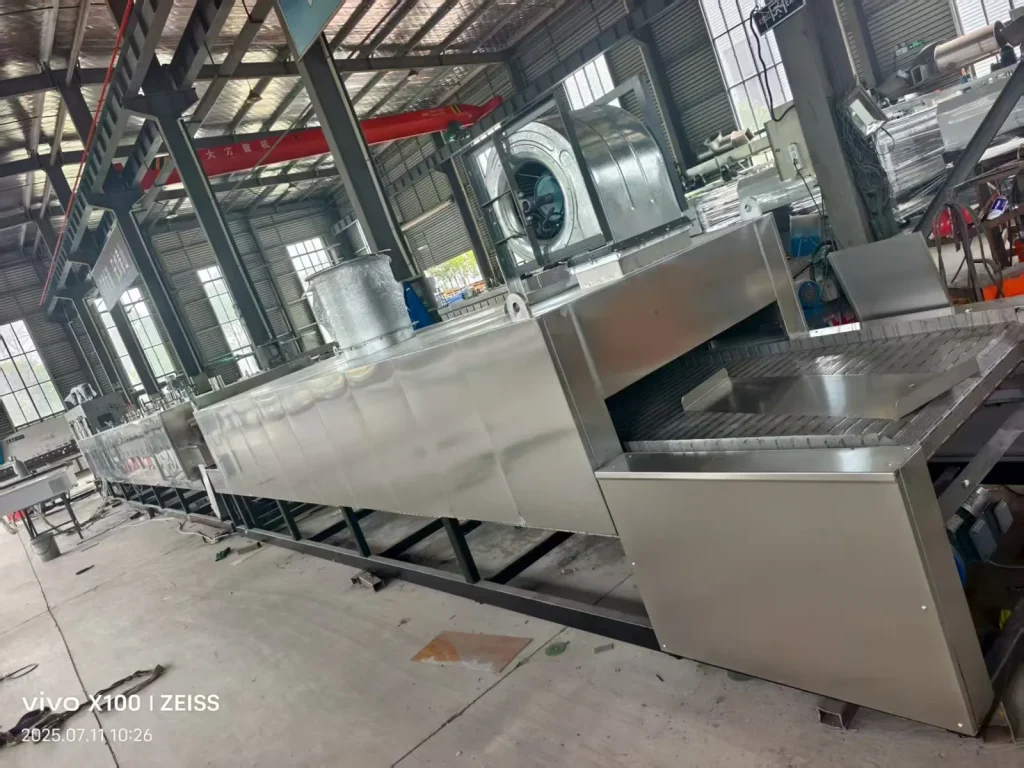
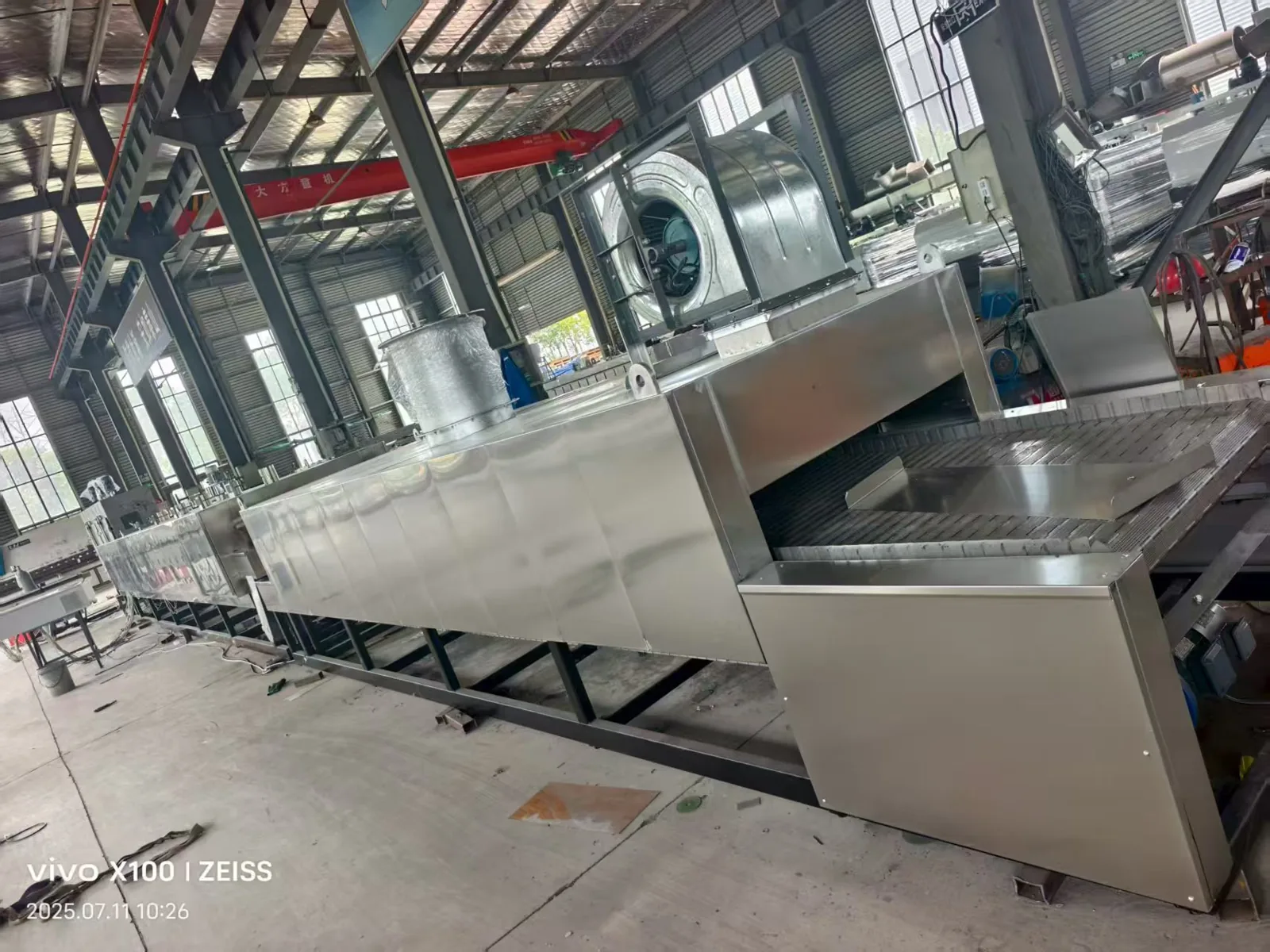
Griffin configured the line as a tunnel belt dryer followed by an enclosed belt cooling machine. During the July 2025 FAT, the assembled line measured approximately 16 m in total length and the usable conveyor width was measured at 1.06 m.
- Product-contact and enclosure material: SUS304 stainless steel in the specified process areas
- Conveyor: stainless-steel mesh plate with a nominal 3 mm opening
- Drive: 1.5 kW transmission motors with variable-frequency speed control
- Heating: 70 kW electric heating system with recirculation fan interlock
- Automation: Siemens main electrical components, inverter control, and HMI interface
- Cooling: enclosed cooling section with a cooling fan, dehumidification fan, and adjustable conveyor
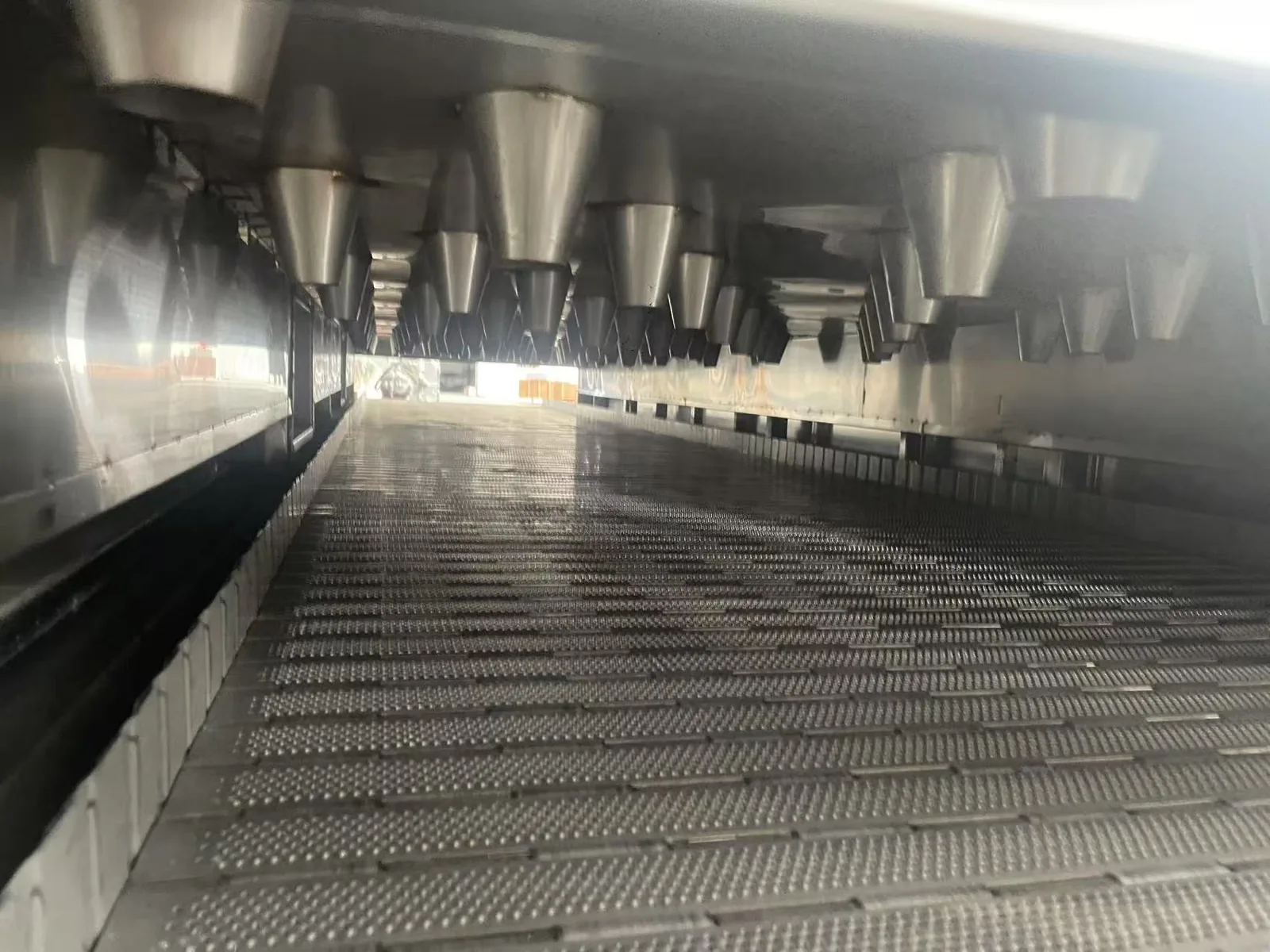
How the process line works
- Metered feeding: A vibration feeder distributes the material onto the stainless-steel conveyor.
- Controlled heating: The recirculation fan starts before the electric heating elements. The temperature controller then maintains the set process temperature and provides over-temperature protection.
- Residence-time control: The conveyor inverter allows operators to adjust belt speed to match product thickness, moisture removal, and target throughput.
- Moisture removal: The exhaust system removes humid air from the tunnel.
- Forced-air cooling: Material transfers directly into the enclosed cooling belt, where forced airflow reduces the discharge temperature before collection or further processing.
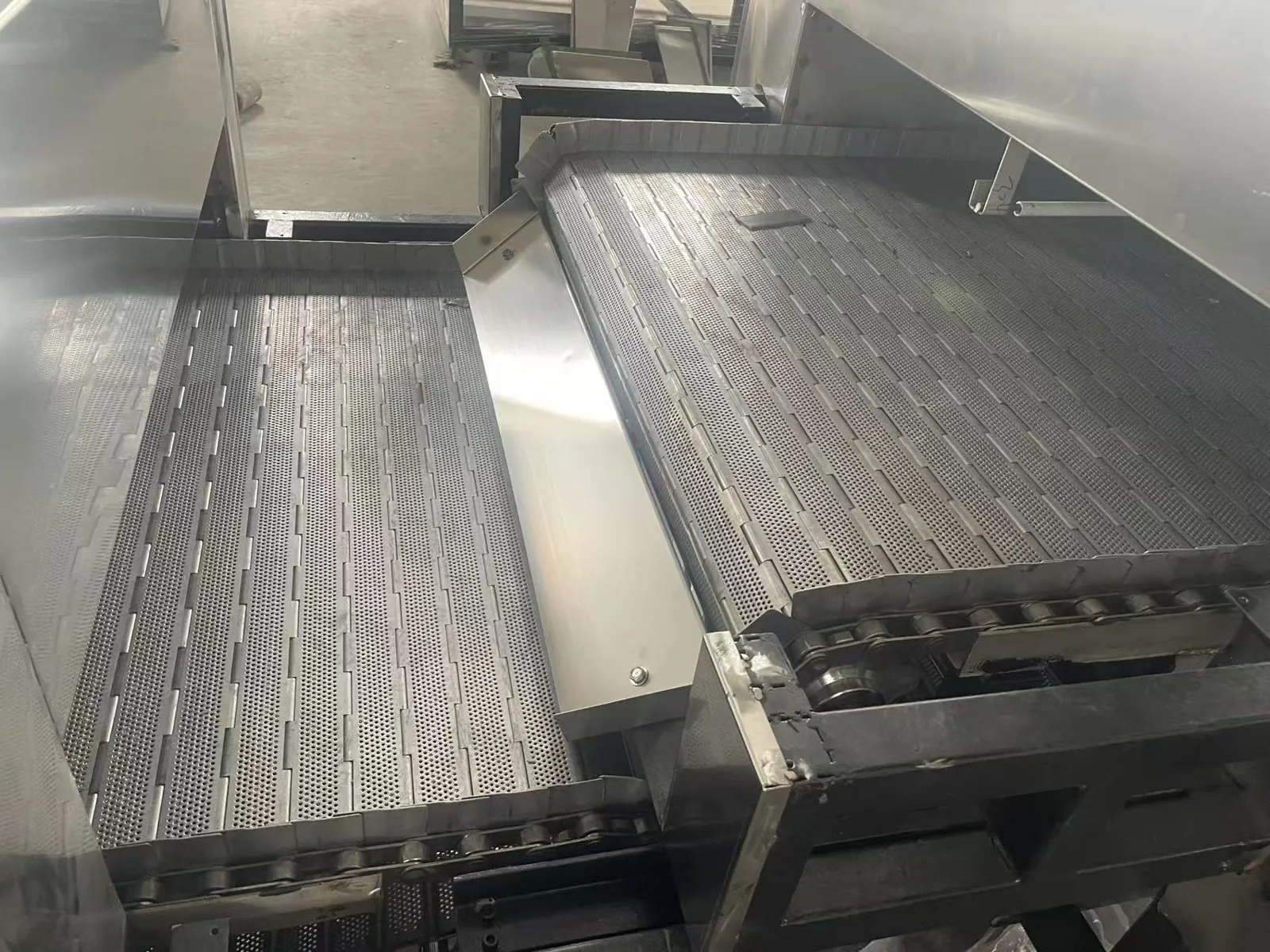
Factory acceptance test results
The FAT team tested conveyor speed at two inverter frequencies over a measured 820 mm distance. The results provide practical residence-time references for commissioning:
| Test setting | Measured belt speed | Approximate time through the assembled line |
|---|---|---|
| 36 Hz | 3.13 mm/s | 1.42 hours |
| 50 Hz | 4.06 mm/s | 1.09 hours |
A separate heating-response test recorded the tunnel temperature rising from 57 °C to 102 °C in approximately seven minutes. This corresponds to an observed average heating rate of about 6.6 °C per minute under the FAT conditions. These values are test observations, not universal production guarantees; actual drying performance depends on the material, feed rate, bed depth, initial moisture, and operating set points.
Cooling trials supported the design
The customer performed forced-air cooling trials on heated briquettes before finalizing the cooling arrangement. The test material was heated to 100 °C, and airflow and temperature were measured at several points. In the reported test, even a five-layer bed reached approximately 50 °C after two minutes of blowing. Follow-up temperature monitoring identified only limited thermal rebound, including with higher stacked layers.
The airflow measurements also revealed an uneven velocity distribution near the perpendicular inlet. That evidence helped the engineering team focus on air distribution, fan arrangement, and the transition between the drying and cooling sections instead of relying only on nominal fan capacity.
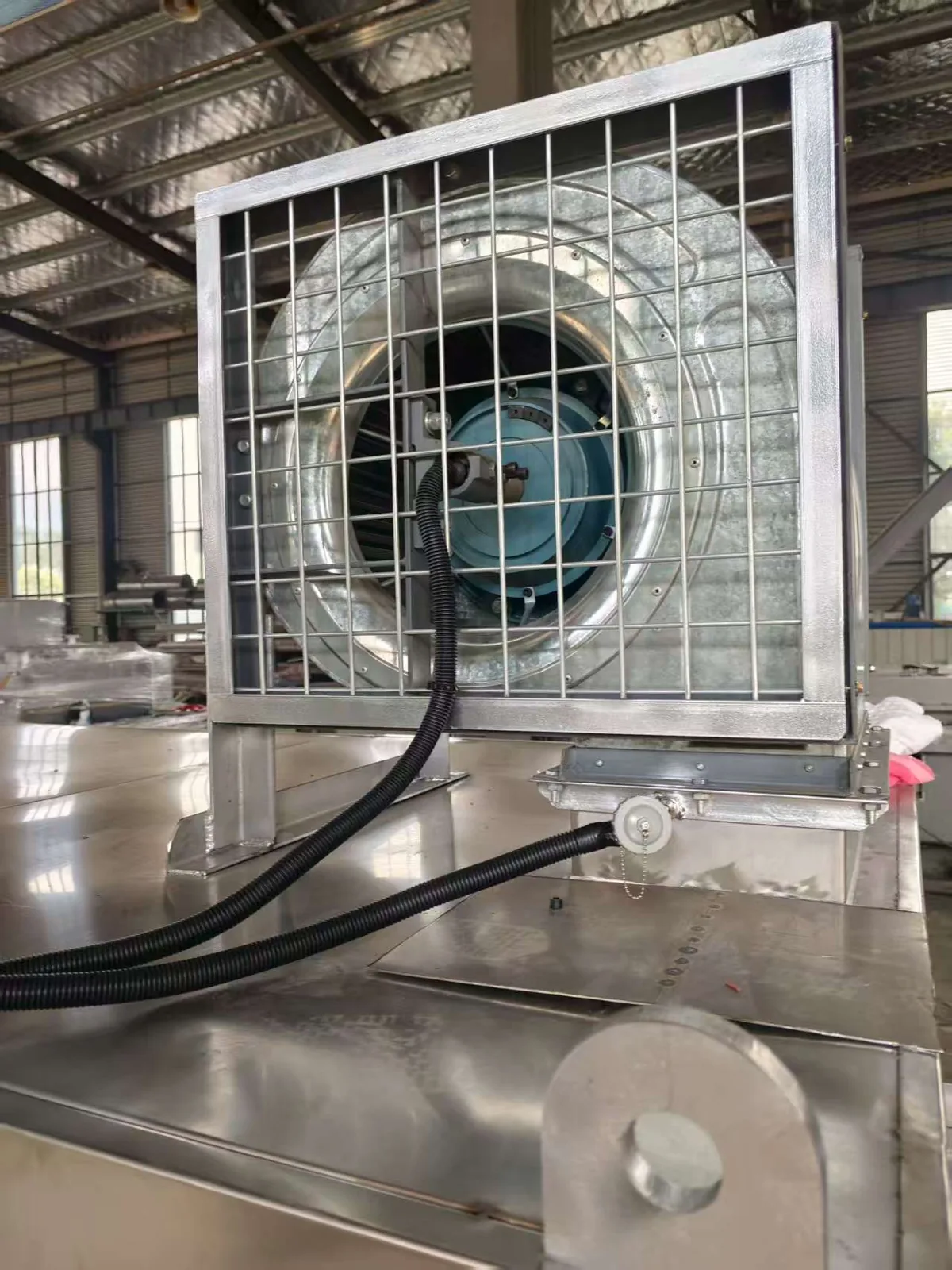
FAT, corrective actions, and documentation
Factory acceptance is not only a demonstration that the line runs. It is a structured quality gate. The inspection recorded the operating results and also generated a close-out list covering paint repair, equipment labels, protective guards, cabinet cable entries, earthing, emergency-stop access, a cooling-section temperature probe, HMI layout, updated component lists, manuals, and final fan testing.
This traceable process allowed the project team to resolve or document open items before shipment and to align the as-built manuals, electrical drawings, spare-parts lists, and operating instructions with the delivered machine.
What this project demonstrates
For continuous industrial drying, the dryer cannot be selected in isolation. Feed distribution, residence time, heat transfer, moisture exhaust, product depth, discharge temperature, controls, maintenance access, and acceptance criteria must be engineered as one process. Adding a purpose-built cooling stage can improve downstream handling and reduce the risk of heat remaining inside a thick product bed.
Frequently asked questions
Why combine a belt dryer with a belt cooler?
The combined arrangement maintains continuous material flow and allows drying and discharge temperature to be controlled as separate process steps. It can reduce manual handling and make downstream packing or processing more predictable.
Can the residence time be adjusted?
Yes. A variable-frequency conveyor drive allows the belt speed to be tuned during commissioning. The final setting should be based on material trials, bed depth, moisture target, and throughput.
Does FAT data equal guaranteed production performance?
No. FAT confirms the mechanical and control functions under defined test conditions. Production capacity and final moisture must be validated with representative material and agreed process parameters.
What information is needed to engineer a similar line?
Useful inputs include the material name and safety data, initial and target moisture, feed temperature, bulk density, particle or briquette dimensions, heat sensitivity, required throughput, target discharge temperature, available utilities, installation space, and applicable electrical or safety standards.
Discuss a continuous drying project
Griffin designs customized mesh belt dryers, continuous drying systems, and integrated cooling sections. Share your material data and process targets through our project inquiry form so our engineers can evaluate the required tests, line configuration, and acceptance criteria.
French Microwave Belt Dryer Project: Engineering Scope
This case study describes an integrated microwave belt drying and forced-air cooling line shown in the project materials. It is intended to explain the engineering interface, not to publish confidential customer information or promise the same result for every material.
Define the drying and cooling duty
A project brief should state feed form, loading pattern, initial and target moisture, product temperature limits, residence-time window, throughput basis and the required cooling condition. These inputs determine the usable heating and cooling zones and the control strategy.
Coordinate belt, air and microwave interfaces
Review belt loading, product depth, air distribution, exhaust routing, microwave shielding, access doors, interlocks, sensors and downstream transfer. Mechanical, electrical and process responsibilities should be recorded in a scope matrix before fabrication.
Use factory testing and documented handover
Factory acceptance testing should follow an agreed protocol using representative material or a documented test substitute. Request drawings, utility requirements, control descriptions, operating limits, maintenance instructions and training scope before shipment and commissioning.
Case-study boundary: photographs and project descriptions do not establish a universal capacity, energy saving, customer result, certification or safety approval. Final performance depends on material properties, operating conditions, site utilities, applicable regulations and the signed acceptance criteria.
Plan a Similar Belt Dryer Inquiry
Send product data, moisture targets, loading and throughput, heating constraints, cooling requirements, site power, exhaust conditions, available space, automation interfaces and acceptance-test needs. Review belt dryer options, project references, engineering services and contact requirements.
Discuss Your Belt Dryer Project
Microwave Belt Dryer Project FAQs
What information is needed for a first review?
Provide material form, moisture range, target condition, loading, throughput, temperature limits, utilities and the intended acceptance method.
Why combine microwave heating with air handling?
The heating and air systems must be evaluated together for product movement, moisture removal, exhaust, controls and safe operation; the correct arrangement is project-specific.
What should factory testing confirm?
Confirm agreed operating sequences, safety interlocks, control functions, utility interfaces, sample handling and the documented acceptance criteria.
Can this exact line be copied to another site?
Not without review. Product behavior, line layout, utilities, controls, regulations and acceptance requirements must be checked for each site.