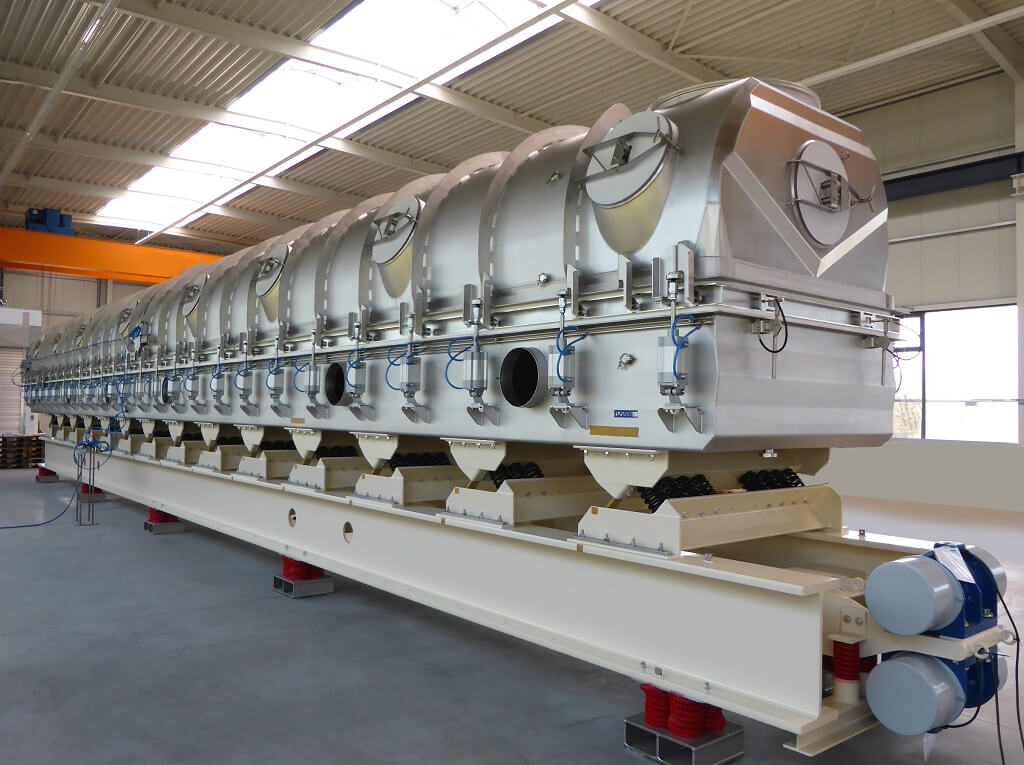
A vibrating fluidized bed dryer uses controlled air flow and mechanical vibration to dry or cool suitable granular materials. It is commonly evaluated for crystals, granules and powders that can move across a perforated bed without excessive breakage or sticking.
How a Vibrating Fluidized Bed Works
Conditioned air is supplied beneath the perforated bed. As air passes through the material layer, it supports and fluidizes the particles. Vibration helps move the material forward and can improve contact between the particles and the drying air. The material travels from the feed end to the discharge end while moisture is removed or the product is cooled.
Main Process Sections
- Air preparation: filtration, fan, heater or cooler, ducting and controls provide the required air volume and condition.
- Feed system: a feeder introduces material at a stable rate so that bed depth and residence time can be controlled.
- Vibrating bed: the perforated deck and vibration drive support material movement and gas-solid contact.
- Discharge and separation: dried material is discharged for downstream handling, while exhaust air passes through appropriate dust-collection equipment.
Materials and Product Considerations
The technology can be considered for free-flowing materials such as certain crystals, granules and agglomerated powders. Suitability depends on particle-size distribution, initial moisture, stickiness, density, attrition sensitivity and required residence time. Materials with broad particle distributions or a strong tendency to adhere may need feed conditioning or another drying approach.
Key Operating Variables
Drying performance is influenced by inlet-air temperature, air volume, bed depth, vibration setting, feed rate and residence time. These parameters should be established using representative material data. For cooling duties, the same system principle can be adapted by using conditioned cooling air and setting the required outlet product temperature.
Specifying a Vibrating Fluidized Bed Dryer
Start with the material description, capacity, inlet and outlet moisture, particle-size range, allowable product temperature and required downstream handling. Griffin Machinery can review these inputs to help assess whether a vibrating fluidized bed is suitable and to define a practical drying or cooling configuration.
SELECTION REVIEW
Data to Review Before Selecting a Vibrating Fluidized Bed Dryer
Vibration can support material movement and bed behavior, but it does not by itself establish suitability. The dryer configuration should be reviewed against the actual feed, drying or cooling duty, product handling target and plant conditions.
Material and feed behavior
- Particle-size distribution, bulk density, flowability and fines content
- Initial and target moisture, feed temperature and required discharge condition
- Cohesion, attrition, agglomeration or carryover observations
- Heat sensitivity and any material-contact or cleaning requirements
Process and equipment duty
- Required capacity, operating schedule and allowable residence-time range
- Drying, cooling or combined duty; inlet and outlet product targets
- Airflow, filtration, exhaust and dust-collection requirements
- Feed/discharge arrangement and downstream conveying or storage
Safety and installation inputs
Identify dust, volatile components, containment, utilities, access and site constraints before configuration. Any safety or protective measures must be defined for the actual material and local requirements.
Selection boundary: The working-principle description on this page is general information, not a performance guarantee. Stable operation and final product condition depend on the material, process duty and project-specific configuration; representative testing may be required.
Related Fluid Bed Equipment
Discuss Your Vibrating Fluid Bed Requirement
Send the material description, particle information, moisture or cooling duty, capacity, product targets and any dust or site constraints for an engineering review.
Vibrating Fluid Bed Dryer FAQs
What materials should be reviewed for a vibrating fluid bed dryer?
Review particle distribution, density, flowability, fines, cohesion, moisture behavior, heat sensitivity and the desired product condition.
Does vibration make every powder suitable for fluidization?
No. Feed behavior still depends on the material and process conditions. Fine, cohesive or sticky materials require material-specific review.
Can a vibrating fluid bed be used for cooling as well as drying?
It may be considered for drying, cooling or combined duties when the actual product requirements and heat-transfer conditions are evaluated for the project.
What information should be included in an inquiry?
Provide material name, particle information, moisture or cooling duty, capacity, temperature limits, product target, dust or volatile information and installation constraints.