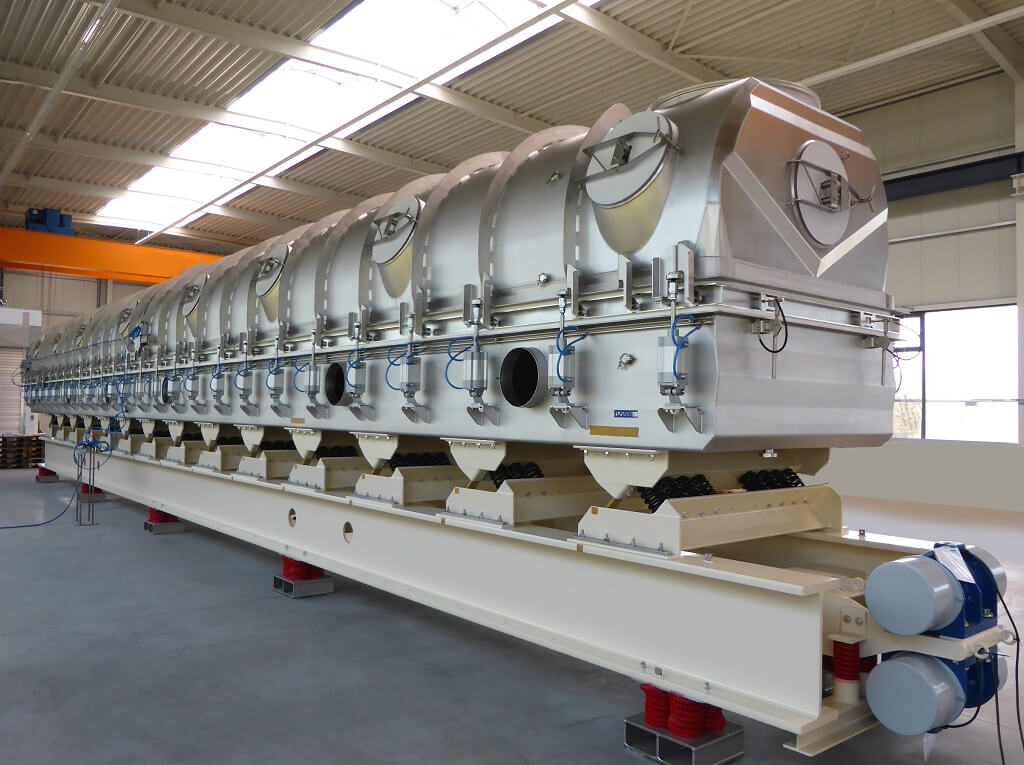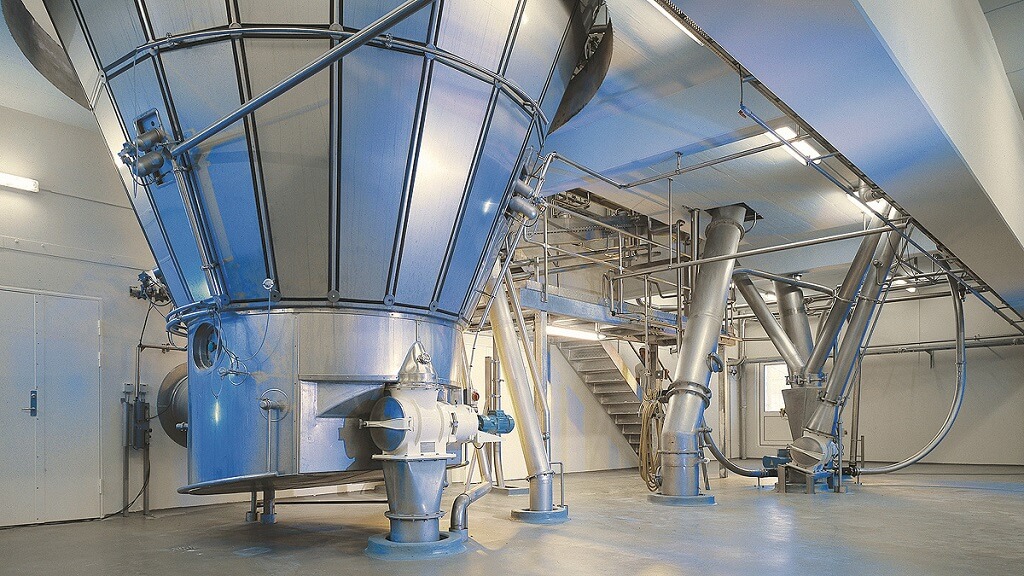
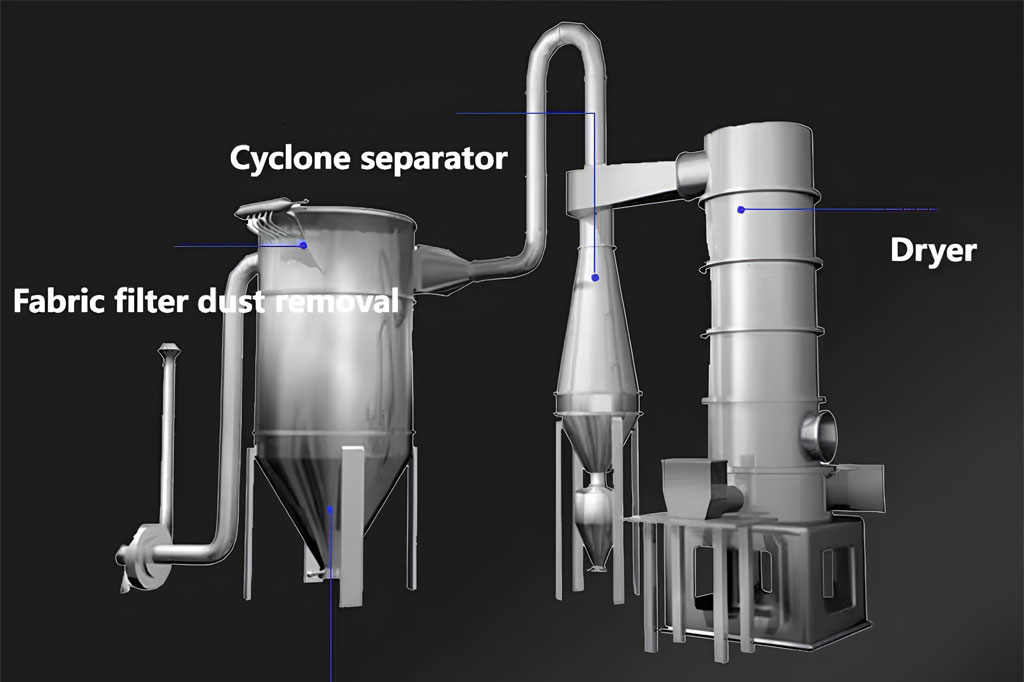
A spin flash dryer is a highly efficient industrial drying system, particularly suitable for drying wet cakes, slurries, and filter residues into fine powders in a continuous process.
The system combines drying, grinding, and classification in a single unit, making it both compact and energy-efficient.
Understanding the key components of a spin flash dryer is essential for optimizing performance, ensuring product quality, and maintaining operational reliability.
Below is a detailed breakdown of its core components and their functions.
1. Feed System
The feed system ensures wet materials are delivered into the drying chamber steadily and precisely. Depending on the physical form of the material, different feeding mechanisms are used:
- Screw feeders for semi-solid or pasty materials
- Rotary valves for granular or powdery feed
- Slurry pumps for liquid suspensions
A well-designed feed system ensures uniform distribution of material into the drying chamber, which is critical for achieving consistent drying results. Poor feeding can lead to agglomeration, uneven moisture content, or system blockages.
2. Drying Chamber
The drying chamber is the core of the spin flash dryer, where heat and mass transfer take place. It is typically a vertical cylindrical vessel designed to facilitate turbulent airflow.
Inside the chamber:
- Hot air enters at high velocity from the bottom
- Wet material is dispersed into fine particles
- Intense mixing ensures rapid evaporation of moisture
The chamber’s design promotes efficient contact between hot air and material, significantly reducing drying time. Its geometry also helps prevent material buildup on the walls.
3. Bag Filter (Dust Collection System)
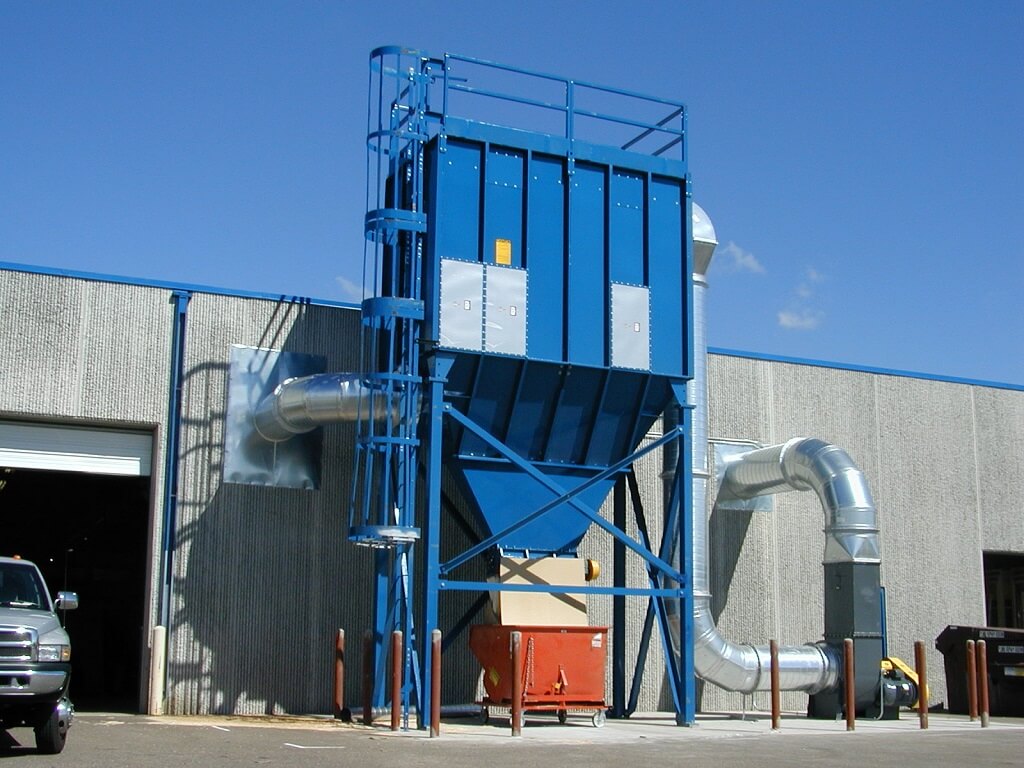
To capture very fine particles that escape the cyclone, a bag filter (or baghouse) is used.
Key benefits:
- Improves product recovery rate
- Minimizes environmental emissions
- Ensures compliance with air quality regulations
Modern systems often use pulse-jet cleaning to maintain filter efficiency and reduce maintenance.
4. Air Heating System
The air heating system supplies the necessary thermal energy to facilitate the drying process. It generates hot air that is introduced into the drying chamber.
Common heating methods include:
- Steam heaters (indirect heating, stable and safe)
- Electric heaters (precise temperature control)
- Gas or oil-fired burners (high efficiency for large-scale operations)
Temperature control is critical. Overheating risks material degradation, whereas insufficient heat reduces drying efficiency.
5. Agitator / Rotor System
Located at the bottom of the drying chamber, the agitator (or rotor) is a high-speed rotating device that plays a crucial role in material processing.
Its main functions include:
- Breaking up wet lumps or agglomerates
- Dispersing material into fine particles
- Enhancing contact between particles and hot air
The rotor ensures that even sticky or cohesive materials are effectively processed, preventing clogging and improving drying efficiency.
6. Air Distributor
The air distributor is positioned at the bottom of the chamber and is responsible for evenly distributing hot air into the system.
Key roles:
- Ensures uniform airflow across the chamber
- Creates a stable vortex or fluidized state
- Prevents dead zones where material might accumulate
A well-designed air distributor improves drying efficiency and ensures consistent product quality.
7. Classification System
The classification system, often located at the top of the drying chamber, controls the final particle size of the dried product.
It works by:
- Allowing fine, dry particles to exit the system
- Returning larger or wetter particles back into the chamber for further drying
This internal recycling mechanism ensures uniform particle size distribution and prevents under-dried material from leaving the system.
8. Cyclone Separator
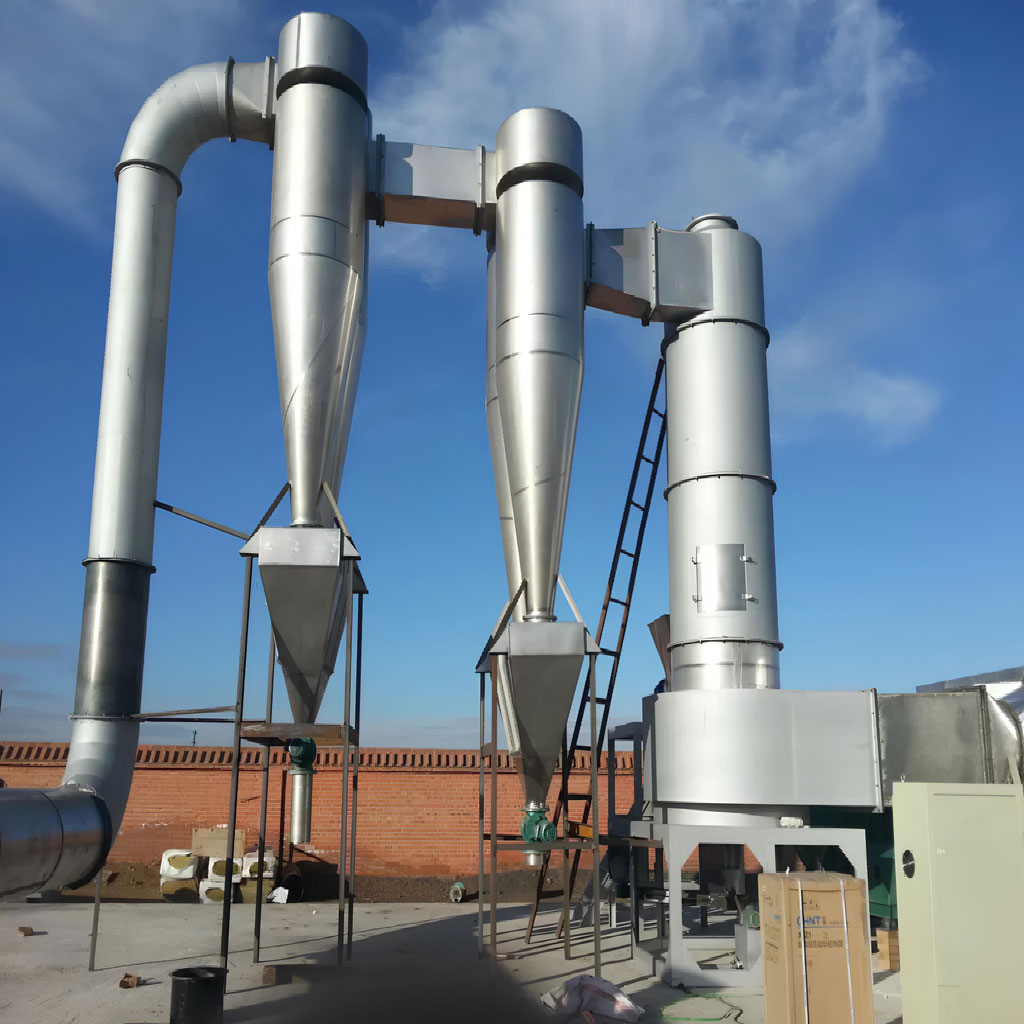
After drying, the air-particle mixture exits the chamber and enters the cyclone separator.
Functions:
- Separates dried powder from exhaust air using centrifugal force
- Collects product efficiently
- Reduces product loss
Cyclones are robust, low-maintenance components widely used in powder processing industries.
9. Induced Draft Fan
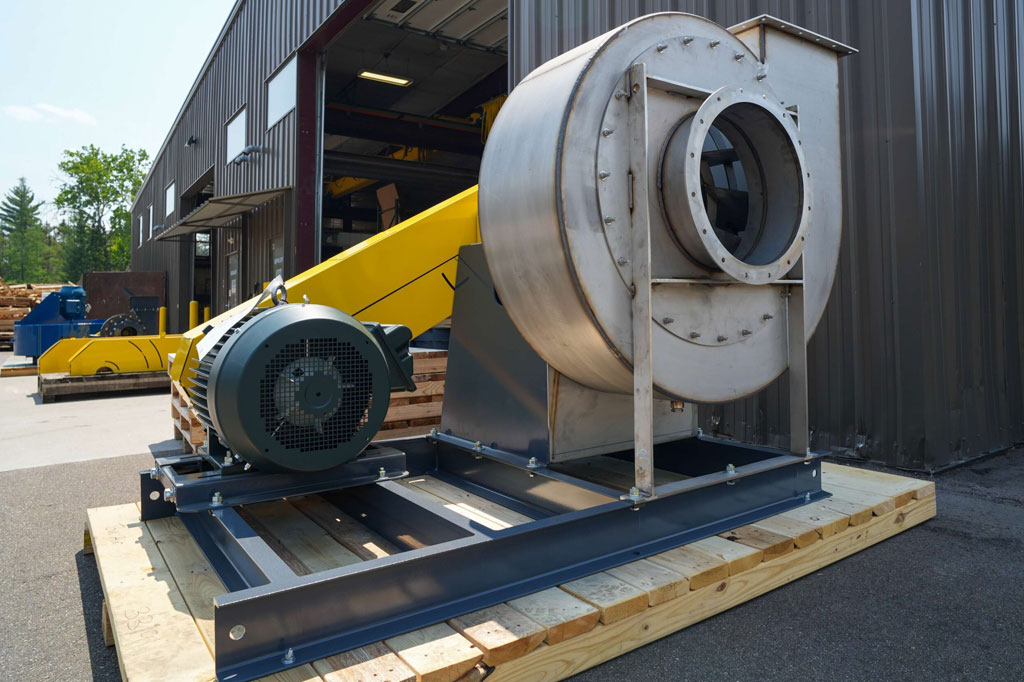
The induced draft (ID) fan creates the airflow required to move air and material through the entire system.
Its functions include:
- Maintaining negative pressure inside the system
- Ensuring continuous airflow
- Transporting dried particles to separation units
Proper fan selection is crucial for system stability and energy efficiency.
10. Control System
The control system integrates all components and ensures smooth, automated operation.
It typically monitors and controls:
- Temperature
- Airflow rate
- Feed rate
- Rotor speed
- System pressure
Modern systems incorporate PLC or SCADA technologies to enable real-time monitoring, fault detection, and process optimization.
SYSTEM REVIEW
Specify Components as an Integrated Drying System
Individual components cannot be selected independently. The feed system, rotor, air circuit, classifier, powder collection and controls must work together for the actual material, drying duty and product target.
Material-contact and wear inputs
- Feed consistency, stickiness, abrasiveness, corrosion and foreign matter
- Required contact materials, surface finish, sanitation or containment
- Expected wear locations, inspection access and replaceable component strategy
Process and equipment interfaces
- Feed preparation and controlled delivery to the drying chamber
- Heat source, airflow, classification, cyclone or filter and exhaust interfaces
- Discharge, cooling, conveying, packaging and downstream connections
Controls, cleaning and maintenance
- Required measurements, alarms, interlocks and approved operating sequences
- Cleaning method, product-change requirements and access for inspection
- Maintenance schedule, spare-part planning and site utility standards
Configuration boundary: A component list is not a complete equipment specification. Sizes, materials, drives, airflow, collection devices, controls and protective systems must be selected from representative material data, process calculations, site conditions and applicable safety requirements.
Related Spin Flash Dryer Resources
- Spin Flash Dryer
- Spin Flash Dryer Working Principle
- Spin Flash Dryer Efficiency
- Spin Flash Dryer Operating Procedures
Review a Spin Flash Dryer Configuration
Send the wet feed and product data, capacity, material-contact requirements, heat source, utilities, cleaning needs and installation constraints.
Spin Flash Dryer Component FAQs
Why must the feed system match the rotor and chamber?
Stable feeding and appropriate dispersion are needed to avoid overload, deposits and inconsistent drying. The interface depends on the wet material behavior.
How is the powder collection system selected?
Particle behavior, fines load, required yield, emissions, temperature, humidity and downstream handling influence the cyclone, filter and exhaust arrangement.
Which factors influence materials of construction?
Product-contact requirements, corrosion, abrasion, temperature, cleaning chemicals, sanitation and contamination control all require review.
What information should be included in a component inquiry?
Provide feed behavior, moisture duty, capacity, powder target, wear or corrosion data, cleaning requirements, utilities, controls and site conditions.