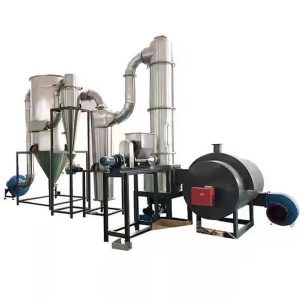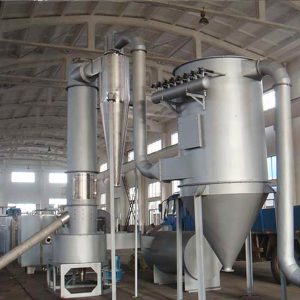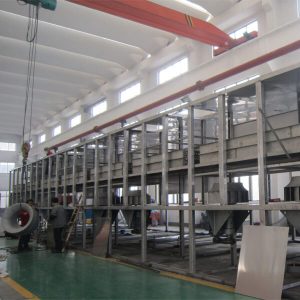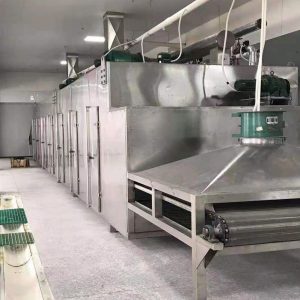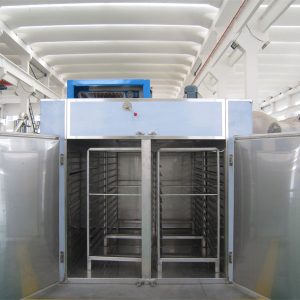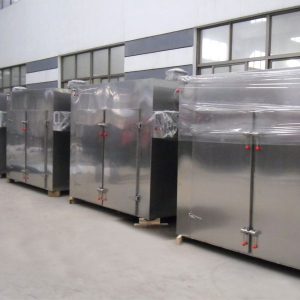
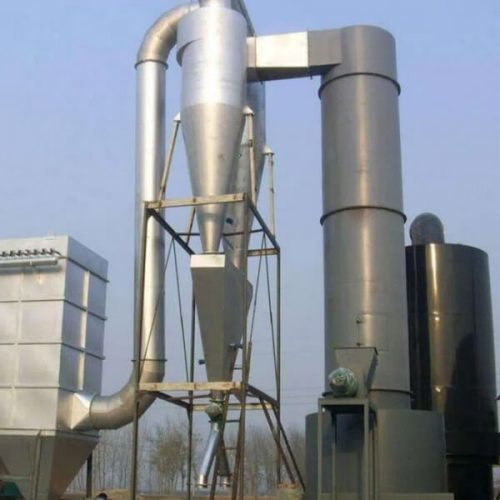
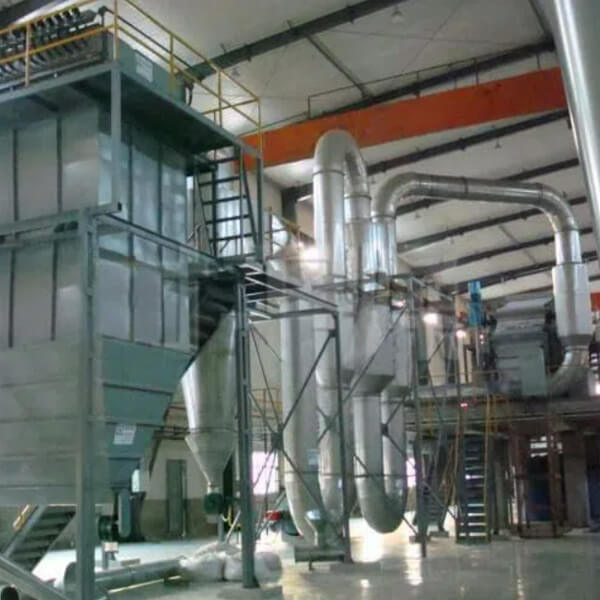
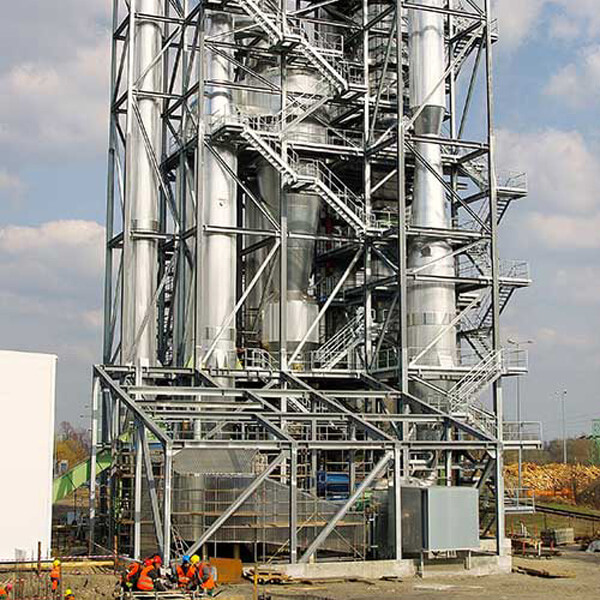
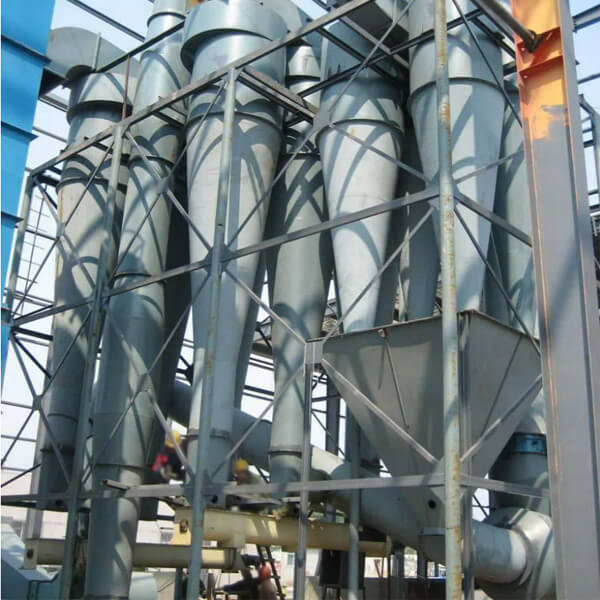
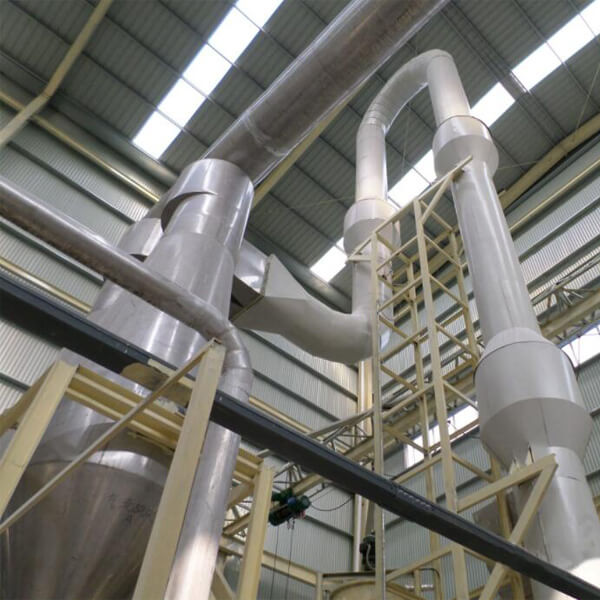
Use an air flow dryer only when the wet feed can be metered, dispersed and conveyed reliably in the heated gas stream. Paste-like, agglomerated or poorly dispersible feeds may require comparison with a spin flash route, while free-flowing granules may be better evaluated against fluid-bed drying. Confirm particle-size distribution, bulk density, feed consistency, initial and target moisture, stickiness, product-temperature limit, required throughput, gas velocity, collection method, dust and safety conditions, utilities and installation constraints before equipment selection.
Optimization
Griffin Technology has been continuously optimizing the airflow dryer.
The airflow dryer is mainly used in the drying of starch and the drying of some inorganic salt products, such as drying of sodium sulfate and sodium metabisulfite, which has always had its unique advantages.
In the feeding mechanism of the air dryer, We have designed a unique anti-arch device, which can ensure the smooth and smooth entry of the raw materials into the air stream dryer without the phenomenon of bridging.
In the main engine of the airflow dryer, a unique pulse link is designed. Some products have relatively high requirements for final moisture. In order to prolong the drying time in the airflow dryer, we have made a pulse expansion section, which will buffer the drying of the product. The speed makes more full contact with the hot air.
In the dust removal and collection process of the airflow dryer, considering a large amount of dust, we have made explosion venting devices in the bag filter and the host to achieve the purpose of safe production.
Actual Measurement Data of Material Suspension Speed
Raw Material Name | True Density (kg/m3) | Bulk Density (kg/m3) | Particle Size (mm) | Suspension Speed (m/s) |
Wheat | 1270~1490 | 650~810 | 4~4.5 | 9.8~11 |
Barley | 1230~1300 | 600~700 | 3.5~4.2 | 8.7~10.5 |
Paddy | 1020 | 550 | 3.58 | 7.5 |
Rice | 1480 | 620~680 | 10×3 | 8~8.5 |
Corn | 1240~1350 | 600~620 | 9×8×6 | 9.8~13.5 |
Soybean | 1180~1220 | 560~720 | 3.5~10 | 10 |
Rapeseed | 1040 | 640 | 1.3~2.2 | 7.6~8.8 |
Granulated Sugar | 1580 | 720~880 | 0.51~1.5 | 8.7~12 |
Dry Fine Salt | 2200 | 900~1300 | <1.0 | 9.8 |
Coarse Salt | 1090 | 720 | 7~7.2 | 14.8~15.5 |
Flour | 1410 | 610 | 0.163~0.197 | 1.5~2 |
Washing Powder | 1270 | 480 | <0.5 | 2 |
Soda | 2480 | 530 | <0.12 | 2.5 |
Talcum Powder | 2600~2850 | 560~950 | >0.01 | 0.5~0.8 |
Clay | 2200~2600 | 320~490 | N/A | 1.8~2.1 |
Zincite | 4300 | 2280 | N/A | 17.7 |
4% Moisture Content Dry Sand | 2300~2600 | 1410 | 50~100 Mesh | 5.13~5.53 |
Molding Sand | 2400 | 1020 | 50~100 Mesh | 8.1~10 |
Ammonium Sulfate | 1770 | 995 | 1.5 | 10.1~13.1 |
Phosphate Rock Powder | 2580 | 1467 | <3.2 | 4.1~11.2 |
Polypropylene Pellets | 900 | 460 | 2~3 | 6.2~6.9 |
Coal | 1000~1700 | 720~940 | 1~3 | 4~5.3 |
Coal | 1000~1700 | 720~940 | 3~5 | 4.2~6.8 |
Coal | 1000~1700 | 720~940 | 5~7 | 6~10.2 |
Coal | 1000~1700 | 720~940 | 10~15 | 11~13.3 |
Potato Starch Airflow Drying Solution
Customer's Material & Related Parameters | |
Material | Potato Starch |
Capacity Requirement | ≧100kg/h |
Initial Moisture | 60% (wet basis) |
Final Moisture | ≤10% (dry basis) |
Raw Material Specific Gravity | Stacking specific gravity 0.7 |
Feed Temperature | Normal temperature |
Discharge Temperature | 50℃ |
Heat Source | Natural gas hot air furnace |
Equipment Process Conditions | |
Receiving Method | Cyclone + bag dust collector |
Air Flow Dryer Model | QG-350 *1 |
Feeding Method | Screw conveyor |
Hot Air Contact Mode | Parallel flow |
Inlet Air Temperature | 160℃ |
Outlet Air Temperature | 60℃ |
Material Requirements | Product contact 304 stainless steel |
Dust Removal Method | Cyclone + bag dust collector |
Installation Site | Indoor |
Installation Site Size | Plant condition drawing is required |
Noise | <80 db |
Public Works Conditions | |
Atmospheric Pressure | 101.3KPa |
Ambient Temperature | 10℃ |
Relative Humidity | 70% |
Electric Power | 380V, 3 phase, 50HZ |
Machine Power | 30KW/unit |
Compressed Air Consumption | 1.1m³/min |
Compressed Air Pressure | 0.3~0.6mpa |
Air Flow Dryer Configuration List | ||||
ID | Name | Models & Specifications | Material | Quantity |
1. Feeding System | ||||
1 | Screw Feeder | LJ-108 | SUS304 | 1 |
2 | Feeding Pipeline | 108 Casing Spiral | SUS304 | 1 |
3 | Arch Breaker System | 18mm round steel | SUS304 | 1 |
2. Drying medium circulation system | ||||
1 | Air Blower | 4-72-4.5A | Q235 | 1 |
2 | Induced Draft Fan | 9-26-6.3A | Q235 | 1 |
3 | Hot Air Duct | Inner δ=2mm | SUS304 | 1 |
4 | Powder Discharge Air Duct | δ=3mm | SUS304 | 1 |
5 | Pipe Connection | Flange type | Q235 | 1 |
3. Air Heating & Purification System | ||||
1 | Ⅰ & Ⅱ Efficiency Air Filter | 2000X1500X500 | Q236 | 1 |
2 | Direct-fired Gas-fired Hot Air Furnace | 13X104kcal | 301S | 1 |
4. Drying System | ||||
1 | Main Pipeline | D290mm | SUS304 | 1 |
2 | Pulse Tube | D380mm | SUS304 | 1 |
3 | Main Machine Skeleton | Q235+SUS304 | 1 | |
5. Material Collection System | ||||
1 | One-stage Cyclone Separator | XF750, straight section δ=4mm, Tapered section δ=3mm | SUS304 | 1 |
2 | Air Hammer | SK-60 | Cast aluminum | 2 |
3 | Continuous Discharge Valve | 8L | SUS304 | 1 |
4 | Bag dust collector | MCBD-64 | SUS304 | 1 |
5 | Solenoid Valve | 8 | ||
6. Control System | ||||
1 | Control Cabinet | Carbon steel spraying | 1 | |
2 | Temperature Module | Siemens | 1 | |
3 | Contactor Components | Siemens | 1 | |
4 | Inverter | Siemens | 2 | |
PNEUMATIC DRYING
How Air Flow Drying Transports and Dries Solids
Suitable wet solids are metered into a hot gas stream, dispersed and conveyed through the drying path. Heat and mass transfer occur while the particles travel with the gas, after which the dried product is separated in the selected collection system. Feeding, gas velocity, duct geometry and separation must be engineered together.
1. Meter and Disperse Feed
The feeder and any deagglomeration device are selected from wet-feed flow, stickiness and particle condition.
2. Convey in Heated Gas
Gas flow and temperature provide transport and drying conditions for the expected particle distribution.
3. Control Residence Profile
Duct length, diameter, expansion sections and airflow affect contact time and particle movement.
4. Separate and Collect Product
Cyclone and filtration stages are selected from particle size, loading, recovery, emissions and dust-safety requirements.
ENGINEERING SELECTION
Air Flow Dryer Selection Requirements
Particle and Feed Data
Wet-feed form, particle size distribution, true and bulk density, stickiness, agglomeration and feeding behavior.
Transport Conditions
Suspension or conveying velocity, gas volume, pressure drop, residence profile and acceptable product carryover.
Thermal Duty
Feed rate, initial and target moisture, temperature limit, heat source and inlet or outlet conditions to be confirmed.
Collection and Safety
Particle recovery, exhaust treatment, dust hazard assessment, protection philosophy, construction materials and site utilities.
Request an Air Flow Drying Review
Send particle, moisture, capacity, heat-source and dust-handling data for an application-specific review.
TECHNICAL QUESTIONS
Air Flow Dryer FAQs
What materials can be evaluated in an air flow dryer?
Air flow drying can be evaluated for suitable dispersed powders, granules or deagglomerated wet solids that can be fed and transported in the gas stream. Particle size, density, moisture, stickiness, thermal sensitivity and suspension behavior must be reviewed.
Why is suspension velocity important in pneumatic drying?
Gas velocity must support the intended material transport and residence profile without unacceptable dropout, carryover or equipment loading. Published suspension-speed data are references; actual wet-feed behavior and particle distribution require application-specific confirmation.
How is an air flow dryer different from a spin flash dryer?
An air flow dryer primarily dries suitable dispersed solids while conveying them through a duct. A spin flash dryer adds mechanical agitation or dispersion and classification in a chamber, which can help with some pastes or filter cakes. Feed condition determines which route should be evaluated.
What information is needed for an air flow dryer proposal?
Provide material name, wet-feed form, particle size distribution, true and bulk density, feed rate, initial and target moisture, temperature limit, suspension or conveying behavior, heat source, collection requirements, dust hazard data, utilities and installation country.