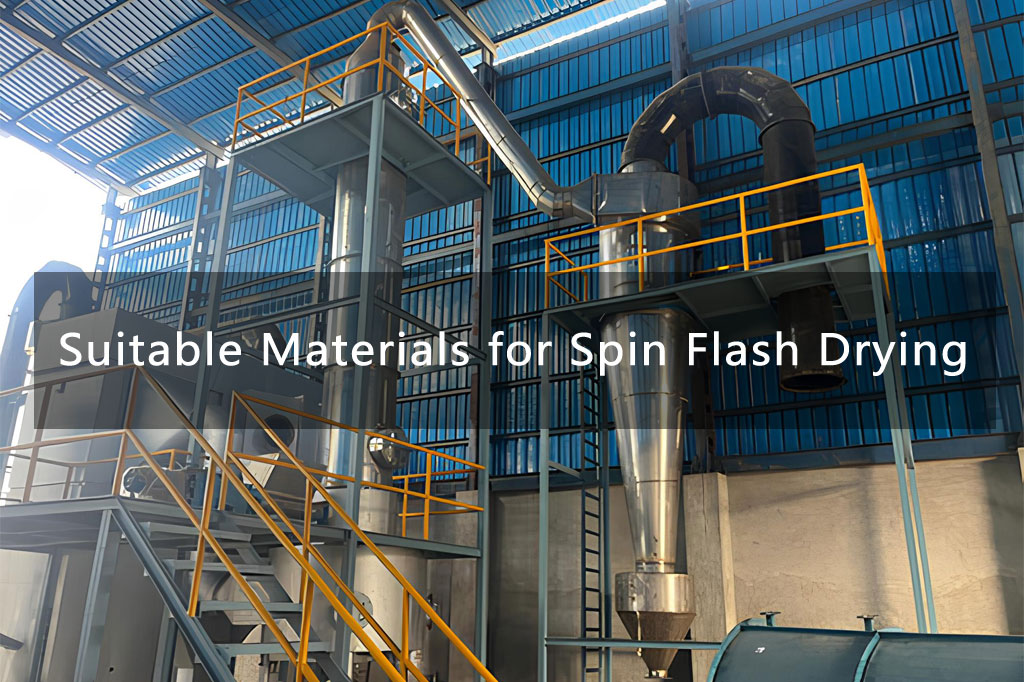
Spin flash drying is a highly efficient industrial drying technology designed to convert wet feed materials into fine powders within seconds.
It combines high-speed mechanical dispersion, intense heat transfer, and pneumatic conveying, making it particularly effective for challenging materials that are difficult to dry using conventional methods.
Understanding which materials are most suitable for spin flash drying is essential for optimizing performance, ensuring product quality, and achieving energy efficiency.
1. Understanding Material Requirements for Spin Flash Drying
Before identifying specific materials, it is important to understand the fundamental requirements for spin flash drying.
Spin flash dryers are designed to handle wet, viscous, or semi-solid feed materials such as slurries, pastes, and filter cakes. These materials are mechanically disintegrated into fine particles and instantly dried in a hot air stream.
To be suitable, materials should generally have the following characteristics:
- Ability to be dispersed into fine particles
- Presence of surface moisture (rather than strongly bound internal moisture)
- Moderate viscosity (typically liquid to paste-like consistency)
- Thermal stability under short exposure to hot air
- Non-cohesive or manageable stickiness after dispersion
Spin flash drying is especially effective because of its extremely short residence time (often less than a few seconds), which minimizes thermal degradation.
2. Slurries and Suspensions
2.1 Why They Are Ideal
Slurries and suspensions are among the most suitable materials for spin flash drying. These systems consist of solid particles dispersed in a liquid phase, making them easy to disintegrate and dry rapidly.
Spin flash dryers can handle a wide range of viscosities, typically from low to moderately viscous fluids, allowing flexibility in processing different slurry types.
2.2 Typical Examples
- Inorganic suspensions (e.g., calcium carbonate, titanium dioxide)
- Chemical slurries
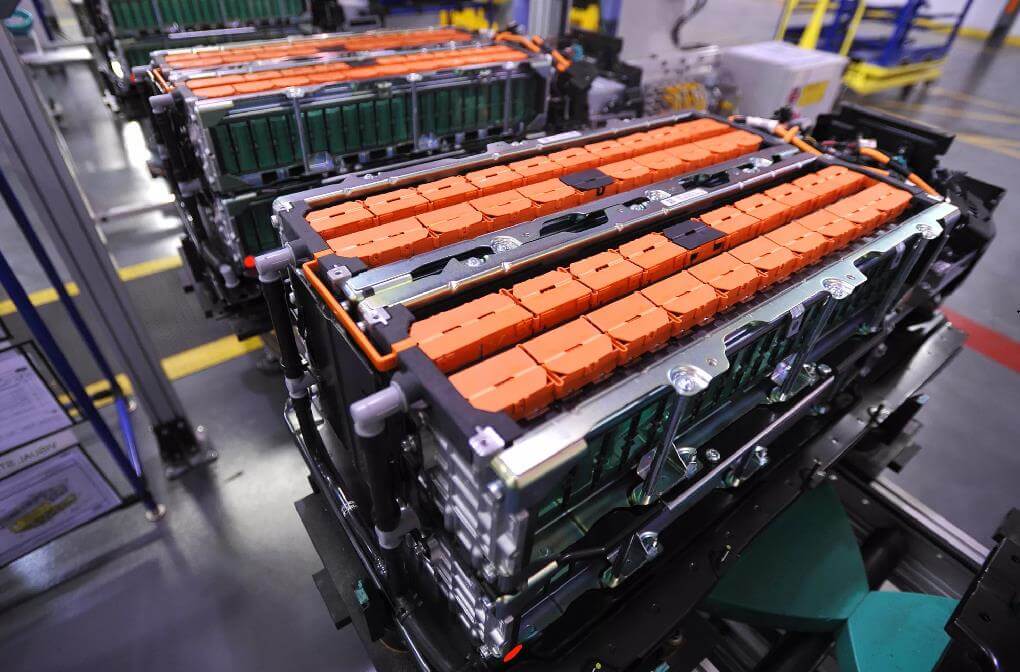
- Battery materials
- Wastewater treatment sludges
These materials benefit from rapid moisture removal and controlled particle size distribution.
3. Pastes and High-Viscosity Materials
3.1 Key Advantages
Pastes are difficult to process in many drying systems due to their high viscosity and poor flowability. However, spin flash dryers are specifically designed to handle such materials through mechanical agitation and dispersion.
The internal rotor system breaks down lumps and continuously exposes fresh surfaces to hot air, enabling efficient drying even for sticky materials.
3.2 Common Applications
- Starch pastes
- Polymer gels
- Adhesive compounds
- Food pastes (e.g., protein concentrates)
Spin flash drying is particularly effective for starch-based materials, where maintaining product quality and avoiding degradation is critical.
4. Filter Cakes and Wet Solids
4.1 Why They Work Well
Filter cakes are semi-solid materials with high moisture content, typically produced after filtration processes. These materials are often difficult to dry due to their compact structure.
Spin flash dryers can efficiently process filter cakes by:
- Mechanically disintegrating agglomerates
- Increasing surface area
- Rapidly evaporating surface moisture
4.2 Typical Materials
- Chemical intermediates
- Pharmaceutical residues
- Mineral filter cakes
- Industrial by-products
Feed materials in spin flash drying are often described as filter cake, paste, or slurry forms, highlighting their compatibility with the process.
5. Heat-Sensitive Materials
5.1 Suitability Factors
One of the major advantages of spin flash drying is its ability to process heat-sensitive materials. The brief exposure to high temperatures minimizes thermal degradation while maintaining effective drying performance.
5.2 Examples
- Pharmaceuticals (APIs, antibiotics, enzymes)
- Food ingredients (proteins, vitamins, flavors)
- Nutraceuticals
- Biochemical products
Spin flash dryers are widely used in pharmaceutical and food industries because they preserve chemical integrity and functional properties during drying.
6. Fine and Dispersible Solids
6.1 Importance of Particle Behavior
Materials that can be easily dispersed into fine particles are highly suitable for spin flash drying. The drying mechanism relies on suspending particles in a hot air stream, which requires:
- Low density or moderate particle weight
- Ability to be fluidized
- Minimal tendency to form large agglomerates
6.2 Typical Materials
- Pigments and dyes
- Catalysts
- Detergent powders
- Fine chemicals
Industries frequently use spin flash dryers for producing uniform, free-flowing powders with controlled particle size.
7. Sticky and Difficult-to-Dry Materials
7.1 Unique Capability
Spin flash drying is particularly valuable for materials that are:
- Sticky
- Agglomerative
- Difficult to atomize
Unlike spray dryers, which require liquid feeds, spin flash dryers can handle semi-solid and sticky substances effectively.
7.2 Examples
- Organic chemicals
- Resins
- Agrochemicals
- Food waste residues
The combination of mechanical agitation and high-velocity air prevents buildup and ensures continuous operation.
8. Inorganic and Mineral Materials
8.1 Application Scope
Spin flash dryers are widely used for drying inorganic materials and minerals due to their robustness and ability to handle abrasive substances.
8.2 Typical Examples
- Clay and kaolin
- Silica
- Ceramic powders
- Metal oxides
These materials are well-suited to rapid drying, delivering uniform particle size distribution essential for downstream processing.
9. Materials Less Suitable for Spin Flash Drying
While spin flash drying is versatile, not all materials are ideal candidates. Limitations include:
- Materials with very large particle sizes that cannot be fluidized
- Products requiring removal of deeply bound moisture
- Highly heat-sensitive materials without tolerance for even short heat exposure
- Materials prone to melting or decomposition at processing temperatures
Additionally, very coarse or dense materials may not be effectively carried by the air stream, reducing drying efficiency.
Conclusion
Spin flash drying is a powerful and versatile drying technology best suited for materials that are difficult to process using conventional methods. The most suitable materials include:
- Slurries and suspensions
- Pastes and high-viscosity substances
- Filter cakes and wet solids
- Heat-sensitive compounds
- Fine, dispersible powders
- Sticky or agglomerative materials
- Inorganic and mineral-based materials
The key to successful application lies in matching material properties—such as viscosity, moisture content, and thermal sensitivity—with the capabilities of the spin flash drying process.
MATERIAL REVIEW
Test the Feed Behavior Behind the Material Name
A material name or industry category does not establish suitability. Representative feed samples can vary in moisture, consistency, agglomeration, impurities and temperature sensitivity, all of which affect feeding, dispersion, drying and powder recovery.
Wet feed and handling data
- Slurry, paste, filter cake or wet-solid form; initial and target moisture
- Consistency, viscosity where applicable, stickiness and agglomeration
- Controlled feeding behavior, foreign matter and storage variation
Thermal and product data
- Heat sensitivity, allowable exposure and any melting, softening or degradation behavior
- Required final moisture, particle behavior, bulk density and acceptable yield
- Dust load, fines recovery, discharge, cooling and downstream handling
Materials requiring additional review
Feeds that are extremely sticky, difficult to meter, highly abrasive, corrosive, volatile, combustible or unable to disperse consistently require additional engineering and safety review. A different dryer route or feed-preparation step may be more suitable.
Suitability boundary: The listed materials are examples, not blanket approvals. Final suitability, capacity and powder result depend on representative feed data, process duty, equipment configuration, utilities and safety requirements. Testing may be required before selection or scale-up.
Related Spin Flash Dryer Resources
- Spin Flash Dryer
- Common Spin Flash Dryer Applications
- Spin Flash Dryer Working Principle
- Key Components of a Spin Flash Dryer
Evaluate a Material for Spin Flash Drying
Send the wet material description, feed form, moisture data, consistency, capacity, temperature limits, desired powder and any dust, solvent, wear or site constraints.
Spin Flash Material Suitability FAQs
Are all filter cakes suitable for spin flash drying?
No. Feed consistency, stickiness, metering, dispersion, heat sensitivity and powder recovery must be reviewed for the representative material.
Why is representative feed variation important?
Changes in moisture, composition, storage or upstream filtration can change feeding and drying behavior even when the material name is unchanged.
When may another dryer route be preferable?
Another route may be preferable when the feed cannot be metered or dispersed reliably, requires a different product form, or creates unresolved thermal, wear, solvent or safety constraints.
What information should be included in a material inquiry?
Provide feed form, initial and target moisture, consistency, capacity, heat sensitivity, powder target, dust or volatile data, contact requirements and site conditions.