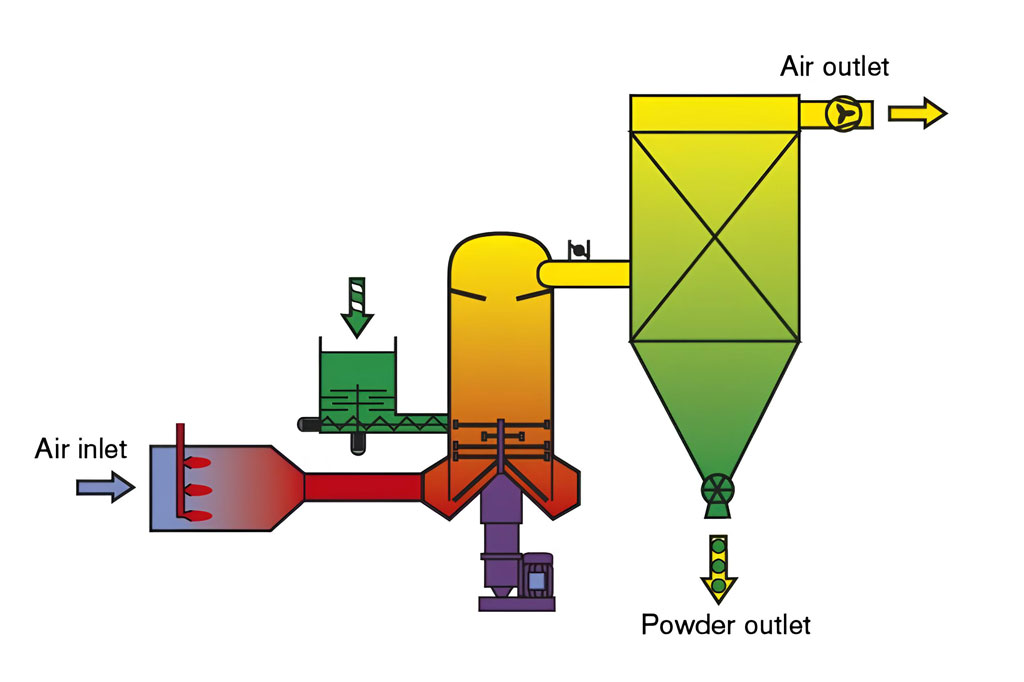
A spin flash dryer works by mechanically dispersing wet feed into a high-velocity hot-air stream, where heat and mass transfer remove moisture before classification and pneumatic discharge. Feed form, inlet moisture, temperature sensitivity and target particle properties determine the operating arrangement.
The core advantage of spin flash dryers lies in their unique combination of high-speed mechanical dispersion and efficient thermal drying.
To fully understand its effectiveness, it is essential to examine its working principle in detail, focusing on how heat transfer, mass transfer, airflow dynamics, and particle behavior interact within the system.
1. Core Process of Spin Flash Drying
The working principle of a spin flash dryer is based on the simultaneous execution of three key processes:
- Mechanical dispersion (breaking agglomerates)
- Convective heat transfer (evaporation of moisture)
- Pneumatic conveying (transport of particles)
Wet material enters the drying chamber and is immediately subjected to high-speed rotating airflow generated by a rotor at the base. This airflow creates intense turbulence, which disperses the material into fine particles. At the same time, hot air introduced into the chamber provides the thermal energy required for rapid moisture evaporation.
2. Material Feeding and Initial Contact
The drying process begins when wet feed material is introduced into the drying chamber through a screw feeder or similar feeding mechanism. The material is typically in the form of paste, filter cake, or slurry with relatively high moisture content.
Once inside the chamber:
- The material encounters a high-velocity hot air stream
- The temperature difference between the hot air and wet material initiates instant surface evaporation
- The feed is directed toward the rotor zone, where the main drying action begins
This initial stage ensures that the material is quickly exposed to both thermal and mechanical forces, preventing lump formation and uneven drying.
3. High-Speed Rotor and Mechanical Dispersion
At the bottom of the drying chamber, a high-speed rotating impeller (rotor) plays a critical role in the working principle.
Its functions include:
- Breaking down wet lumps and agglomerates
- Dispersing material into fine particles
- Creating a strong swirling airflow pattern
The rotor generates centrifugal force and intense shear, which continuously reduces particle size. This mechanical action significantly increases the specific surface area of the material, making moisture evaporation more efficient.
The combination of mechanical energy and airflow turbulence ensures that:
- Large wet particles cannot remain intact
- Drying occurs uniformly across all particles
- Heat transfer efficiency is maximized
4. Formation of Turbulent Hot Airflow
Hot air enters the drying chamber tangentially or axially, depending on the design, creating a spiral (vortex) airflow pattern.
This airflow has several important characteristics:
- High velocity: Enhances heat and mass transfer
- Strong turbulence: Keeps particles suspended
- Uniform temperature distribution: Prevents localized overheating
The turbulent airflow ensures that particles remain in constant motion, avoiding settling or sticking to the chamber walls. This dynamic environment is essential for rapid drying.
5. Heat Transfer Mechanism
The primary drying mechanism in a spin flash dryer is convective heat transfer between hot air and wet particles.
The process occurs as follows:
- Hot air transfers thermal energy to the particle surface
- Moisture at the surface evaporates into vapor
- Internal moisture migrates to the surface due to diffusion
- The cycle continues until the particle reaches the desired dryness
Because the particles are finely dispersed and constantly moving, the heat transfer coefficient is very high. This results in:
- Short drying time (seconds)
- Efficient energy utilization
- Minimal thermal degradation of materials
6. Mass Transfer and Moisture Removal
Alongside heat transfer, mass transfer governs the removal of moisture from the material.
Key steps include:
- Evaporation: Moisture converts into vapor at the particle surface
- Diffusion: Internal moisture moves outward due to concentration gradients
- Convective removal: Airflow carries vapor away from the particle surface
The continuous renewal of the air boundary layer around each particle ensures that evaporation is not hindered. This is critical for maintaining a high drying rate throughout the process.
7. Particle Classification and Residence Time Control
One of the distinguishing aspects of the spin flash dryer’s working principle is its built-in particle classification system.
Inside the drying chamber:
- Finer, lighter particles are lifted and transported upward by the airflow
- Larger or wetter particles are forced back toward the rotor by gravity and centrifugal force
This creates a self-regulating mechanism:
- Only sufficiently dried particles can exit the chamber
- Wet or oversized particles remain in the drying zone for further processing
As a result, the system automatically controls residence time based on particle size and moisture content, ensuring consistent product quality.
8. Dry Product Discharge
Once particles reach the desired dryness and size:
- They are transported upward with the exhaust air
- A separation system (such as a cyclone separator or bag filter) captures the dried product
- Moist air is discharged or treated further
The separation step ensures that:
- Fine powder is efficiently recovered
- Exhaust air meets environmental requirements
- Product loss is minimized
9. Integrated Process Dynamics
The effectiveness of the spin flash dryer lies in the integration of multiple simultaneous processes:
- Fluid dynamics: Governing airflow patterns and particle suspension
- Thermodynamics: Driving heat transfer and evaporation
- Mechanical forces: Enabling particle size reduction
- Mass transfer: Controlling moisture removal
These processes are tightly coupled and occur within a compact drying chamber, allowing for rapid and continuous operation.
10. Continuous and Instantaneous Drying Behavior
Unlike traditional drying systems, the spin flash dryer operates as a continuous process with extremely short residence times.
Key characteristics include:
- Instant drying upon contact with hot air
- Continuous feeding and discharge
- Stable operation under controlled airflow and temperature conditions
Because drying occurs in seconds, the system is particularly suitable for heat-sensitive materials, as prolonged exposure to high temperatures is avoided.
PROCESS REVIEW
Translate the Working Principle into Project Inputs
The same process sequence can produce different results with different feeds. Feeding, mechanical dispersion, air contact, classification and powder collection should be reviewed as one system against the actual wet material and target product.
Feed and dispersion stage
- Wet feed form, consistency, stickiness, agglomeration and initial moisture
- Controlled feeding behavior and the mechanical work needed to disperse the material
- Abrasiveness, corrosion, foreign matter and product-contact requirements
Drying and classification stage
- Moisture-removal duty, temperature sensitivity and required capacity
- Desired final moisture, particle behavior and acceptable residence history
- Airflow, heat source, classification and recirculation considerations
Collection and plant integration
- Powder recovery, fines load, dust collection and exhaust treatment
- Discharge, cooling, conveying, packaging or downstream processing
- Utilities, controls, cleaning, access and installation constraints
Working-principle boundary: This page explains general process behavior and does not establish a guaranteed capacity, moisture result, particle size or operating window. Final configuration depends on representative material data, calculations, project utilities and safety requirements; testing may be required.
Related Spin Flash Dryer Resources
- Spin Flash Dryer
- Key Components of a Spin Flash Dryer
- Suitable Materials for Spin Flash Drying
- Spin Flash Dryer Operating Procedures
Discuss a Spin Flash Drying Process
Send the wet feed description, moisture data, material behavior, capacity, powder target, temperature limits and site or safety constraints.
Spin Flash Dryer Working Principle FAQs
Why is mechanical dispersion important?
It helps expose wet material to the drying air, but the required dispersion depends on feed consistency, stickiness, agglomeration and product sensitivity.
How is residence behavior influenced?
Material properties, airflow, chamber geometry, dispersion and classification interact, so residence behavior must be evaluated for the complete system.
Why is powder collection part of dryer selection?
Particle size, fines load, required yield, emissions and downstream handling influence the cyclone, filter, exhaust and discharge arrangement.
What information should be included in an inquiry?
Provide the wet feed form, initial and target moisture, capacity, temperature limit, desired powder, dust or volatile information, utilities and installation location.