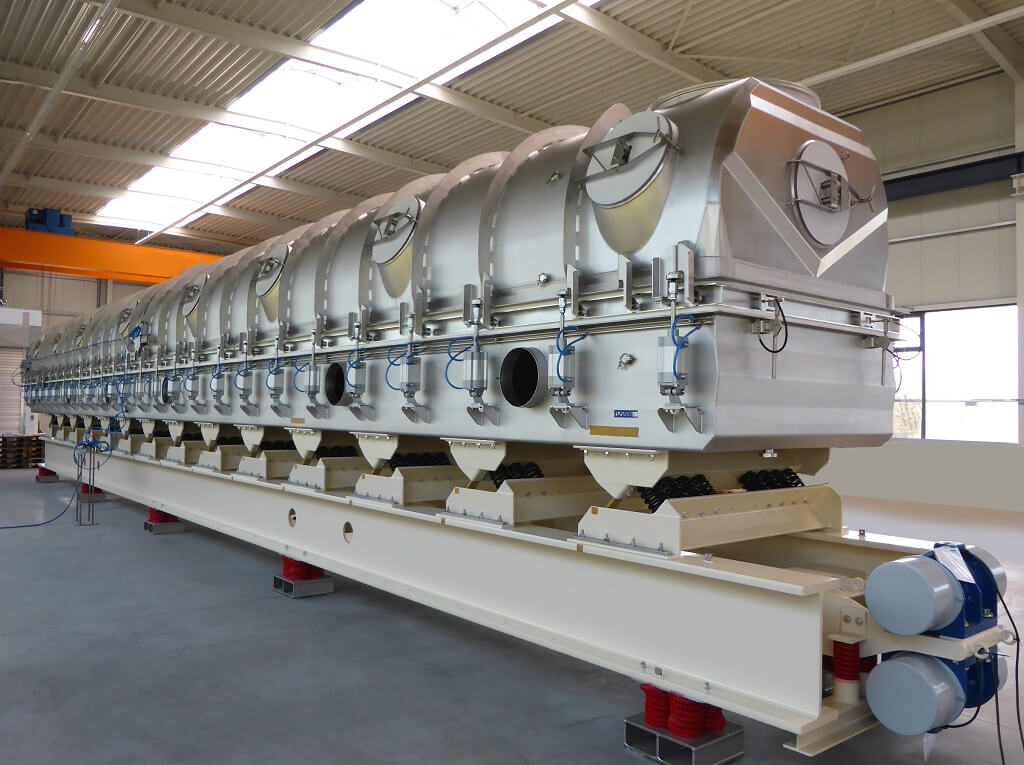
Drying is one of the most important preservation methods in the food industry. By removing moisture from food materials, manufacturers can extend shelf life, reduce storage costs, and maintain product stability.
However, many food products—such as fruit extracts, dairy ingredients, probiotics, enzymes, and flavor compounds—are highly sensitive to heat. Excessive temperatures during drying can cause degradation of vitamins, enzymes, flavors, and bioactive compounds.
To overcome this challenge, modern food processing plants use specialized industrial drying solutions designed specifically for heat-sensitive food products. These methods reduce thermal damage while ensuring effective moisture removal.
Among the most widely used systems are spray drying, freeze drying, and vacuum drying.
Why Heat-Sensitive Food Products Require Special Drying Methods
Heat-sensitive foods contain components that degrade or change structure when exposed to high temperatures. Examples include:
- Vitamins such as vitamin C and B-complex
- Enzymes and probiotics
- Essential oils and flavor compounds
- Proteins and peptides
- Bioactive plant extracts
Traditional hot-air drying methods may operate at temperatures above 80–120 °C, which can lead to oxidation, denaturation, loss of flavor, and reduced nutritional value. Therefore, advanced drying technologies are used to reduce the thermal exposure time, drying temperature, or oxygen presence during the drying process.
Modern industrial drying technologies focus on three key principles:
- Low-temperature processing
- Short residence time
- Controlled atmosphere (vacuum or inert conditions)
These principles help maintain the product’s original quality while still achieving effective moisture removal.
1. Spray Drying
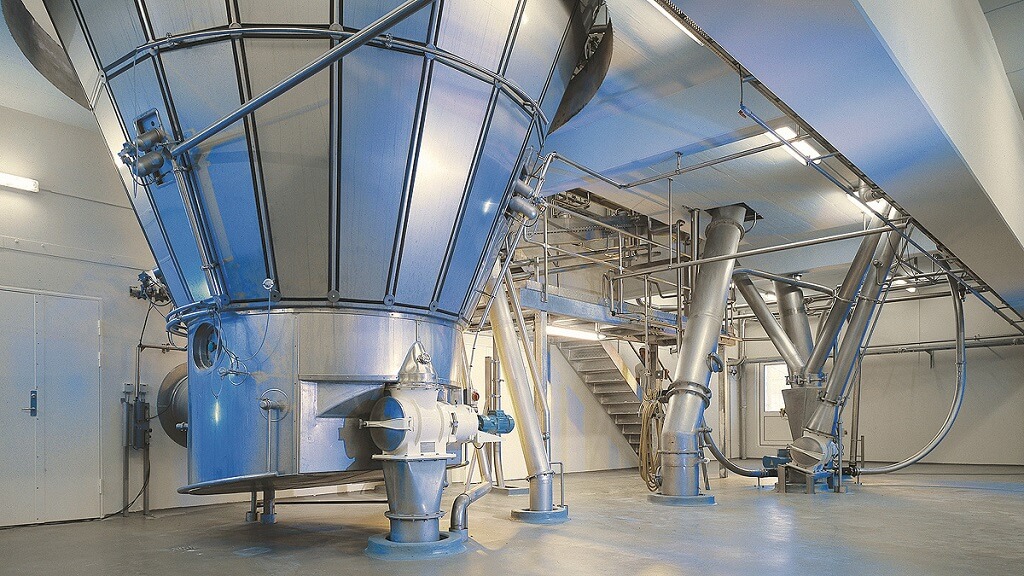
Spray drying is one of the most widely used drying technologies in the food industry. In this technique, liquids like milk, fruit juice, or plant extracts are atomized into tiny droplets and sprayed into a heated drying chamber. Because the droplets have a very large surface area, moisture evaporates rapidly as they contact hot air.
The entire drying process typically occurs within a few seconds, which limits the time the product is exposed to heat.
Main components of a spray dryer include:
- Feed pump
- Atomizer or spray nozzle
- Hot air generator
- Drying chamber
- Cyclone separator or bag filter
- Powder collection system
The final product usually takes the form of a fine powder, exhibiting excellent flowability and solubility.
Advantages
Spray drying offers several advantages when processing moderately heat-sensitive food products:
- Extremely fast drying time reduces thermal degradation.
- High production efficiency suitable for continuous industrial operation.
- Uniform powder particles with good solubility and dispersibility.
- Good nutrient retention because exposure to heat is brief.
- Cost-effective for large-scale manufacturing.
Limitations
Despite its efficiency, spray drying is not suitable for extremely heat-sensitive materials. Potential drawbacks include:
- High inlet air temperatures may degrade sensitive compounds.
- Some flavor loss can occur during evaporation.
- Higher residual moisture compared to freeze-dried products.
Typical Applications
Spray drying is widely used in food manufacturing, including:
- Milk powder and whey protein
- Instant coffee and tea extracts
- Fruit juice powders
- Flavor encapsulation
- Nutritional supplements
Because of its scalability and relatively low operating cost, spray drying is considered one of the most economical solutions for large-volume food powder production.
2. Freeze Drying (Lyophilization)
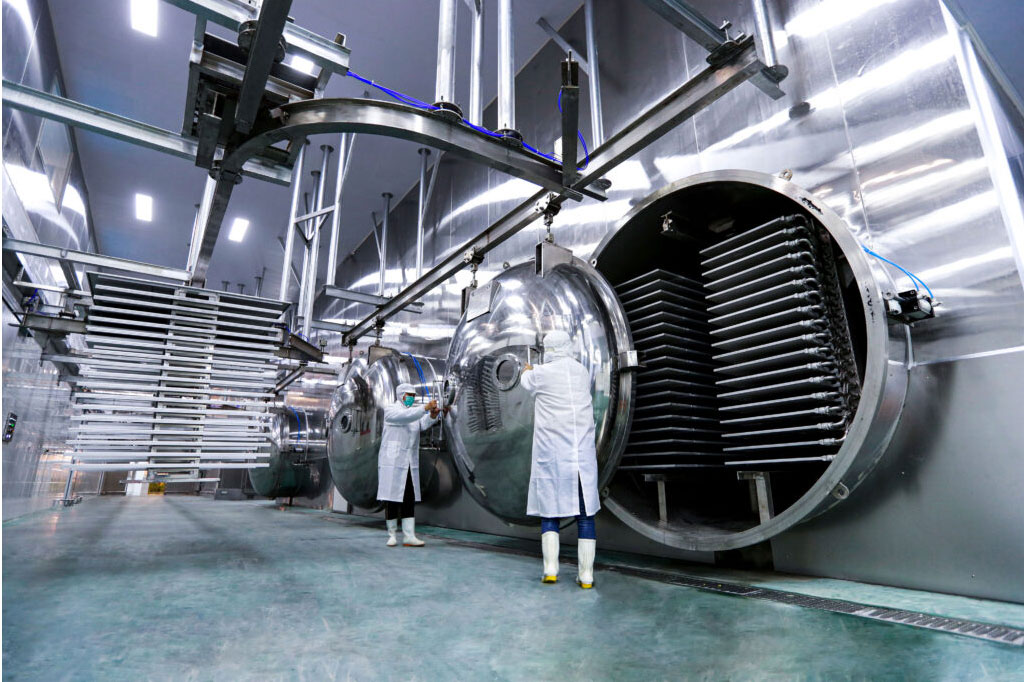
Freeze drying, also known as lyophilization, is one of the most effective drying technologies for highly heat-sensitive foods. The process involves three main steps:
- Freezing the product at very low temperatures
- Creating a vacuum environment
- Removing moisture through sublimation (ice converting directly into vapor)
Since the drying occurs under vacuum and at low temperatures, heat damage is minimal.
Freeze drying preserves the structure of the food while removing moisture, resulting in a porous product that can easily rehydrate.
Advantages
Freeze drying offers several important benefits:
- Minimal thermal damage to sensitive materials.
- Preservation of flavor, aroma, and nutritional content.
- Excellent rehydration capability due to porous structure.
- Very low moisture content, extending shelf life significantly.
- Maintains original color and texture of food products.
Limitations
The primary disadvantages of freeze drying include:
- High equipment and energy costs
- Long drying cycles (often several hours)
- Complex operational requirements
Despite these limitations, freeze drying remains the preferred technology for high-value products.
Typical Applications
Common freeze-dried food products include:
- Freeze-dried fruits and vegetables
- Instant coffee
- Probiotic powders
- Nutraceutical ingredients
- Specialty health foods
Because of its superior quality preservation, freeze drying is widely used for premium food products.
3. Vacuum Drying
Vacuum drying works by reducing the surrounding pressure, which lowers water’s boiling point, allowing moisture to evaporate at significantly lower temperatures than under standard atmospheric conditions.
Typical vacuum drying temperatures range between 30 °C and 80 °C, making the process suitable for moderately heat-sensitive foods.
The basic components of a vacuum drying system include:
- Vacuum chamber
- Heating system
- Vacuum pump
- Condenser or solvent recovery system
Advantages
Vacuum drying provides several important benefits:
- Lower drying temperatures, reducing heat damage.
- Reduced oxidation due to limited oxygen exposure.
- Faster drying than freeze drying in many cases.
- Energy recovery possibilities, improving efficiency.
Limitations
However, vacuum drying also has some drawbacks:
- Product shrinkage or density changes can occur.
- Equipment maintenance can be complex.
- Not suitable for extremely heat-sensitive materials.
Typical Applications
Vacuum drying is commonly used for:
- Fruit and vegetable powders
- Herbal extracts
- Nutraceutical ingredients
- Heat-sensitive food additives
It is often considered a compromise between spray drying efficiency and freeze drying quality.
Choosing the Right Drying Solution
Selecting the appropriate drying technology depends on several factors:
Product Sensitivity
Highly heat-sensitive materials such as probiotics and enzymes typically require freeze drying.
Production Scale
Large-scale manufacturing often favors spray drying due to its high throughput and lower cost.
Product Form
Powder products with good solubility are best produced using spray drying.
Cost Considerations
Freeze drying provides the best quality but has higher capital and operating costs.
Shelf Life Requirements
Products requiring extremely long shelf life may benefit from freeze drying due to its very low residual moisture.
Conclusion
Industrial drying is a critical process in modern food manufacturing, especially for products containing delicate nutrients, flavors, and bioactive compounds. Heat-sensitive foods require specialized drying technologies that minimize thermal degradation while maintaining efficiency.
Among the available solutions:
- Spray drying offers high productivity and cost-effective large-scale powder production.
- Freeze drying provides superior quality preservation for highly sensitive products.
- Vacuum drying balances lower temperatures with moderate processing costs.
PROCESS REVIEW
Define What Must Be Protected During Drying
“Heat-sensitive” should be translated into measurable product attributes and an acceptable exposure history. The suitable route depends on the feed form, target product, production scale and the quality changes that must be controlled.
Feed and sensitivity data
- Liquid, slurry, paste, particulate or frozen feed form
- Initial moisture, solids, viscosity, particle or piece size and freezing behavior
- Sensitivity of flavor, color, aroma, activity, oxidation or other specified quality attributes
Finished-product requirements
- Powder, granule, piece or porous structure; final moisture and water-activity target
- Reconstitution, bulk density, particle behavior and acceptable product yield
- Cooling, packaging, storage and shelf-life validation requirements
Hygiene, cleaning and production conditions
- Product-contact materials, sanitation, allergen or cross-contamination controls
- Cleaning method, inspection access and product-change schedule
- Required capacity, utilities, installation environment and local food-safety requirements
Product and compliance boundary: This comparison does not guarantee nutrient, flavor, color, microbial or shelf-life results, and it does not establish regulatory compliance for a particular food product or market. The process and equipment must be validated against the actual formulation, quality plan, hygiene program and applicable requirements; representative testing may be necessary.
Related Drying Equipment for Process Review
Review a Heat-Sensitive Food Drying Project
Send the food or ingredient description, feed form, moisture data, sensitive quality attributes, target product, capacity, cleaning needs and installation location.
Heat-Sensitive Food Drying FAQs
Does a lower operating temperature always protect product quality?
No. Product quality depends on both temperature and exposure time, as well as oxygen, moisture history, formulation and the required final condition.
When may spray drying be considered?
It may be evaluated for pumpable feeds that need powder production, subject to atomization behavior, product sensitivity, powder targets and recovery requirements.
When may freeze drying or vacuum drying be considered?
These routes may be evaluated when product structure or lower-pressure moisture removal is important, subject to feed form, capacity, cycle time, utilities and quality targets.
What information should be included in an inquiry?
Provide the product and feed form, moisture data, sensitive attributes, final product target, capacity, sanitation and cleaning requirements, utilities and destination market.