Industrial drying is a critical step in the production of many food, pharmaceutical, and chemical products.
Large-scale dryers are often energy-intensive and can represent a significant share of a facility’s energy use. With energy costs climbing and environmental regulations tightening, improving efficiency has become both an economic necessity and an ecological responsibility.
Reducing energy consumption in dryers can substantially lower operating costs, decrease carbon emissions, and improve overall process sustainability.
Moreover, energy-efficient drying practices support broader corporate sustainability goals, helping companies achieve greener production standards and comply with emissions targets.
1. Understanding Energy Consumption in Drying Processes
To reduce energy usage, it’s essential to understand how dryers consume energy. Most industrial dryers convert electrical or thermal energy into heat and airflow to remove moisture from a product. Energy losses typically occur through:
- Excessive exhaust heat escaping the system.
- Inefficient air circulation, leads to uneven drying.
- Overheating, where temperature exceeds the optimal level for moisture removal.
Key factors influencing energy consumption include:
- Moisture content of the feed material – Higher moisture requires more energy to evaporate.
- Dryer type and design – Some dryers inherently consume more energy per kilogram of water removed.
- Airflow efficiency – Inefficient airflow design can lead to uneven drying and longer processing cycles.
- Heat recovery systems – Lack of heat recycling leads to unnecessary energy expenditure.
- Operational practices – Overloading or underloading the dryer reduces efficiency.
By analyzing these factors, operators can identify opportunities to cut energy consumption without compromising product quality.
2. Types of Large-Scale Dryers and Their Energy Profiles
Different dryer types have varying energy demands. Understanding their energy profiles is key to selecting and optimizing equipment:
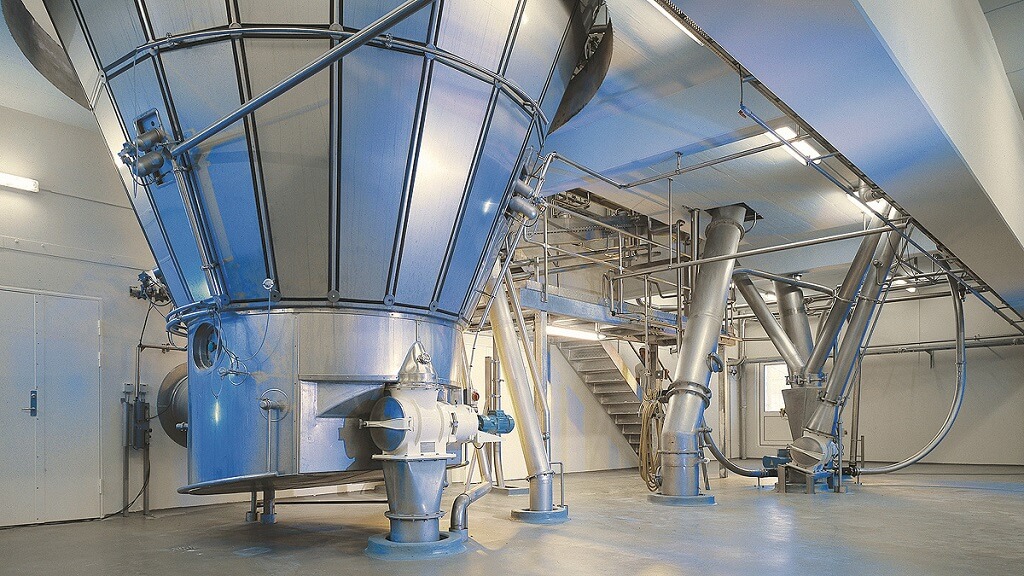
- Spin Flash Dryers: Designed for fine powders and high-moisture materials, spin flash dryers typically operate at 0.8–1.2 kWh per kg of water evaporated. They achieve rapid drying through a combination of centrifugal force and hot air. Their high throughput makes them energy-efficient for certain feed types, but energy losses occur if airflow is not carefully managed.
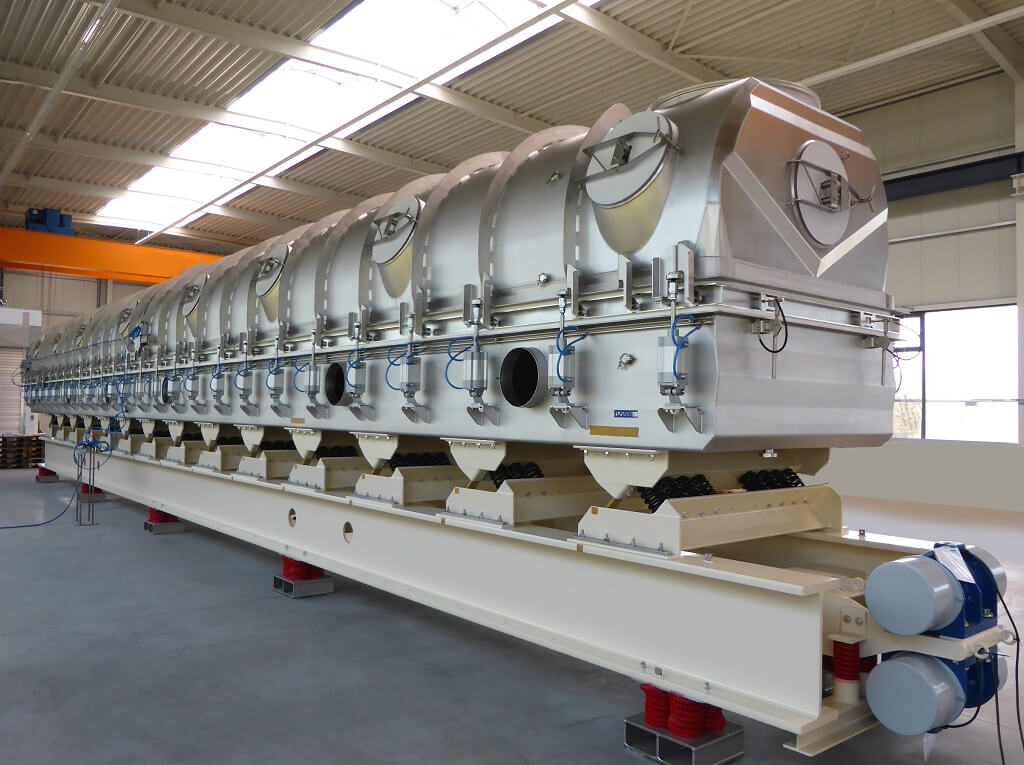
- Fluidized Bed Dryers: These dryers suspend particles in an upward stream of hot air, creating excellent heat and mass transfer. Energy consumption ranges from 1.0–1.5 kWh/kg water, depending on bed depth and air velocity. Fluidized bed dryers are efficient for granular products, but energy use increases with higher moisture content or irregular particle size distribution.
- Spray Dryers: Common in dairy and chemical industries, spray dryers atomize liquid feed into hot air, rapidly producing fine powder. Their energy intensity is higher, ranging from 2–3 kWh/kg water removed, due to the high surface area of evaporation. However, innovations like multi-stage drying and heat recovery can significantly lower energy use.
Quantitative comparison illustrates that the dryer type and feed properties have a substantial impact on overall energy consumption, highlighting the need for tailored energy-saving strategies.
3. Optimizing Dryer Design for Energy Efficiency
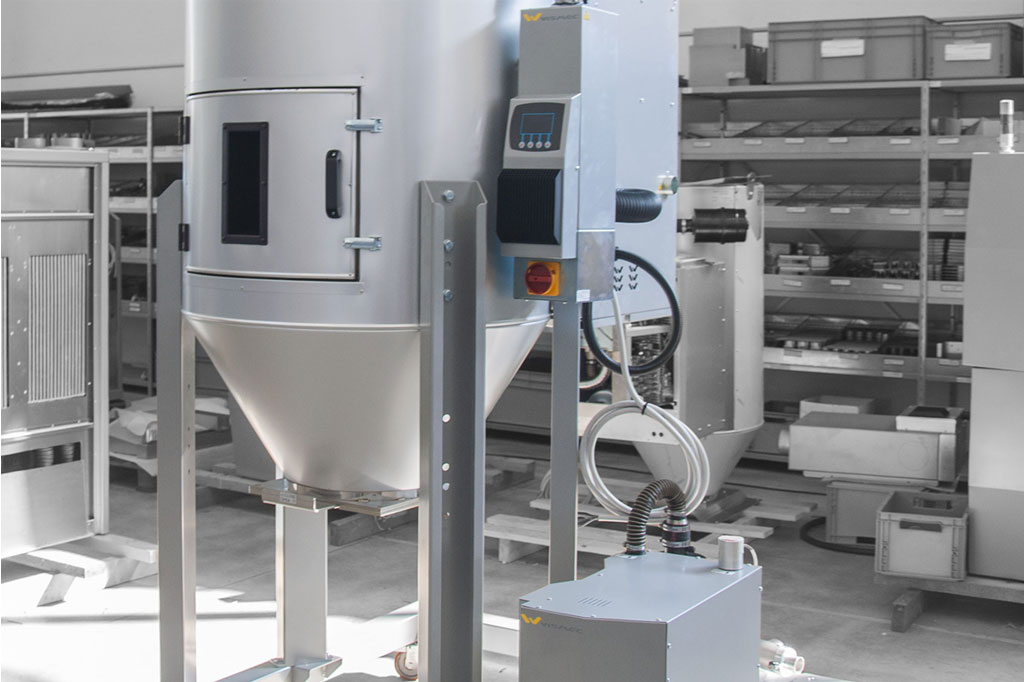
Innovations in dryer design play a major role in reducing energy use. Key design considerations include:
- Improved insulation: Minimizing heat loss from walls and doors ensures more thermal energy is used for drying rather than lost to the environment.
- Optimized airflow paths: Computational fluid dynamics (CFD) can model airflow to ensure even distribution, reducing hotspots and over-drying.
- Advanced material handling: Uniform feed distribution reduces recirculation time and energy waste.
- Compact, modular designs: Reducing chamber volume without sacrificing throughput decreases the energy required to heat air and maintain temperatures.
Modern dryers often integrate these design features to achieve up to 15–20% energy savings compared to conventional models.
4. Heat Recovery and Waste Heat Utilization
A significant portion of energy in large-scale dryers escapes as exhaust heat. Capturing and reusing this energy is a proven strategy to reduce consumption:
- Exhaust gas heat exchangers: Recover thermal energy to preheat incoming air.
- Condensate recovery: In spray drying, vaporized water can be condensed and used as process water or to preheat feed material.
- Combined heat and power (CHP) integration: Facilities with CHP systems can utilize electricity and recovered heat for drying operations.
Heat recovery systems can reduce energy usage by 10–25%, depending on process design and waste heat potential, while also lowering cooling requirements and emissions.
5. Airflow and Temperature Control Strategies
Efficient energy use also depends on precision control of air velocity, temperature, and humidity:
- Variable speed blowers: Adjusting airflow based on moisture load reduces unnecessary air heating.
- Zoned temperature control: Optimizing temperatures across different dryer zones ensures effective moisture removal while preventing over-drying.
- Humidity sensors and feedback loops: Real-time moisture monitoring allows automatic adjustment of heat and airflow, improving drying efficiency and product quality.
Advanced control systems can cut energy use by up to 15% and prolong equipment life by minimizing overheating and thermal stress.
6. Reducing Energy Through Pre-Treatment and Feed Optimization
Reducing the load on a dryer before processing is one of the simplest ways to save energy:
- Moisture pre-reduction: Techniques such as centrifugation, filtration, or partial thermal drying reduce the water content before entering the main dryer.
- Particle size adjustment: Smaller, uniform particles dry more efficiently due to greater surface area and consistent heat transfer.
- Slurry concentration: Higher solids content in liquid feeds reduces the volume of water needing evaporation.
- Pre-heating feed materials: Utilizing low-grade waste heat or solar thermal energy to warm feed reduces the energy required in the drying chamber.
These pre-treatment strategies can cut dryer energy usage by 10–30%, depending on material and process specifics.
7. Conclusion
Energy efficiency in large-scale drying is a multi-faceted challenge that combines equipment design, process optimization, and operational strategies.
By understanding energy consumption patterns, selecting appropriate dryer types, implementing heat recovery, controlling airflow and temperature precisely, and optimizing feed preparation, facilities can achieve substantial energy savings.
Beyond cost reductions, these measures reduce environmental impact, improve sustainability metrics, and enhance overall process reliability.
ENERGY REVIEW
Establish Energy Use per Unit of Acceptable Product
A large dryer should be evaluated against useful production output, not only fuel or electrical consumption. Record a stable material, moisture duty, product target and operating period before comparing improvements.
Production and moisture balance
- Wet feed rate, initial moisture and representative feed variation
- Acceptable dry product output, final moisture, yield and operating hours
- Start-up, shutdown, cleaning and off-specification production
Thermal, airflow and utility data
- Heat-source consumption, major electrical loads and available utility measurements
- Inlet, exhaust and product temperatures under stable production
- Air leakage, exhaust humidity, insulation and pressure observations
Prioritize changes by verified loss
Separate avoidable losses from the energy required to remove moisture and meet the product specification. Evaluate feed dewatering, insulation, leakage, airflow, controls and heat recovery against product quality, fouling, corrosion, emissions, cleaning and safety.
Performance boundary: This article does not promise a fixed energy reduction or payback period. Achievable performance depends on the material, dryer type, heat source, operating schedule, ambient conditions and required product. Changes require project-specific engineering and approved operating procedures.
Related Industrial Dryer Resources
- Industrial Drying Equipment Products
- Spray Dryer Energy Evaluation
- Rotary Kiln vs. Rotary Dryer
- Drying Equipment Engineering Services
Review Large-Scale Dryer Energy Data
Send the material and moisture balance, acceptable output, operating schedule, heat source, temperatures, utility data and the loss or constraint being evaluated.
Large-Scale Dryer Energy FAQs
What is a useful energy-performance metric?
Use measured energy per unit of acceptable dry product, with a consistent material, moisture duty and product specification.
Why should off-specification product be included?
Energy used to make rejected or reprocessed material does not create acceptable output and can hide the true production cost.
Can exhaust heat always be recovered?
No. Temperature, humidity, contaminants, fouling, corrosion, cleaning, safety and the availability of a useful heat sink determine feasibility.
What information should be included in an energy inquiry?
Provide feed and product moisture, capacity, operating hours, heat source, temperatures, utility consumption, product yield, exhaust conditions and site constraints.