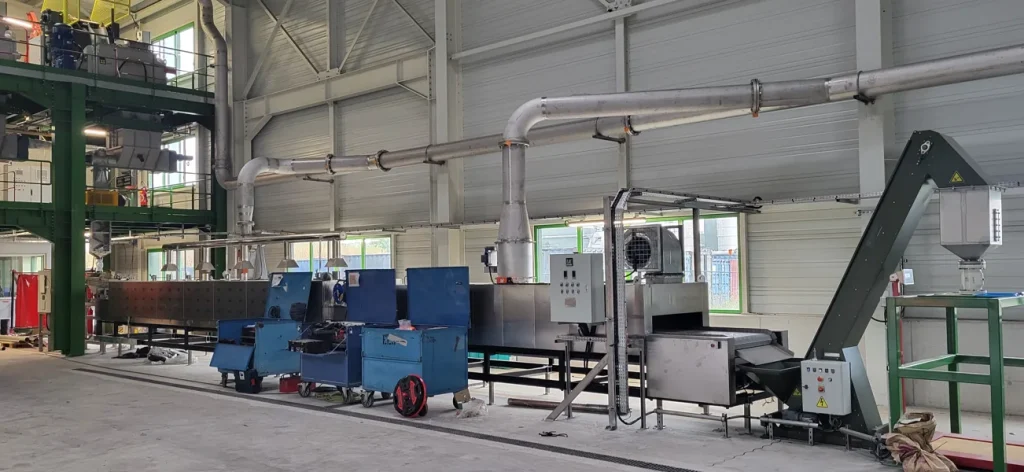
Application: Continuous drying and forced-air cooling of industrial polymer briquettes or pellets in a French production plant.
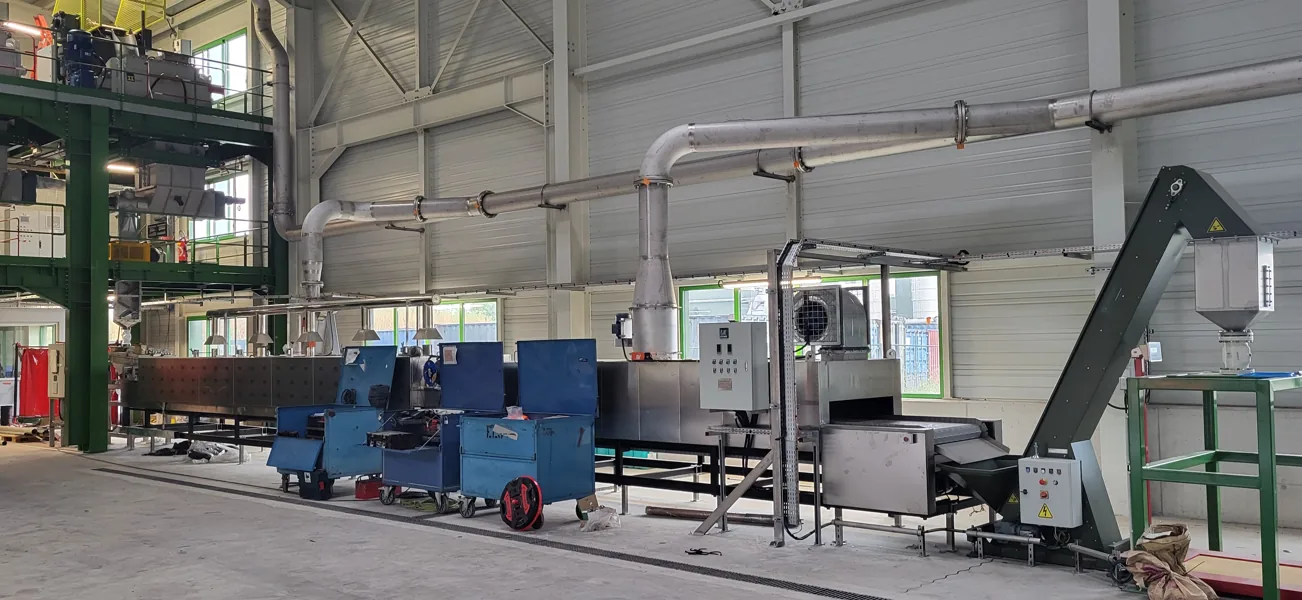
Griffin supplied an integrated material-handling, belt drying, and belt cooling system designed around the customer’s factory layout and downstream handling requirements. The installed line combines controlled feeding, product distribution, continuous heat treatment, moisture exhaust, cooling, and discharge conveying in one connected process.
Why polymer briquettes need controlled drying and cooling
Thick pellets and briquettes can retain heat and moisture inside the product even when the outer surface appears dry or cool. If residence time, bed depth, airflow, and discharge temperature are not coordinated, the process may create uneven final moisture, thermal rebound after cooling, or difficult downstream handling.
For this project, the customer required a continuous line capable of receiving formed material, spreading it across the conveyor width, controlling the time inside the dryer, and reducing the product temperature before the next production step. Equipment also had to fit an existing building layout and interface with the customer’s upstream and downstream machinery.
Installed process configuration
The final arrangement uses an inclined vibrating screening and distribution section ahead of the tunnel dryer. The rectangular discharge helps spread material over the working width instead of concentrating it at the center of the belt.
- Screening and distribution: An inclined vibrating sieve removes unsuitable particles and distributes the product across the belt.
- Continuous conveying: A 3 mm stainless-steel mesh belt carries the product through the heating section. Raised side protection helps prevent pellets from entering the drive chains.
- Controlled drying: Electric heating, recirculation, exhaust, temperature sensing, and variable belt speed allow residence time and temperature to be adjusted during commissioning.
- Forced-air cooling: The material transfers into an enclosed cooling conveyor where dedicated airflow reduces the discharge temperature.
- Plant discharge: An inclined conveyor lifts the cooled product to the customer’s downstream collection or processing point.
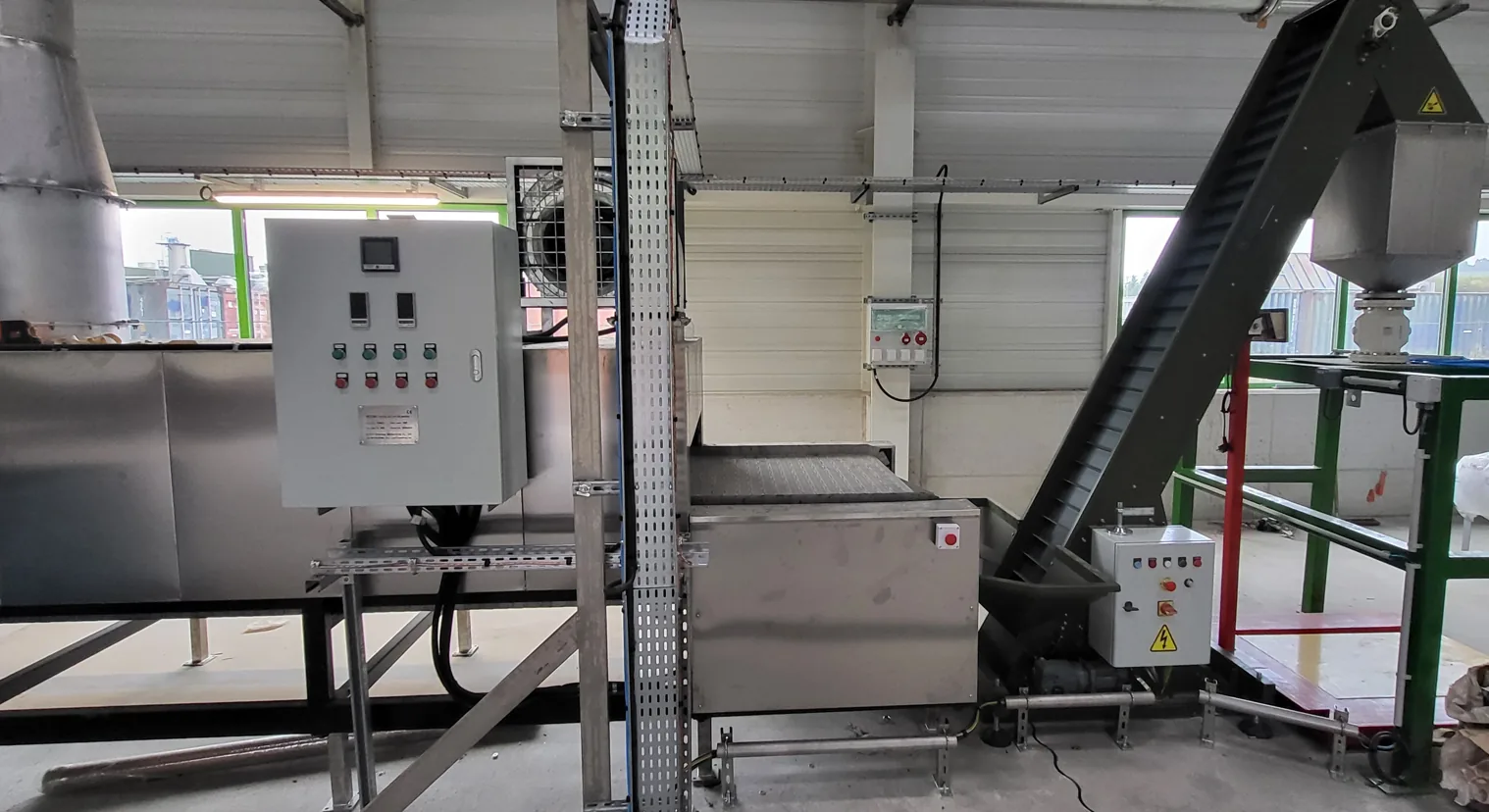
Engineering the line around the existing factory
The customer supplied plant-layout information so the screening, drying, cooling, electrical cabinets, exhaust ducts, and discharge conveyor could be positioned within the available space. The controls were arranged for practical access rather than fixed directly to the dryer where this would interfere with operation or maintenance.
Mechanical and electrical interfaces were coordinated through layout drawings, cabinet dimensions, process schematics, instrumentation information, and confirmed motor loads. The PLC interface was specified for English and French operation. These details are important for an export project because the dryer must work as part of the plant—not as an isolated machine.
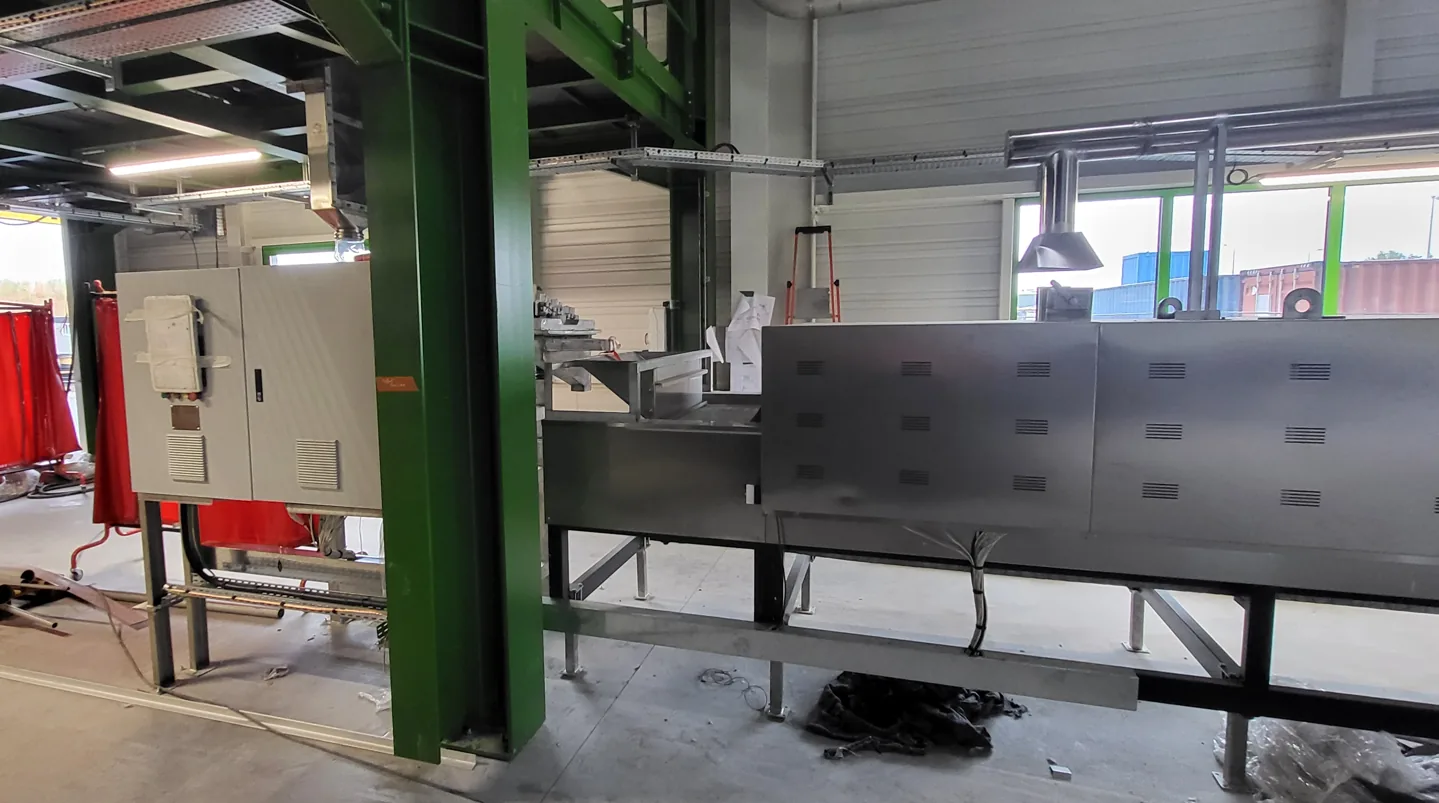
Key design features
| Design item | Project solution | Process purpose |
|---|---|---|
| Feed distribution | Inclined vibrating sieve with rectangular outlet | Spread material across the conveyor width |
| Conveyor surface | 3 mm SUS304 mesh plate | Support the product while permitting process airflow |
| Product containment | Raised belt-side protection | Reduce the risk of pellets entering conveyor chains |
| Residence time | Variable-frequency belt drives | Match drying and cooling time to the product condition |
| Controls | Siemens electrical components and bilingual HMI | Provide adjustable, maintainable process control |
| Cooling | Enclosed belt cooler with forced airflow | Limit product temperature before downstream handling |
Verification before and after shipment
Before delivery, Griffin assembled the dryer and cooler as a continuous line and carried out operating, temperature, and conveyor-speed tests. During the July 2025 factory acceptance test, the assembled line measured approximately 16 m long with a measured usable belt width of 1.06 m.
The FAT recorded belt speeds of 3.13 mm/s at 36 Hz and 4.06 mm/s at 50 Hz, corresponding to approximate line residence times of 1.42 hours and 1.09 hours under the measured setup. A heating-response test recorded the tunnel rising from 57 °C to 102 °C in about seven minutes. These are project test observations rather than guaranteed production values; actual performance depends on feed rate, initial moisture, briquette dimensions, bed depth, and final product requirements.
The customer also performed separate forced-air tests with briquettes heated to 100 °C. The results helped evaluate cooling time, product-layer thickness, airflow distribution, and thermal rebound. This testing informed the cooling arrangement before the equipment was integrated at the French site.
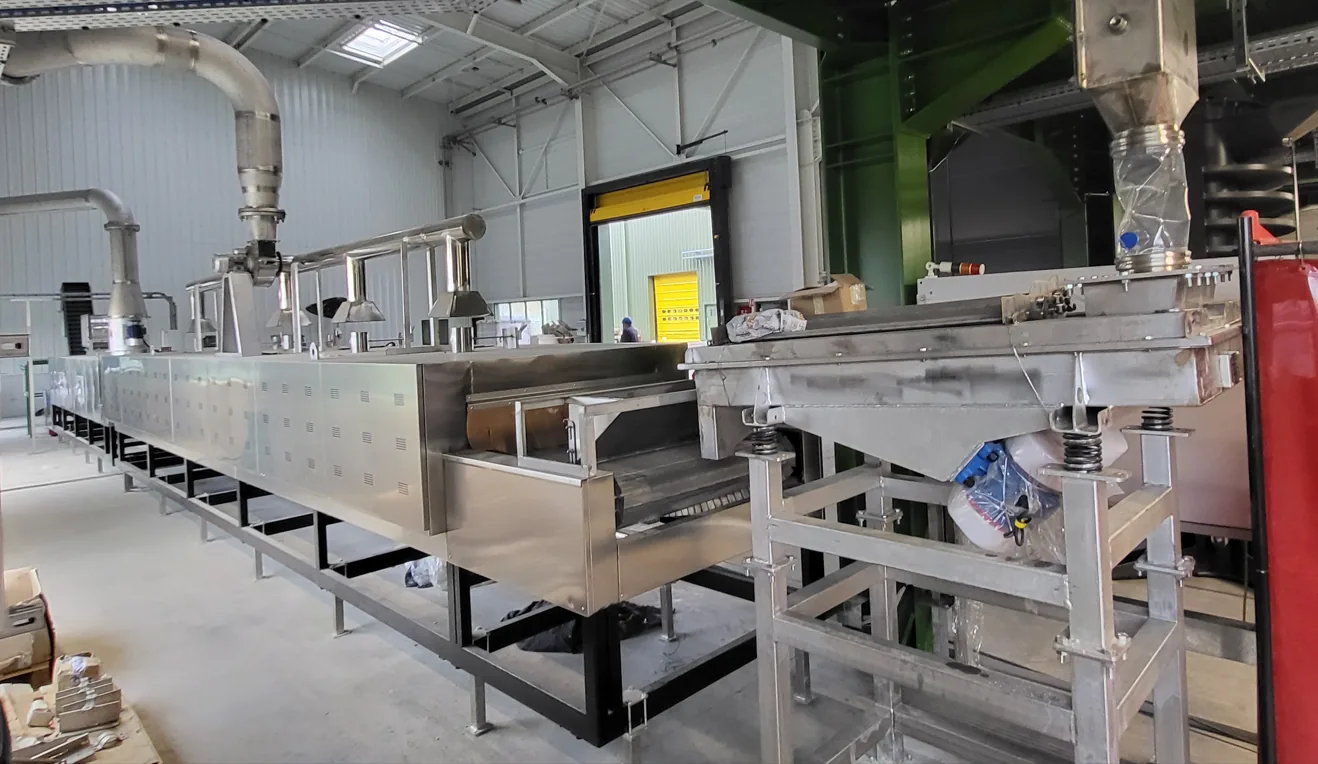
What manufacturers can learn from this application
A continuous dryer application should be defined by the full material path. Product properties determine the feeder and belt design; drying targets determine residence time and heat input; cooling targets determine airflow and cooling length; and the factory layout determines transfer heights, duct routes, cabinet positions, and maintenance access.
For polymer pellets or briquettes, representative material trials are especially valuable. They help identify whether the limiting factor is surface moisture, internal heat, bed depth, airflow distribution, or the mechanical handling of the product.
Frequently asked questions
Can a belt drying and cooling line be fitted into an existing plant?
Yes. The supplier needs an accurate factory layout, feed and discharge elevations, structural restrictions, utility locations, maintenance clearances, and upstream and downstream interface information.
Why use a vibrating distributor before the dryer?
A vibrating distributor can screen the feed and create a more uniform product bed. More consistent bed depth supports more predictable heat and mass transfer across the conveyor width.
How is drying residence time adjusted?
The conveyor speed is adjusted with a variable-frequency drive. The final setting should be established using representative product, target moisture, feed rate, bed depth, and temperature limits.
What should be tested before ordering?
Provide representative material, initial and target moisture, bulk density, particle or briquette dimensions, allowable temperature, required throughput, target discharge temperature, and relevant safety data. Bench or pilot testing may be recommended when the drying behavior is uncertain.
Plan a polymer drying and cooling line
Griffin engineers customized mesh belt dryers, continuous drying systems, and integrated belt coolers. Review the factory acceptance case study for additional test data, or send your material and layout information for an application review.
Polymer Briquette Drying and Cooling: Project Review
This France project page shows an integrated line for polymer briquettes, including vibrating distribution, belt drying and forced-air cooling. The layout is a project example, not a universal specification for every polymer or briquette process.
Define briquette integrity and moisture targets
Share briquette dimensions, green strength, bulk density, initial and target moisture, allowable temperature, fines generation, residence-time limits and the required cooled discharge condition. These factors guide loading, conveying, drying zones and cooling duty.
Coordinate distribution, drying and cooling
Review the feed distributor, belt loading, product depth, air temperature, exhaust routing, cooling airflow, transfer points and downstream packaging or storage. Record interfaces for controls, utilities, dust collection, guarding and cleaning in the approved scope.
Use FAT evidence and a controlled handover
Agree sampling locations, test material, operating window, moisture method, temperature checks and acceptance criteria before factory testing. Request drawings, utility schedules, control descriptions, maintenance instructions, spare-parts scope and commissioning responsibilities.
Case-study boundary: the project description and photographs do not establish a universal capacity, energy saving, quality result, certification or guaranteed performance. Actual results depend on briquette formulation, operating conditions, site utilities, controls, maintenance and signed acceptance criteria.
Prepare a Polymer Briquette Dryer Inquiry
Include formulation and feed data, production duty, moisture targets, temperature limits, cooling requirements, dust or emissions constraints, available space, utilities, automation interfaces and acceptance-test needs. Review belt dryer systems, project references, engineering services and contact requirements.
Discuss Your Briquette Drying Project
Polymer Briquette Drying FAQs
What material information is needed first?
Provide formulation, briquette size and strength, bulk density, moisture range, throughput, temperature limits and the desired cooled condition.
Why is cooling integrated with drying?
Cooling can protect briquette integrity and downstream handling, but the required airflow, residence time and discharge temperature must be determined for the product.
What does a useful FAT plan include?
Define representative material, operating sequence, sampling, moisture and temperature measurements, alarms, interlocks and acceptance criteria before testing.
Can the France line be replicated directly?
Not without an engineering review. Formulation, briquette behavior, utilities, layout, controls and site requirements vary between projects.