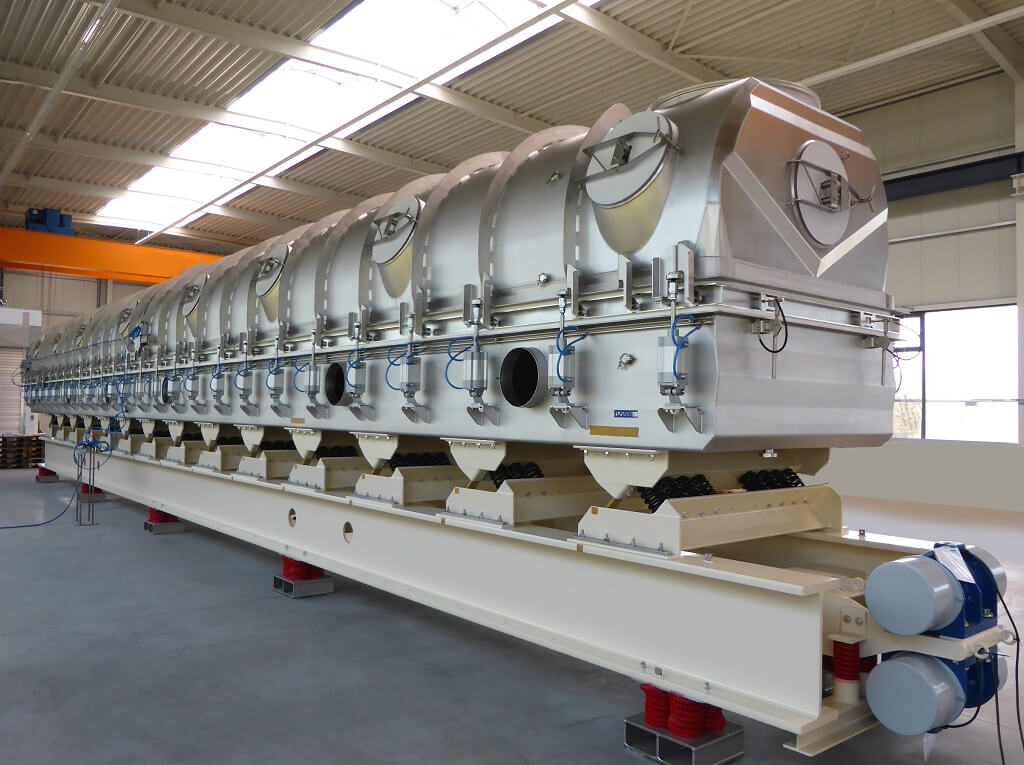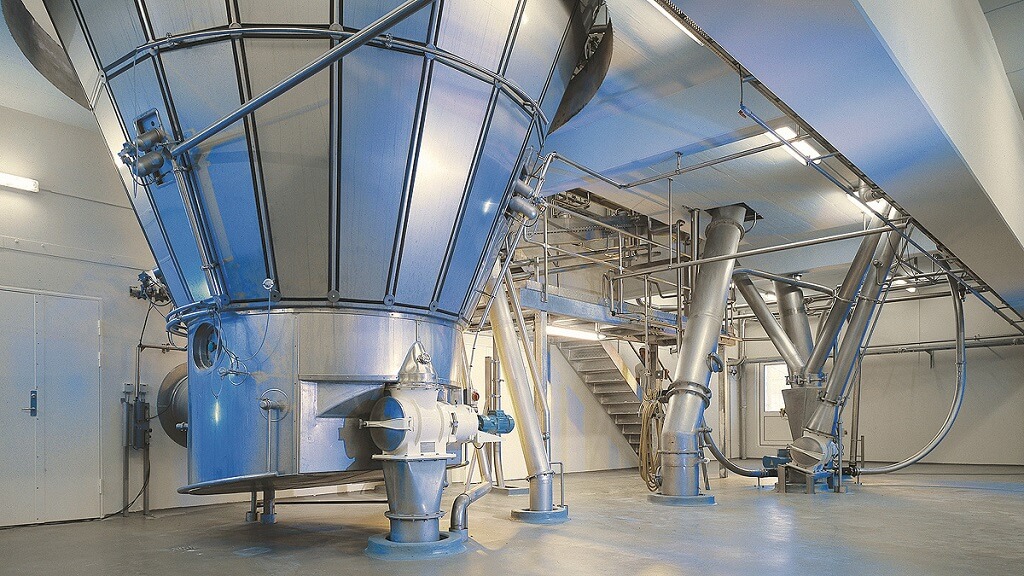
The efficiency of spin flash dryers stems from the combination of high-speed mechanical dispersion and hot air drying, enabling moisture removal in seconds.
However, achieving optimal drying efficiency requires more than simply operating the equipment—it involves a careful balance of material properties, process parameters, equipment design, and operational control.
This article explores key strategies to optimize drying efficiency in spin flash dryers.
1. Understanding Drying Efficiency in Spin Flash Dryers
Drying efficiency refers to how effectively a spin flash dryer removes moisture while minimizing energy consumption and preserving product quality. In these systems, wet material is introduced into a high-temperature air stream, where it is dispersed into fine particles and rapidly dried through heat and mass transfer.
Efficient drying ensures:
- Uniform moisture removal
- Reduced processing time
- Lower operational costs
- Consistent particle quality
Because the drying process occurs within seconds, even small inefficiencies can significantly impact throughput and energy usage.
2. Optimize Material Properties
Material characteristics play a critical role in drying performance. Understanding and controlling these properties is the first step toward improving efficiency.
Moisture Content
Materials with higher initial moisture require more energy and longer drying time. Pre-dewatering (e.g., filtration or centrifugation) can significantly improve efficiency.
Particle Size and Distribution
Fine particles exhibit accelerated drying rates owing to their higher surface area-to-volume ratio. Uniform particle size also ensures consistent drying and prevents over- or under-dried material.
Heat Sensitivity
Heat-sensitive materials require lower drying temperatures, which can reduce efficiency. In such cases, optimizing residence time and airflow becomes critical to compensate for lower temperatures.
3. Control Key Operating Parameters
Optimizing process parameters is essential for maximizing drying efficiency.
Air Temperature
Higher temperatures accelerate evaporation but must be carefully controlled to avoid product degradation. Proper temperature balance ensures fast drying without compromising quality.
Air Velocity
Adequate air velocity ensures particles remain suspended and fully exposed to the drying medium. Insufficient airflow leads to incomplete drying, while excessive velocity may cause product loss.
Feed Rate
A consistent and optimized feed rate prevents overloading the dryer and ensures uniform drying conditions.
Residence Time
The time particles spend in the drying chamber must be sufficient for complete moisture removal but short enough to prevent overheating. Adjusting airflow and chamber design helps control residence time.
4. Improve Airflow and Heat Transfer Efficiency
Efficient heat and mass transfer are the foundation of spin flash drying performance.
Optimize Air Distribution
Uniform air distribution ensures all particles receive equal exposure to heat, preventing uneven drying and agglomeration.
Enhance Turbulence and Dispersion
The spinning mechanism should effectively disperse material into fine particles, maximizing surface area for heat transfer.
Reduce Heat Loss
Insulating the dryer and minimizing heat leakage improves thermal efficiency and reduces energy consumption.
Spin flash dryers are inherently energy-efficient due to direct contact between hot gas and material, maximizing heat transfer efficiency.
5. Optimize Equipment Design and Configuration
The design of the spin flash dryer significantly impacts its efficiency.
Drying Chamber Design
Proper chamber size and geometry ensure optimal airflow patterns and residence time.
Agitation Mechanism
Efficient mechanical agitation improves particle dispersion and prevents clumping, enhancing drying performance.
Cyclone Separator Efficiency
A high-efficiency cyclone ensures effective separation of dried particles from the air stream, reducing product loss.
Air Heating System
Using efficient heat sources (e.g., gas burners, steam heaters, or heat recovery systems) improves energy utilization.
6. Implement Advanced Process Control
Modern control systems play a crucial role in optimizing drying efficiency.
Real-Time Monitoring
Monitoring parameters such as temperature, humidity, and airflow allows operators to make immediate adjustments.
Automation and Feedback Control
Automated control systems dynamically regulate operating conditions to ensure consistent optimal performance.
Moisture Control
Continuous moisture measurement ensures the final product meets specifications without over-drying, which wastes energy.
7. Prevent Common Efficiency Losses
Several operational issues can reduce drying efficiency if not properly managed.
Agglomeration and Clumping
Poor dispersion or improper airflow can lead to particle agglomeration, reducing drying efficiency and product quality.
Over-Drying
Excessive drying wastes energy and may damage product properties.
Airflow Obstruction
Dust buildup or mechanical wear can restrict airflow, reducing drying performance.
Inconsistent Feed
Irregular feeding disrupts process stability and leads to uneven drying.
8. Enhance Energy Efficiency
Energy consumption is a major cost factor in drying operations.
Heat Recovery Systems
Recovering heat from exhaust air can significantly reduce energy usage.
Optimize Operating Conditions
Running the dryer at optimal temperature and airflow minimizes energy waste.
Use Energy-Efficient Components
Modern fans, burners, and control systems improve overall efficiency.
Spin flash dryers are already more energy-efficient than some alternatives due to their rapid drying mechanism and short residence time.
9. Regular Maintenance and System Optimization
Routine maintenance is essential for sustaining high efficiency.
Equipment Inspection
Regularly check critical components such as the feed system, agitator, and cyclone separator.
Cleaning and Dust Removal
Minimize material accumulation that may hinder airflow and impair heat transfer efficiency.
Calibration of Sensors
Ensure accurate monitoring of temperature, pressure, and moisture.
Continuous Process Optimization
Evaluate operational data and fine-tune process parameters to enhance efficiency over time.
10. Tailor the Process to Specific Applications
Different industries and materials require customized drying strategies.
- Pharmaceuticals: Precise temperature control to protect active ingredients
- Food Processing: Preservation of flavor, color, and nutrients
- Chemicals: Control of particle size and flowability
Spin flash dryers excel in handling diverse materials due to their flexibility and rapid drying capability.
PERFORMANCE REVIEW
Measure Efficiency Against Acceptable Product Output
Dryer efficiency should be evaluated against stable production of acceptable powder, not against a single temperature, feed-rate or fuel reading. Establish a repeatable baseline for the same material and product target before evaluating changes.
Material and production baseline
- Wet feed form, initial moisture, consistency and representative variation
- Dry powder output, final moisture, acceptable yield and operating hours
- Start-up, shutdown, cleaning and off-specification production periods
Thermal and process observations
- Heat-source use, electrical load, inlet and exhaust temperatures
- Feed rate, airflow or pressure indications and discharge condition
- Deposits, carryover, blockages, unstable feeding and maintenance history
Evaluate controlled changes
Review one approved change at a time and compare energy use, product quality, yield, emissions and equipment behavior over a representative period. A higher throughput is not an improvement if moisture, powder quality, deposits or safety conditions become unacceptable.
Performance and safety boundary: This article does not promise a fixed efficiency gain and is not authorization to change operating limits, bypass interlocks or modify safety controls. Adjustments require the approved equipment procedure, representative process data and qualified review for the actual material and site.
Related Spin Flash Dryer Resources
- Spin Flash Dryer
- Spin Flash Dryer Working Principle
- Spin Flash Dryer Operating Procedures
- Suitable Materials for Spin Flash Drying
Review Spin Flash Dryer Performance Data
Send the material and moisture data, acceptable powder target, production rate, operating observations, heat-source use and the performance issue being evaluated.
Spin Flash Dryer Efficiency FAQs
What is a useful efficiency baseline?
Use energy and utility consumption per unit of acceptable dry product under a stable material, moisture target and production condition.
Why should product yield be included?
Lower energy input is not useful if more material becomes off-specification, is lost in collection or requires additional processing.
Can operating temperature be optimized by itself?
No. It must be reviewed with feed rate, moisture load, airflow, residence behavior, product quality and equipment limits.
What information should be included in a performance inquiry?
Provide the wet feed and product data, capacity, temperatures, airflow or pressure observations, utility use, deposits or carryover, maintenance history and site constraints.