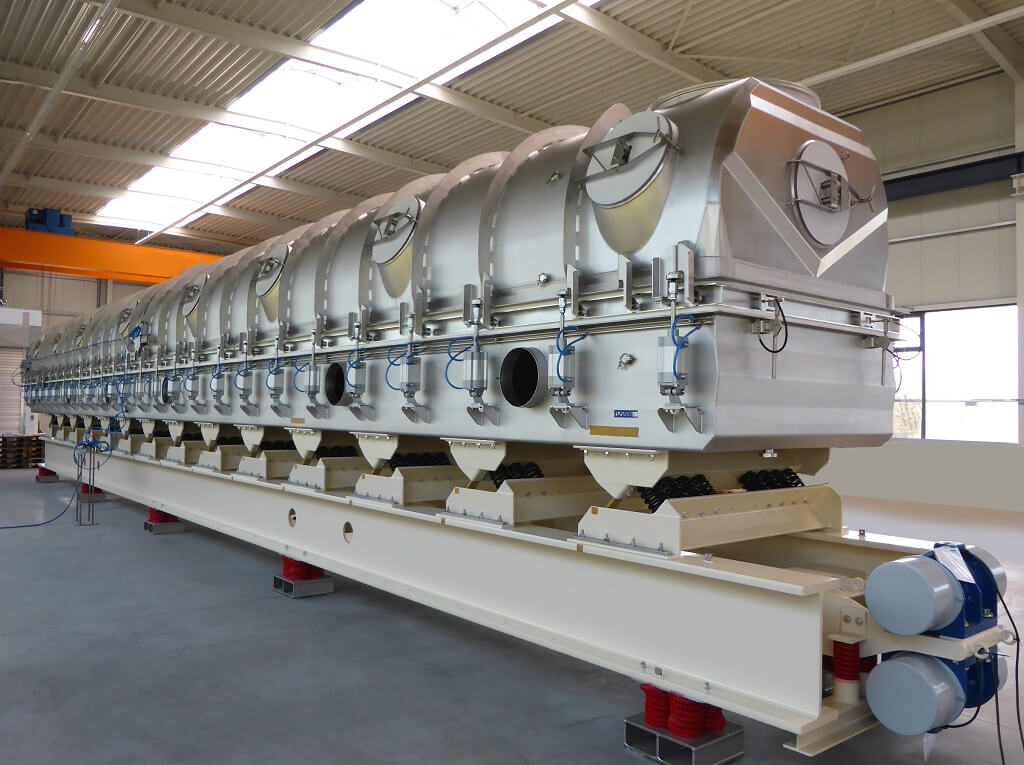
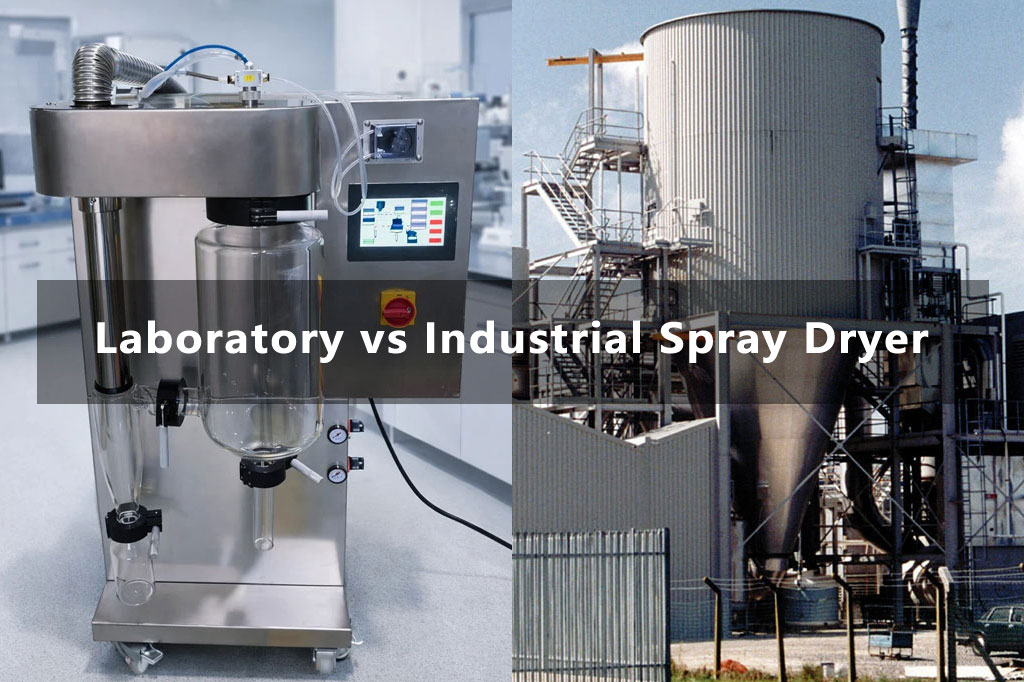
Depending on the application scale, spray dryers can be categorized into laboratory-scale spray dryers and industrial spray dryers.
- Laboratory spray dryers prioritize flexibility, small sample usage, and experimental control.
- Industrial spray dryers focus on high efficiency, automation, and large-scale powder production.
Although both operate using the same fundamental principle, they differ significantly in terms of capacity, equipment size, flexibility, cost, and operational objectives.
Overview of Laboratory Scale Spray Dryers
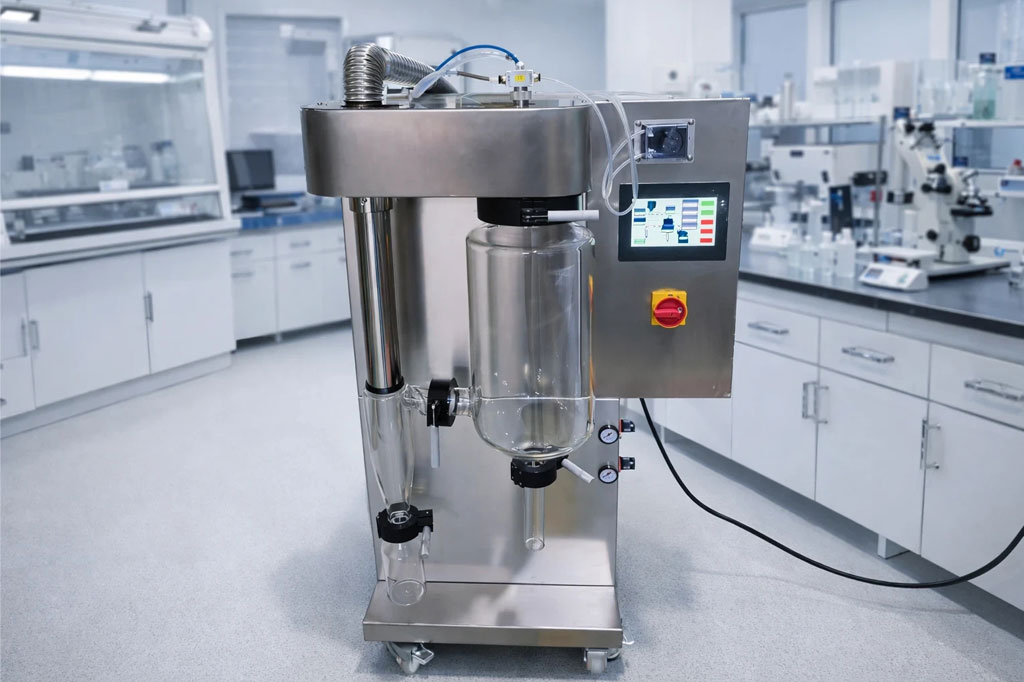
A laboratory scale spray dryer is a compact version of an industrial spray dryer designed primarily for research, product development, and small-scale production. These machines allow researchers to test formulations and optimize process parameters before scaling up to larger production systems.
Laboratory spray dryers are typically bench-top or small floor-standing systems. They are capable of processing very small quantities of feed material, sometimes as little as a few milliliters, making them ideal for experiments where raw materials are expensive or limited.
In many research laboratories, these dryers are used to develop new food powders, pharmaceutical formulations, and chemical products. Scientists can control important parameters such as inlet temperature, outlet temperature, feed rate, and atomization pressure, allowing them to study how these factors influence particle size, moisture content, and powder characteristics.
Another advantage of laboratory spray dryers is their flexibility. Because they are designed for experimental work, they allow quick adjustments and easy cleaning between trials. Researchers can run multiple experiments in a short period and evaluate different formulations efficiently.
Typical characteristics of laboratory spray dryers include:
- Small processing capacity (grams to a few kilograms per batch)
- Compact equipment size
- High precision control of drying parameters
- Easy cleaning and maintenance
- Lower equipment cost
These features make laboratory spray dryers essential tools for R&D and pilot studies before industrial production.
Advantages and Disadvantages of Laboratory Scale Spray Dryers
|
|
Overview of Industrial Spray Dryers
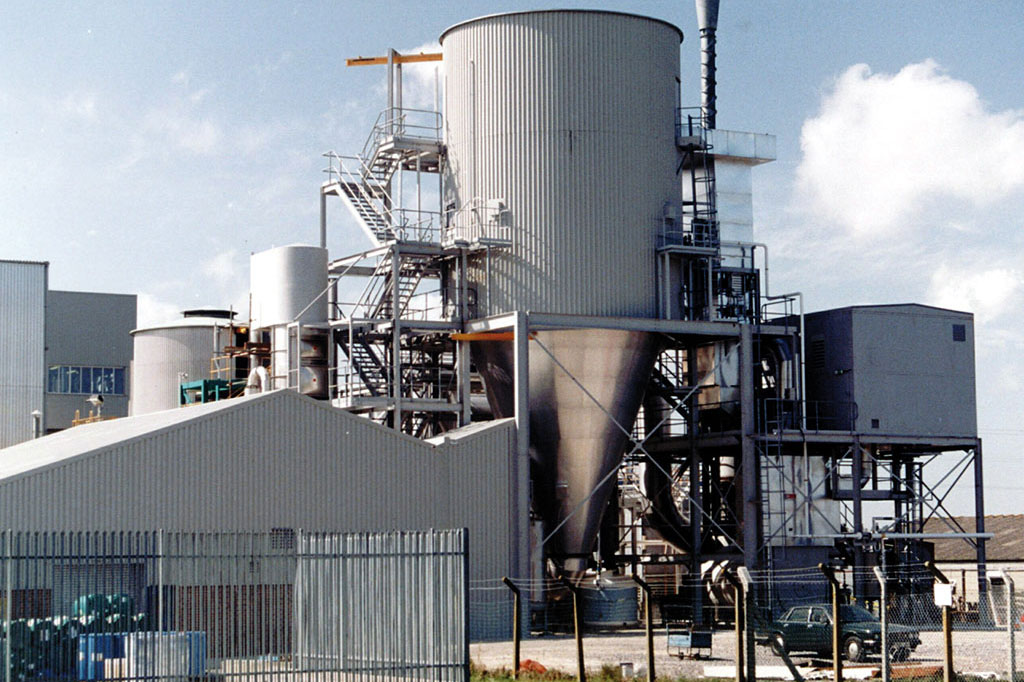
Industrial spray dryers are large-scale systems designed for continuous, high-volume production. These dryers are commonly installed in manufacturing plants and operate as part of automated production lines.
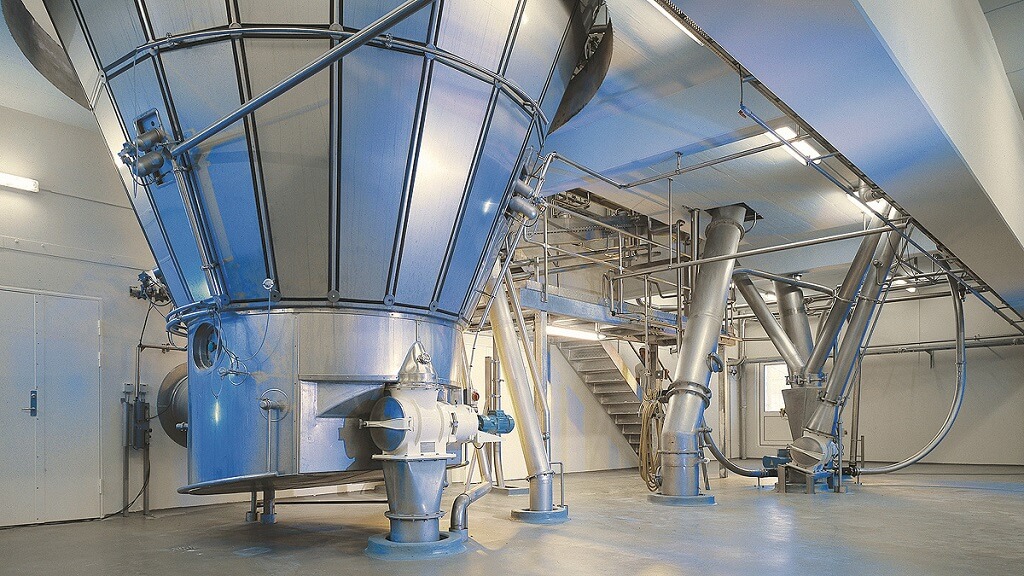
Unlike laboratory units, industrial spray dryers are massive pieces of equipment that require a dedicated installation area, specialized infrastructure, and professional operation.
Industrial spray dryers can process hundreds or even thousands of kilograms of powder per hour, depending on the equipment size and configuration.
To achieve such high productivity, these systems use large drying chambers, powerful air handling systems, and advanced atomization technologies such as centrifugal atomizers or high-pressure nozzles. The drying chambers are typically designed as tall towers to provide enough residence time for droplets to dry fully before reaching the collection system.
Industrial spray dryers also incorporate sophisticated automation systems. These control systems continuously monitor and regulate variables such as temperature, airflow, and feed rate to maintain stable operation and consistent product quality.
Because they operate continuously and handle large volumes of materials, industrial spray dryers are widely used for producing:
- Milk powder and dairy products
- Instant coffee and tea
- Pharmaceutical powders
- Chemical catalysts and pigments
- Ceramic and detergent powders
Typical characteristics of industrial spray dryers include:
- Large drying towers and complex structures
- High production capacity
- Continuous operation capability
- Advanced automation and monitoring systems
- High installation and operating costs
These systems are optimized for mass production rather than experimentation.
Advantages and Disadvantages of Industrial Spray Dryer
|
|
Laboratory vs Industrial Spray Dryer Comparison Chart
Below is a clear comparison chart summarizing the key differences between laboratory-scale spray dryers and industrial spray dryers. It helps you quickly understand the distinctions.
| Aspect | Laboratory Scale Spray Dryer | Industrial Spray Dryer |
|---|---|---|
| Primary Purpose | Research, product development, and formulation testing | Large-scale commercial production |
| Processing Capacity | Small quantities (grams to a few kilograms per batch) | Large volumes (hundreds or thousands of kilograms per hour) |
| Equipment Size | Compact, bench-top or small floor-standing units | Large drying towers requiring dedicated factory space |
| Design Complexity | Simple structure with basic components | Complex systems with large chambers, cyclones, bag filters, and air handling units |
| Process Flexibility | Highly flexible; parameters easily adjusted for experiments | Optimized for specific products; major adjustments require downtime |
| Control System | Basic manual or semi-automatic controls | Advanced automation with PLC and real-time monitoring |
| Atomization Method | Usually two-fluid nozzle atomizers | High-pressure nozzles or centrifugal atomizers |
| Material Consumption | Requires only small feed quantities | Requires continuous large feed supply |
| Cleaning and Maintenance | Easy cleaning between experiments | More complex cleaning procedures due to large system size |
| Installation Requirements | Minimal installation; suitable for laboratories | Requires large installation area, utilities, and infrastructure |
| Investment Cost | Lower equipment and operating costs | High capital investment and operating costs |
| Typical Users | Universities, research institutes, R&D departments | Industrial manufacturers and large production facilities |
| Common Applications | Food formulation testing, pharmaceutical research, material studies | Milk powder, instant coffee, pharmaceuticals, detergents, chemicals |
| Operational Mode | Usually batch operation | Continuous production process |
Key Differences Between Laboratory and Industrial Spray Dryers
1. Processing Capacity
The most obvious difference between the two systems is their production capacity.
Laboratory spray dryers handle small quantities of material, producing only grams or kilograms of powder per batch. This small capacity is suitable for research experiments and prototype product development.
In contrast, industrial spray dryers are built for large-scale production and are capable of generating hundreds or even thousands of kilograms of powder per hour.
As a result, laboratory units focus on precision and flexibility, while industrial units prioritize efficiency and productivity.
2. Equipment Size and Design
Laboratory spray dryers are compact and typically installed on a bench or small platform. Many models even use transparent glass drying chambers, allowing researchers to observe the drying process directly.
Industrial spray dryers are much larger and may include multi-story drying towers, large cyclones, bag filters, and air handling systems. These installations require dedicated factory space and complex infrastructure.
3. Process Flexibility
Laboratory spray dryers offer a high degree of flexibility. Operators can easily adjust operating parameters to evaluate different formulations and processing conditions.
Industrial spray dryers are usually configured for specific production processes. Once the system is optimized for a particular product, making major changes may require significant adjustments or downtime.
4. Control and Automation
Lab-scale spray dryers often use relatively simple control systems, allowing operators to manually adjust key parameters such as feed rate and temperature.
Industrial spray dryers employ advanced automation systems with sensors, programmable logic controllers (PLCs), and real-time monitoring to maintain stable operating conditions and consistent product quality.
5. Cost and Investment
Another important difference is cost.
Laboratory spray dryers are significantly less expensive because they are smaller and have simpler designs. This makes them accessible to universities, research institutes, and small companies.
Industrial spray dryers require substantial investment. The cost involves not only the equipment itself but also installation, maintenance, utilities, and skilled operators.
However, the high productivity of industrial dryers allows manufacturers to achieve economies of scale in large-scale production.
6. Applications
Laboratory spray dryers are mainly used for:
- Research and development
- Process optimization
- Product formulation testing
- Small-scale specialty production
Industrial spray dryers are used for:
- Mass production of powdered products
- Continuous manufacturing operations
- Commercial food, pharmaceutical, and chemical production
Scaling Up from Laboratory to Industrial Spray Dryers
In many industries, spray drying processes start at the laboratory scale and gradually scale up to industrial production. Laboratory experiments help determine optimal process parameters such as droplet size, drying temperature, and feed concentration.
However, scaling up spray drying is not always straightforward. Differences in drying kinetics, residence time, and droplet behavior between small and large systems can affect product properties.
To address this challenge, many manufacturers use pilot-scale spray dryers as an intermediate step between laboratory and industrial systems. Pilot dryers provide data that helps engineers design large-scale production equipment with consistent performance.
SCALE-UP REVIEW
Data Required for Laboratory-to-Industrial Scale-Up
Scale-up is not a direct multiplication of laboratory feed rate. Droplet formation, heat and mass transfer, residence-time distribution, wall interaction, powder separation and cleaning all change with equipment geometry and production duty.
Document the laboratory trial
- Feed composition, solids concentration, viscosity, density and temperature
- Atomizer type, relevant operating settings, inlet and outlet observations
- Powder moisture, yield, particle behavior, bulk density and reconstitution results
Define the industrial production target
- Required capacity, batch or continuous schedule and acceptable product range
- Feed preparation, holding, cleaning and product-change requirements
- Powder collection, cooling, conveying, packaging and emission-control interfaces
Identify scale-up gaps
Review whether the laboratory atomizer, air pattern, collection method and product residence history can be represented at production scale. If critical behavior is uncertain, use additional representative testing or an intermediate pilot step before final equipment commitments.
Scale-up boundary: A laboratory result demonstrates behavior under the tested conditions; it does not guarantee industrial capacity, yield or powder specification. Final scale-up requires representative data, mass and energy balances, equipment-specific calculations, site utilities, safety review and applicable quality requirements.
Related Spray Dryer Scale-Up Resources
- Complete Guide to Spray Dryers
- Spray Dryer Design Principles
- Centrifugal Spray Dryer
- Industrial Spray Dryer Systems
Review a Spray Dryer Scale-Up Project
Send the laboratory trial record, representative feed data, powder results, required production rate, cleaning needs, utilities and installation location.
Laboratory and Industrial Spray Dryer FAQs
Can laboratory feed rate be multiplied directly for industrial sizing?
No. Scale changes airflow, residence-time distribution, wall interaction, separation and heat-transfer behavior, so equipment-specific calculations are required.
Which laboratory results are useful for scale-up?
Useful records include feed properties, atomizer and operating conditions, powder moisture, yield, particle behavior, bulk density, reconstitution results and observed deposits.
When is a pilot step useful?
A pilot step may be useful when atomization, heat sensitivity, wall deposition, powder recovery or product quality cannot be predicted reliably from laboratory data.
What site information is required for an industrial review?
Provide utilities, electrical standard, heat source, air handling, emissions, installation space, cleaning requirements and upstream or downstream interfaces.