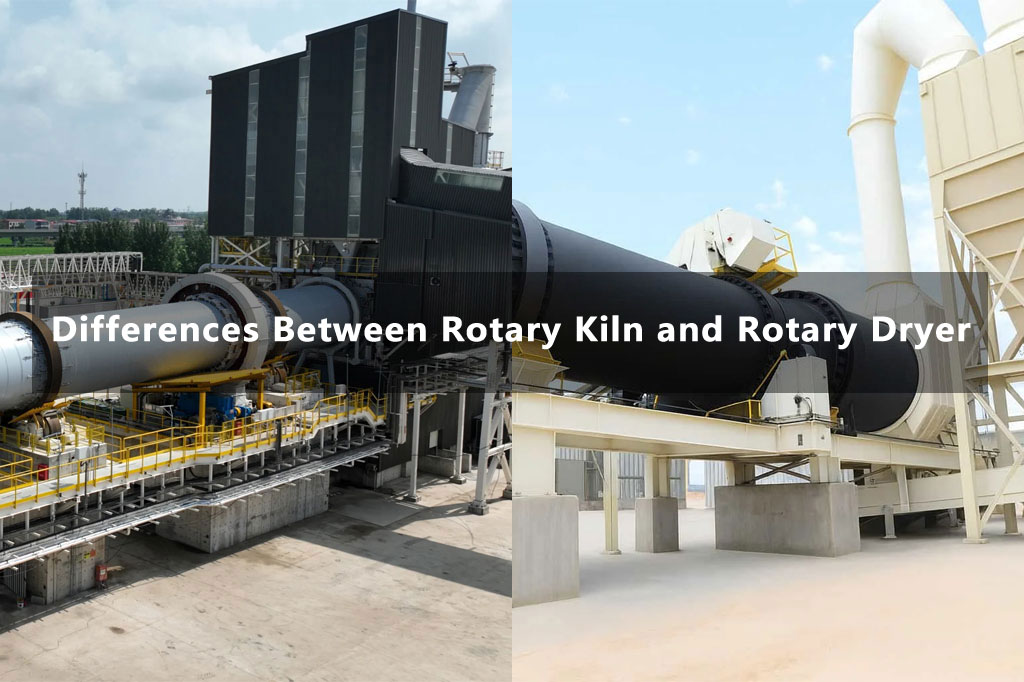
Rotary equipment plays an essential role in many industrial processing operations, particularly in industries such as mining, chemicals, cement, and food processing.
Two commonly used pieces of equipment are the rotary kiln and the rotary dryer.
While they share a similar cylindrical rotating structure, their purposes, operating conditions, and applications are significantly different.
What Is a Rotary Dryer?
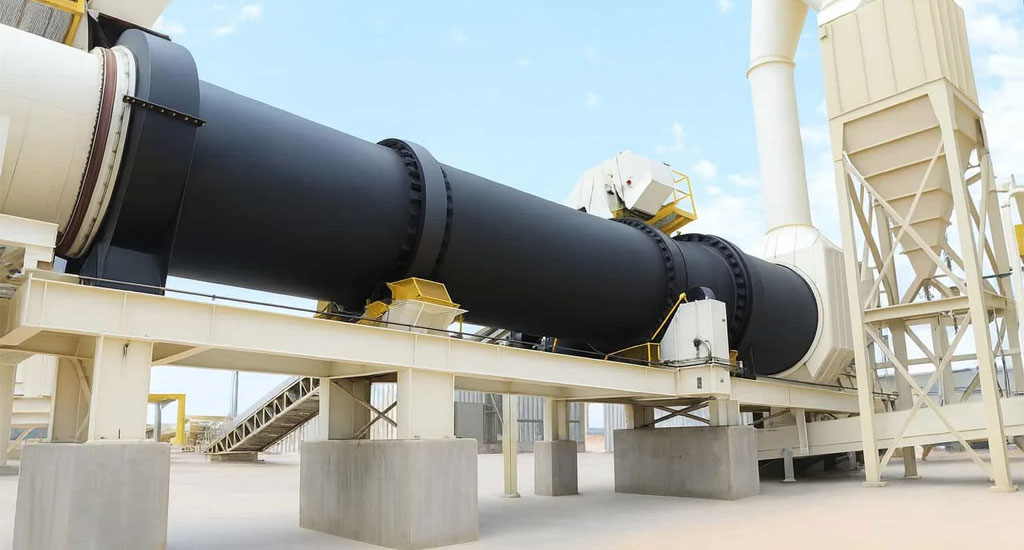
A rotary dryer is designed to remove moisture from materials by using heated air. It consists of a rotating cylindrical drum through which the material passes while being exposed to hot gas.
Inside the drum, lifting flights raise and cascade the material through the hot airflow, allowing efficient heat transfer and moisture evaporation. As the drum rotates, the material slowly travels from the feed end to the discharge end, drying progressively along the way.
Key Features of Rotary Dryers
- Operate at moderate temperatures
- Primarily designed for moisture removal
- Use direct or indirect heating systems
- Suitable for continuous processing
- Capable of handling large volumes of material
Typical Applications
Rotary dryers are widely used for drying:
- Food ingredients and agricultural products
- Fertilizers
- Sand and minerals
- Biomass materials
- Chemical powders
- Wood chips and sawdust
In the food industry, rotary dryers help reduce moisture in grains, starch, and other bulk ingredients to improve shelf life and storage stability.
What Is a Rotary Kiln?
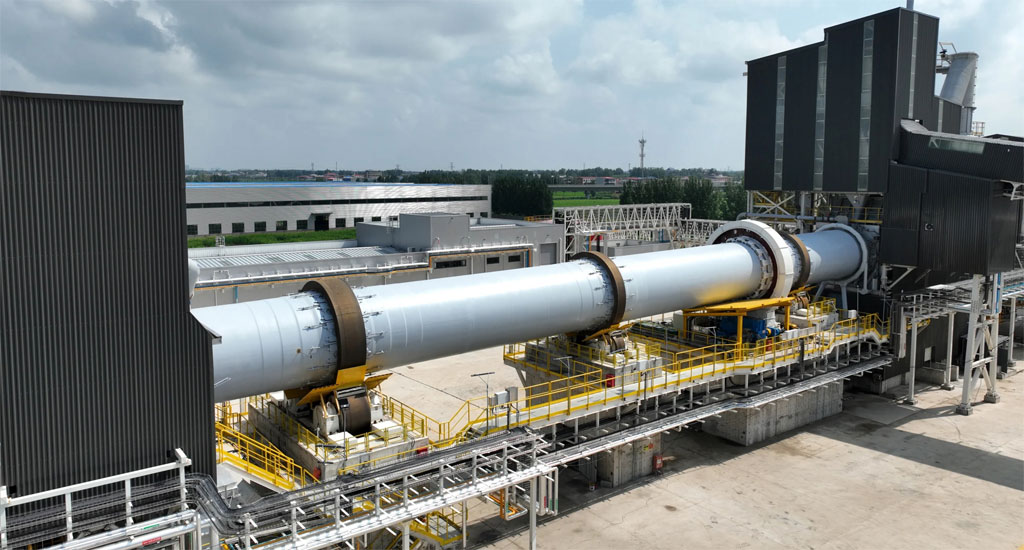
A rotary kiln is a high-temperature processing furnace used to carry out thermal chemical reactions in materials. Like a rotary dryer, it is a rotating cylindrical drum, but it operates at much higher temperatures and often includes refractory lining to withstand extreme heat.
Rotary kilns are used for processes that require calcination, pyrolysis, sintering, or thermal decomposition. Materials move slowly through the kiln while being exposed to controlled heat, allowing chemical transformations to occur.
Key Features of Rotary Kilns
- Operate at very high temperatures (often 800–2000°C)
- Designed for thermal processing and chemical reactions
- Usually lined with refractory bricks
- Longer residence time for materials
- Can use direct or indirect heating
Typical Applications
Rotary kilns are commonly used in industries such as:
- Cement production
- Lime manufacturing
- Metallurgy
- Waste treatment and incineration
- Activated carbon production
- Chemical material calcination
For example, in cement manufacturing, rotary kilns heat limestone and clay to produce clinker through a complex chemical reaction process.
Key Differences Between Rotary Kiln and Rotary Dryer
Although both machines feature rotating drums, their functions and operating conditions are very different. The following comparison highlights the main distinctions.
1. Purpose of Operation
The most fundamental difference lies in their purpose.
- Rotary dryers are designed to remove moisture from materials.
- Rotary kilns are designed to induce chemical or physical transformations through high-temperature heating.
In other words, dryers focus on drying, while kilns focus on thermal processing.
2. Operating Temperature
Temperature levels vary greatly between the two machines.
- Rotary dryers typically operate between 100°C and 600°C depending on the material.
- Rotary kilns operate at much higher temperatures, often between 800°C and 2000°C.
These high temperatures allow kilns to drive chemical reactions that dryers cannot perform.
3. Structural Design
Although both machines use rotating drums, their internal structures differ.
Rotary Dryer Design:
- Equipped with lifting flights
- Optimized for maximum material-air contact
- Focused on efficient heat transfer for evaporation
Rotary Kiln Design:
- Often includes refractory lining
- Designed to retain high temperatures
- May include burners and combustion systems
The kiln structure must withstand extreme heat and mechanical stress.
4. Residence Time
The time materials spend inside the machine also differs.
- Rotary dryers typically have shorter residence times, since moisture evaporation occurs relatively quickly.
- Rotary kilns often require longer residence times to allow chemical reactions or phase transformations to complete.
Material flow rates and drum speeds are carefully controlled in both systems.
5. Heating Method
Both systems may use direct or indirect heating, but their configurations vary.
Rotary Dryers
- Direct-fired hot air systems are common
- Heat source may include natural gas, coal, or biomass
- Focus on efficient airflow and moisture removal
Rotary Kilns
- Often use powerful combustion burners
- Require precise temperature control
- May involve multiple heating zones
The heating system in a kiln is typically more complex due to the need for precise thermal reactions.
When to Choose a Rotary Dryer
A rotary dryer is the best choice when the main goal is to reduce moisture content in bulk materials. It is ideal for industries that process large quantities of wet solids and require efficient, continuous drying.
Common scenarios include:
- Drying agricultural products
- Reducing moisture in fertilizers
- Processing biomass fuels
- Drying minerals or sand
- Food ingredient dehydration
Rotary dryers are favored for their high capacity, simple operation, and energy efficiency.
When to Choose a Rotary Kiln Dryer
A rotary kiln should be used when materials require high-temperature treatment or chemical conversion rather than simple drying.
Typical situations include:
- Calcining limestone
- Producing cement clinker
- Thermal decomposition of chemicals
- Metallurgical roasting
- Hazardous waste treatment
Because of their ability to maintain extreme temperatures and controlled environments, rotary kilns are essential for complex thermal processing applications.
Here is a clear comparison chart summarizing the key differences between rotary kilns and rotary dryers.
| Aspect | Rotary Dryer | Rotary Kiln |
|---|---|---|
| Primary Purpose | Removes moisture from materials | Performs high-temperature thermal processing or chemical reactions |
| Main Function | Drying and moisture evaporation | Calcination, pyrolysis, sintering, and thermal decomposition |
| Operating Temperature | Typically 100°C – 600°C | Typically 800°C – 2000°C |
| Internal Structure | Equipped with lifting flights to cascade materials for efficient drying | Often lined with refractory bricks to withstand extreme heat |
| Heating Method | Usually direct hot air or indirect heating systems | Uses high-temperature burners or combustion systems |
| Material Residence Time | Generally shorter due to rapid moisture removal | Longer to allow chemical or physical transformations |
| Material Processing Goal | Reduce moisture content | Change chemical composition or physical structure |
| Typical Industries | Food processing, agriculture, mining, biomass, fertilizer | Cement, metallurgy, chemicals, waste treatment |
| Example Materials | Grains, sand, fertilizer, wood chips, food powders | Limestone, cement clinker, activated carbon, ores |
| Energy Requirement | Moderate energy usage | High energy consumption due to extreme temperatures |
| Equipment Complexity | Relatively simpler design | More complex due to refractory lining and high-temperature systems |
| End Product Outcome | Dry material with lower moisture content | Chemically or physically transformed material |
Quick Summary
Although rotary kilns and rotary dryers look similar in appearance, they serve very different industrial purposes. Rotary dryers focus on removing moisture using heated air, while rotary kilns are designed for high-temperature thermal reactions and material transformations.
The key differences lie in temperature levels, structural design, residence time, and processing objectives. Choosing the correct equipment depends largely on whether the goal is simple drying or high-temperature chemical processing.
SELECTION REVIEW
Define the Required Material Transformation First
The first selection question is whether the process mainly removes moisture or requires a thermal transformation such as calcination, phase change or a high-temperature reaction. The answer defines a starting direction, but the complete material and process duty must still be reviewed.
Material and feed data
- Material composition, particle size, bulk density, flowability and feed moisture
- Abrasiveness, stickiness, dust behavior and any corrosive or volatile components
- Temperature sensitivity and the physical or chemical change required
Process duty and product target
- Moisture-removal duty versus calcination, sintering or reaction duty
- Required capacity, residence-time range and operating schedule
- Target product moisture, temperature, phase or other measurable condition
Heating, gas handling and site inputs
- Direct or indirect heating considerations and available heat source
- Exhaust volume, dust collection, emissions and heat-recovery requirements
- Feed/discharge interfaces, installation space, utilities and local safety requirements
Selection boundary: This comparison is a general orientation, not a final process recommendation. Equipment type, dimensions, temperatures, residence time, materials of construction and protective systems require project-specific calculations, representative material data and applicable environmental and safety requirements. Testing may be necessary.
Related Rotary Drying Resources
Discuss a Rotary Drying or Thermal Process
Send the material data, feed moisture, required transformation, capacity, product target, heat source, emissions constraints and installation location.
Rotary Kiln and Rotary Dryer FAQs
Is a rotary kiln simply a higher-temperature rotary dryer?
No. A rotary kiln is generally selected for a required thermal transformation, while a rotary dryer is generally selected to remove moisture. Their internals, heating approach and process controls may differ.
Can the feed moisture alone determine the equipment type?
No. The required product transformation, temperature exposure, residence time, gas handling, material behavior and site requirements must also be considered.
Why are dust and exhaust data important?
They influence air or gas handling, collection, emissions control, heat recovery, safety review and the interfaces around the main rotating equipment.
What information should be included in an inquiry?
Provide the material composition and size, feed moisture, capacity, required product condition, thermal duty, heat source, operating schedule and environmental or safety constraints.