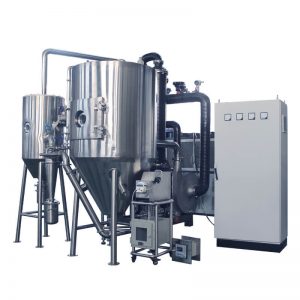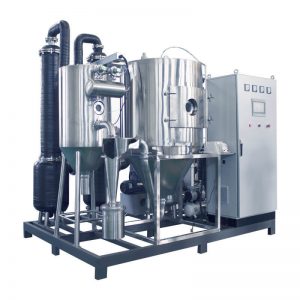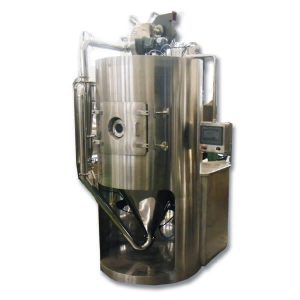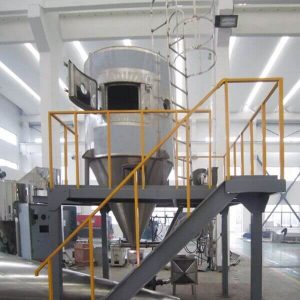
Technical Parameters
|
Model
|
Evaporated Amount(kg/h)
|
Power(kW)
|
Diameter of the Tower(mm)
|
Total Height of Equipment(mm)
|
|
YPG-25
|
25
|
0.35
|
1300
|
7800
|
|
YPG-50
|
50
|
4
|
1800
|
9200
|
|
YPG-100
|
100
|
7.5
|
2400
|
11600
|
|
YPG-150
|
150
|
11
|
2600
|
14000
|
|
YPG-200
|
200
|
15
|
2800
|
15300
|
|
YPG-300
|
300
|
22
|
3200
|
17100
|
|
YPG-500
|
500
|
30
|
3800
|
19000
|
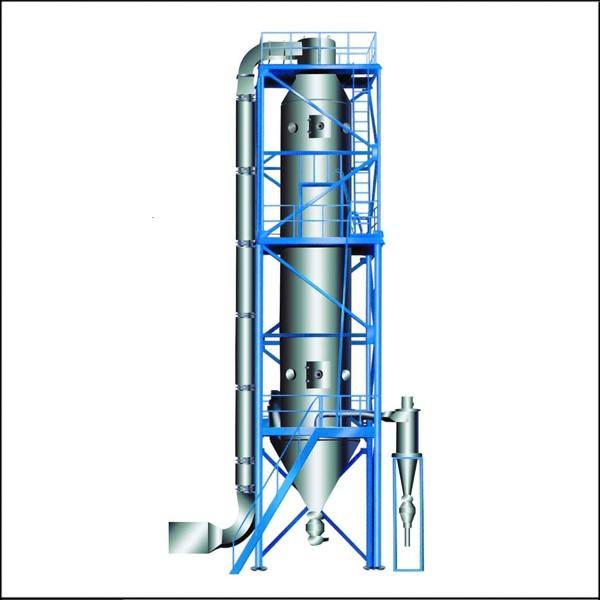
Pressure Spray Drying Machine Composition
1. Feeding System
The peristaltic pump adopts the step speed regulation, and the feeding volume matches the discharge air temperature to precisely control the discharge air temperature.
2. Media Circulation System
This system is composed of supply fan, induced draft fan, air regulating butterfly valve, air duct, and so on. The matching of air volume, air pressure and airspeed in this system is the key.
3. Air Heating And Purification System
This system consists of primary and secondary air filters, fans, coil fin radiators, etc.
The heat source is electric heating, and the heating tube is made of stainless steel with finned radiator, which has high thermal efficiency and greatly extended service life.
4. Drying Tower System
This system is the core system, consisting of the main drying tower, hot air distributor, atomizer, observation manhole, lighting device in the tower, pneumatic hammer, etc.
5. Receiving System
The receiving system of the spray drying unit is formed by the combination of cyclone separator + cloth bag dust collector. The cyclone adopts high air volume and high-efficiency cyclone for collection, and its collection rate can reach about 95%, while the cloth bag dust collector is specially designed for protein powder dust removal optimization equipment, which can make the material and wind completely separated and settled, and the filter mesh can reach more than 500 mesh.
6. Control System
It is composed of the main control element, programmable touch screen, fuzzy controller, etc.
The system color touch screen animation display process flow, control set the relevant parameters.
PLC programmable control, touch screen animation display process flow; according to the discharge air temperature automatically adjust the feed volume speed; digital display temperature, pressure, differential pressure, frequency conversion to adjust the atomization speed, etc.
7. Cool Air Centralized Material Collection System
It is composed of air filter, refrigerated dehumidifier, clean duct, fan, etc.
Filtered fresh air after passing through the refrigerated dehumidifier, it quickly becomes dry and low temperature, and forcibly sent into the material-filled cyclone separator under the collection bin, so that the material cools, which has two advantages:
- Maximum reduction of the relative humidity in the aggregate bin, to prevent the material from being returned to moisture in the natural cooling process in the aggregate bin, thus avoiding the phenomenon of moisture absorption and caking of materials.
- 25℃ dehumidifying wind controls the temperature in the aggregate bin at about 40℃, which is a good solution to the problem of protein powder being softened by high temperature and ensures the fluidity of the product.
Pressure Spray Dryer Applications
1. Our YPG-25 Pressure Spray Dryer Drying Solution for Milk Powder
1. Customer Materials & Requirements | |
Material | Milk |
Solid Content | 20~50% |
Final Moisture | ≤3% |
Water Evaporation | 20-25kg/h |
Liquid Temperature | Normal temperature |
2. Drying Solution Technical Parameters | |
Equipment Model | YPG-25 Pressure Spray Dryer *1 |
Atomization Method | Pressure |
Mist Droplet and Hot Air Contact Method | Parallel flow |
Inlet Air Temperature | 180~200℃ |
Outlet Air Temperature | 90~110℃ |
Material | Stainless steel |
Dust Removal Method | Cyclone + Water film dust collector |
Heating Method | Steam + electric heating |
3. Public Works Conditions | |
Atmospheric Pressure | Standard |
Ambient Temperature | 20℃ |
Relative Humidity | 80% |
Electric Power | 380V, 3-phase, 50HZ |
Machine Power | 9KW |
Compressed Air Consumption | 0.5m³/min |
Compressed Air Pressure | 0.6mpa |
2. Our YPG-1000 Pressure Spray Dryer Drying Solution for Washing Powder
1. Customer Materials & Requirements | |
Material | Washing powder |
Moisture state | Free water |
Evaporation | 1000kg/h |
Wet Bsis Moisture Content | 60~70% (free water) |
Dry Bsis Moisture Content | ≤1% (free water) |
Raw Material Density | 150~350g/L |
Feed Temperature | 40℃ |
Discharge Temperature | 50℃ |
Heat Source | Oil-fired hot air stove |
Receiving Method | Cyclone + Water film dust collector |
2. Our Drying Solution Technical Parameters | |
Equipment Model | YPG-1000 Pressure Spray Dryer *1 |
Atomization Method | Pressure |
Hot Air Contact Method | Parallel flow |
Inlet Air Temperature | 200~300℃ |
Outlet Air Temperature | 70~80℃ |
Material | Product contact SUS316 |
Dust Removal Method | Cyclone separator |
Heating Method | Oil-fired hot air stove |
Feeding Method | Diaphragm high pressure pump |
Installation Site | General area |
Installation Site Size | Plant condition drawing is required |
Noise | <80 dB |
3. Public Works Conditions | |
Atmospheric Pressure | 101.3KPa |
Ambient Temperature | 10℃ |
Relative Humidity | 70% |
Electric Power | 380V, 3-phase, 50HZ |
Machine Power | 75KW |
Compressed Air Pressure | 0.3~0.6mpa |
Compressed Air Consumption | 0.6m³/min |
Water Consumption | 300kg/batch |
Diesel Consumption | 51kg/h |
ATOMIZATION SELECTION
Pressure Spray Dryer Selection Requirements
A pressure spray dryer should be selected from the actual feed behavior, nozzle atomization duty, powder target and plant utilities. The YPG model table and the milk powder and washing powder solutions on this page are reference information, not universal operating guarantees.
Liquid Feed
Composition, solids content, viscosity, density, abrasiveness, stability, feed temperature and pumpability.
Nozzle Atomization
Required droplet range, nozzle arrangement, operating pressure, wear considerations and cleaning access.
Powder Target
Final moisture, particle size, bulk density, flowability, product temperature and collection requirements.
Plant Conditions
Heat source, exhaust treatment, construction materials, utilities, cleaning method, footprint and installation country.
Pressure Nozzle or Centrifugal Atomizer?
Neither atomization method is universally better. Compare feed rheology, solids loading, abrasiveness, required droplet distribution, maintenance approach, production rate and powder specification before choosing the dryer configuration.
Request a Pressure Spray Drying Review
Send your liquid feed properties and powder target for an application-specific configuration review.
TECHNICAL QUESTIONS
Pressure Spray Dryer FAQs
When should a pressure spray dryer be evaluated?
Pressure spray drying can be evaluated when a pumpable liquid feed can be atomized through a pressure nozzle and the required powder properties align with nozzle atomization. Feed viscosity, solids content, abrasiveness, stability and pressure response must be reviewed.
How is pressure atomization different from centrifugal atomization?
Pressure atomization forces liquid through a nozzle, while centrifugal atomization distributes liquid from a rotating disc or wheel. Feed properties, required droplet distribution, throughput, cleaning, wear and powder target determine which method should be evaluated.
Are the milk powder and washing powder conditions universal?
No. The YPG-25 and YPG-1000 data describe two reference projects. Atomizing pressure, temperatures, evaporation duty, heat source, collection system, utilities and construction materials must be recalculated or confirmed for a different feed.
What information is needed for a pressure spray dryer proposal?
Provide feed composition, solids content, viscosity, density, abrasiveness, feed temperature and rate, target moisture, particle size and bulk density, product temperature limit, heat source, cleaning needs, collection requirements and installation country.