
Anonymous engineering study · proposal-stage design basis
Hastelloy Double-Cone Vacuum Drying: Engineering Study
A corrosion-resistant batch vacuum drying project requires more than naming an alloy. Griffin evaluates process exposure, material movement, vacuum duty, vapor recovery, cleaning, controls and acceptance criteria as one system.
Why the complete system must be reviewed
Corrosion and contamination
Feed composition, dissolved species, solvent load, temperature, concentration changes and cleaning chemistry can affect compatibility and trace-metal risk.
Batch movement
Bulk density, fill volume, flowability, adhesion, agglomeration and attrition determine whether the batch can tumble and renew wall contact.
Heat and vacuum
Jacket duty, product-temperature limit, target pressure and vapor generation interact throughout the drying cycle.
Recovery and containment
Vapor piping, condenser, receiver, seals and vacuum equipment must match the stream, emissions boundary and site-safety requirements.
1. Map corrosion risk by exposure zone
Specifying “Hastelloy construction” is not a complete material schedule. The project should identify surfaces exposed to wet feed, concentrated solids, dry product, vapor, condensate, cleaning fluid and utility media. Product-contact alloy can then be separated from jacket, insulation cladding and structural materials where their exposures differ.
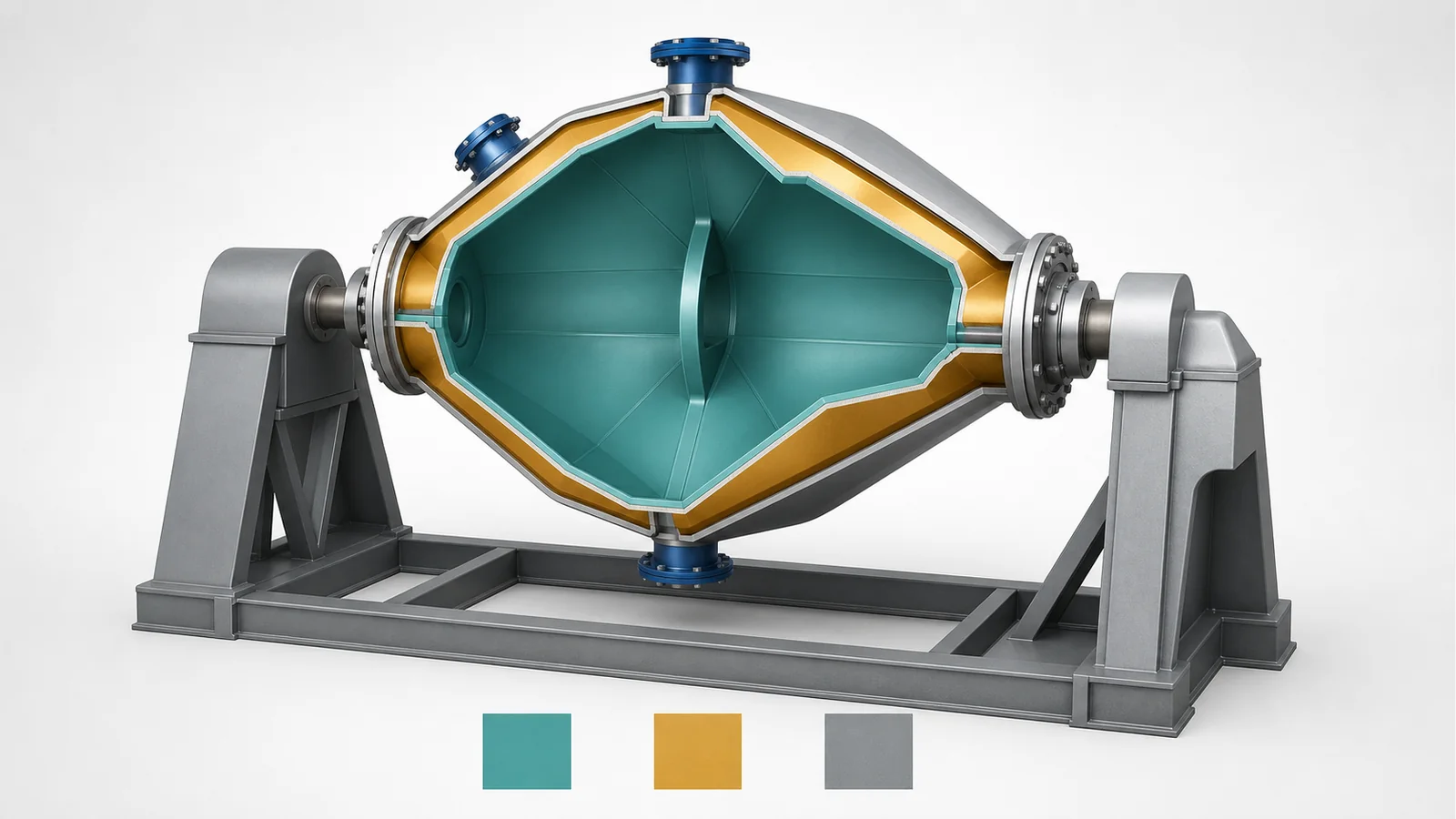
Compatibility inputs
- Complete feed composition, concentration range and known impurities.
- Solvent, acid, chloride or other corrosive species.
- Minimum and maximum process temperatures and concentration changes.
- Cleaning chemicals, concentration, temperature and exposure time.
- Product contamination limits, corrosion data and coupon-test requirements.
2. Confirm batch movement and heat transfer
In a double-cone vacuum dryer, vessel rotation renews material contact with the heated wall while reduced pressure supports volatile removal. Useful movement depends on the actual powder, granule or crystal. Too little free volume can restrict tumbling; a sticky transition or hard agglomeration can require a different cycle, internals or dryer type.
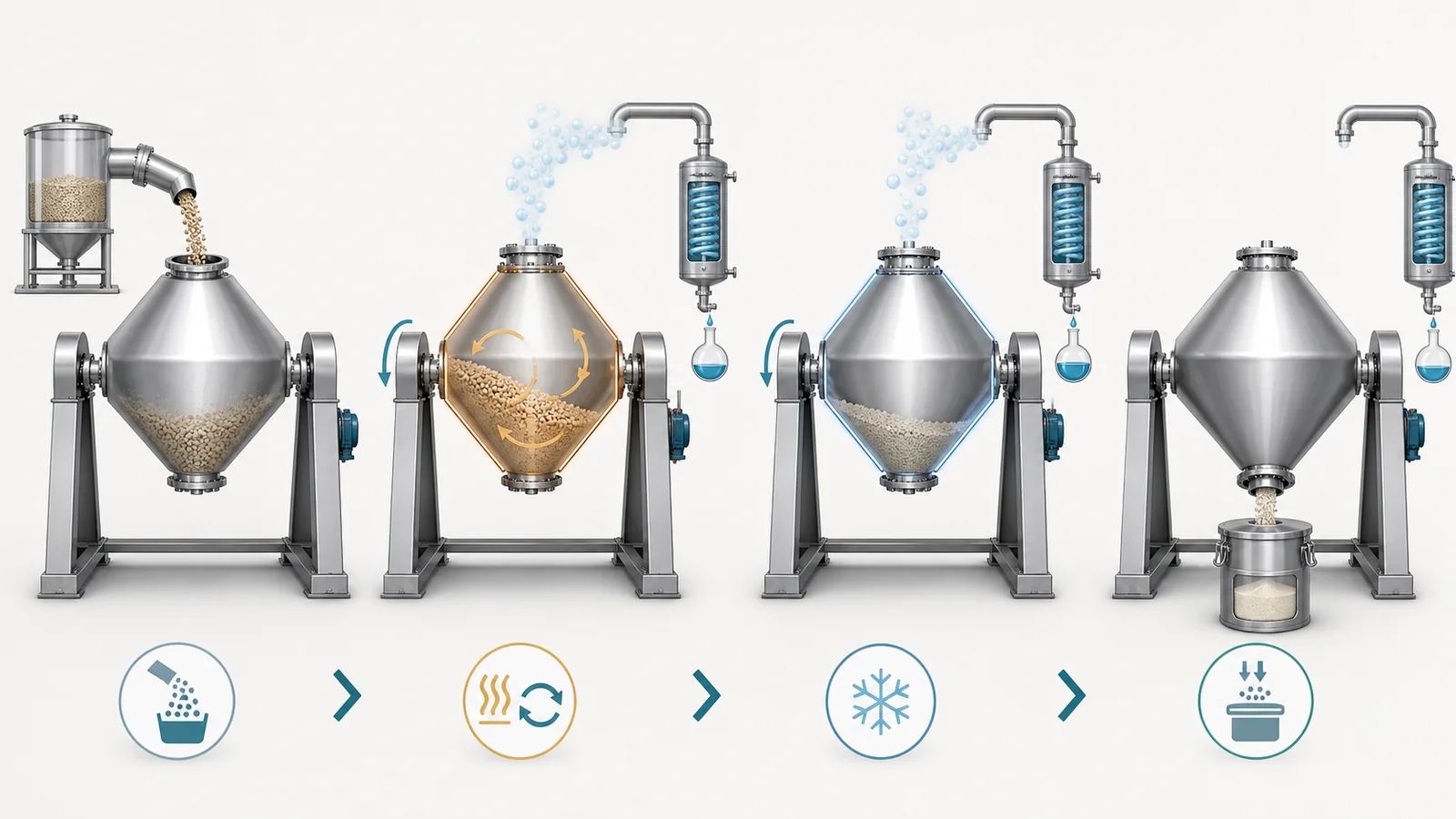
Define the load
Confirm batch mass, bulk density, working volume, free space and feed/discharge method.
Characterize movement
Review particle size, flowability, adhesion, agglomeration and allowable attrition.
Set the thermal boundary
Establish initial and target volatile, jacket medium and maximum product temperature.
3. Size vacuum and condensation as one train
Vacuum equipment cannot be selected from vessel volume alone. Required pressure, leakage allowance, vapor generation, solvent properties, condenser temperature, non-condensable gas and recovery target all affect the train. Where recovery is required, condenser and receiver materials must be checked against both vapor and condensate.
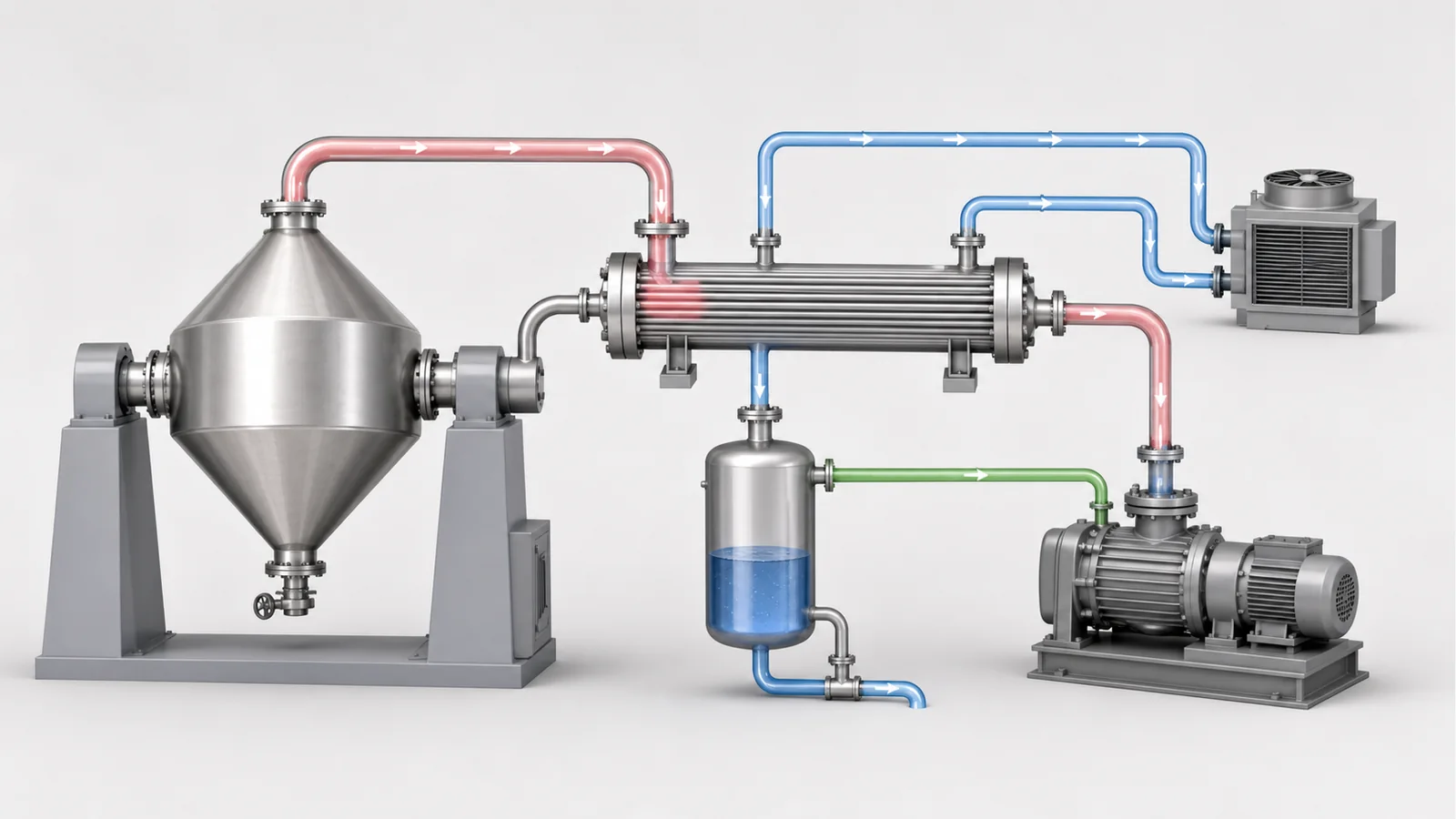
Recovery design inputs
- Volatile identity, mass per batch and expected evaporation profile.
- Target pressure and maximum allowable product temperature.
- Cooling-medium conditions and required condensate recovery.
- Non-condensable gas, emissions, containment and site classification.
- Materials for vapor piping, condenser, receiver, seals and vacuum equipment.
4. Define safety, cleaning and containment
Vacuum does not remove chemical, dust or solvent hazards. Flammable, toxic, reactive or oxygen-sensitive materials require a material-specific process hazard review. The project may need inerting, oxygen monitoring, grounding, explosion protection, relief, closed transfer, leak testing, condensate controls, ventilation and suitable electrical classification.
Cleaning and maintenance requirements also affect alloy selection, surface finish, weld treatment, gasket materials, valve design, drainage and inspection access. Statements about corrosion resistance do not mean a standard configuration is automatically suitable.
5. Convert the process basis into a project architecture
| System area | Engineering decision | Evidence required before commitment |
|---|---|---|
| Rotating vessel | Working volume, material zones, jacket and speed range | Batch mass, bulk density, movement and thermal data |
| Vacuum train | Pressure, leakage allowance and vapor-handling duty | Evaporation profile, gas load and operating envelope |
| Condenser and receiver | Area, temperature, materials and recovery route | Volatile properties, cooling utility and condensate requirements |
| Controls | Temperature, vacuum, drive and interlock philosophy | Cause/effect, hazard review and operating procedure |
| Acceptance | Inspection, testing, FAT/SAT and performance criteria | Approved drawings, material certificates and measurable targets |
Project data required for a qualified review
Material and corrosion
- Composition and concentration
- Corrosive species and impurities
- Solvent or volatile identity
- Corrosion data and preferred contact alloy
- Cleaning chemistry
Batch and product
- Wet batch mass and bulk density
- Initial and target volatile
- Particle behavior and attrition limit
- Maximum product temperature
- Discharge and containment
Vacuum and utilities
- Target pressure and vapor load
- Heating and cooling conditions
- Recovery and emission requirements
- Electrical and inert-gas supply
- Installation and site classification
Acceptance
- Material certificates and PMI
- Weld, finish and leak tests
- Dry and loaded test scope
- FAT/SAT responsibilities
- Measurable process criteria
Request a Corrosion-Resistant Vacuum Drying Review
Send material composition, batch data, volatile load, temperature limit, corrosion information, cleaning requirements and site utilities. Griffin can review the vessel, material zoning, vacuum train, condenser, controls and acceptance scope as one project-specific system.
Technical questions
Hastelloy Vacuum Dryer FAQs
When should Hastelloy be considered for a double-cone vacuum dryer?
Hastelloy may be evaluated when the process stream, condensate or cleaning chemicals present corrosion or contamination risks that standard stainless steels may not meet. Selection must be based on composition, concentration, temperature, impurities, cleaning exposure and applicable corrosion data; the alloy name alone does not establish suitability.
Should the entire dryer be made from the same alloy?
Not necessarily. A material-of-construction map can separate wet product contact, dry product contact, vapor, condensate, jacket, insulation cladding and structural zones. Each zone should be assigned from its actual exposure, fabrication needs, inspection requirements and lifecycle risk.
How is condenser duty selected for a vacuum dryer?
Condenser selection starts with volatile identity, mass per batch, evaporation profile, vacuum pressure, inlet condition, cooling-medium temperature and required recovery. Non-condensable gases, pressure drop, materials and downstream vacuum equipment must be evaluated as one train.
Can a proposal confirm drying time and final moisture?
No. Cycle time and final moisture depend on material behavior, loading, heat transfer, vacuum conditions, vapor removal and endpoint definition. Representative trials or a justified scale-up basis and agreed acceptance criteria are needed before those results can be committed.
What should be included in a Hastelloy vacuum dryer RFQ?
Include feed composition, corrosive species, solvent data, batch mass, bulk density, initial and target volatile, product-temperature limit, preferred alloy or corrosion data, cleaning chemicals, vapor-recovery target, utilities, site classification and acceptance requirements.
Related equipment and application paths
Engineering boundary: this page provides a proposal-stage selection framework, not a material-compatibility certificate, final design, construction P&ID, safety approval or performance guarantee.