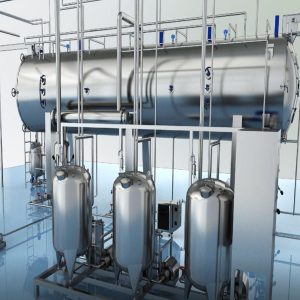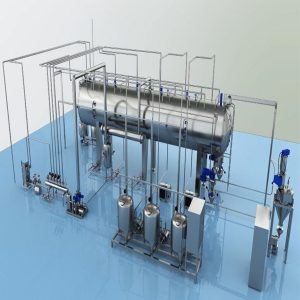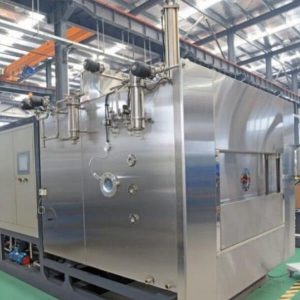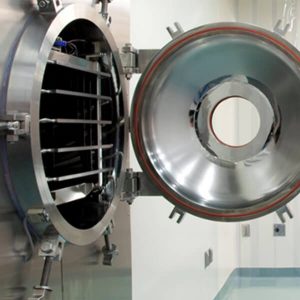
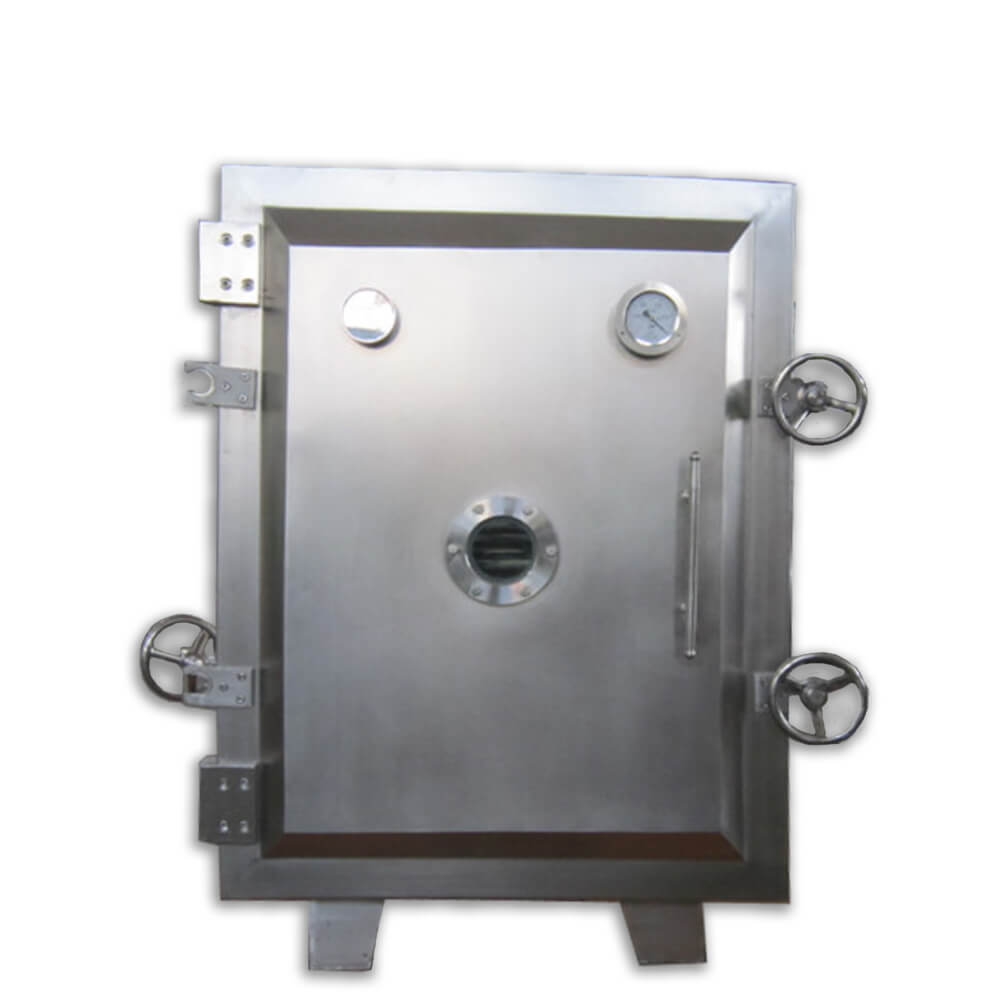
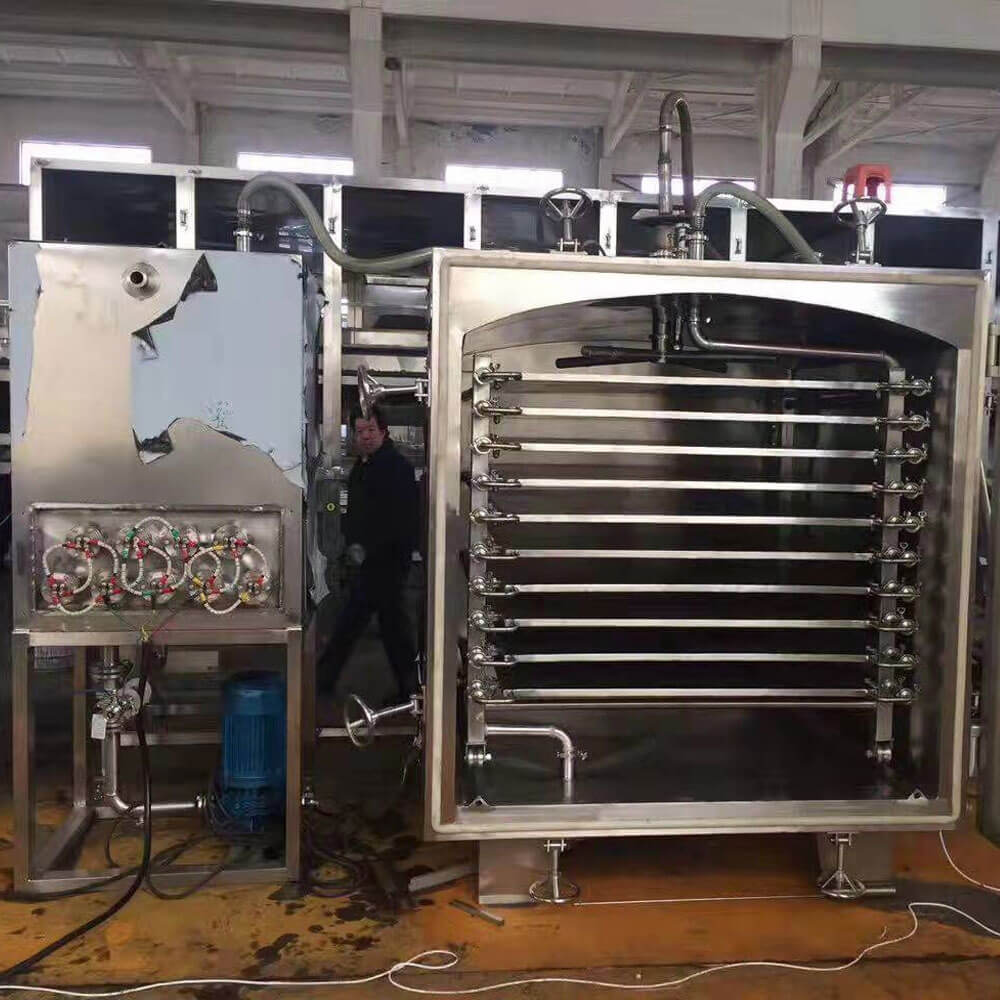
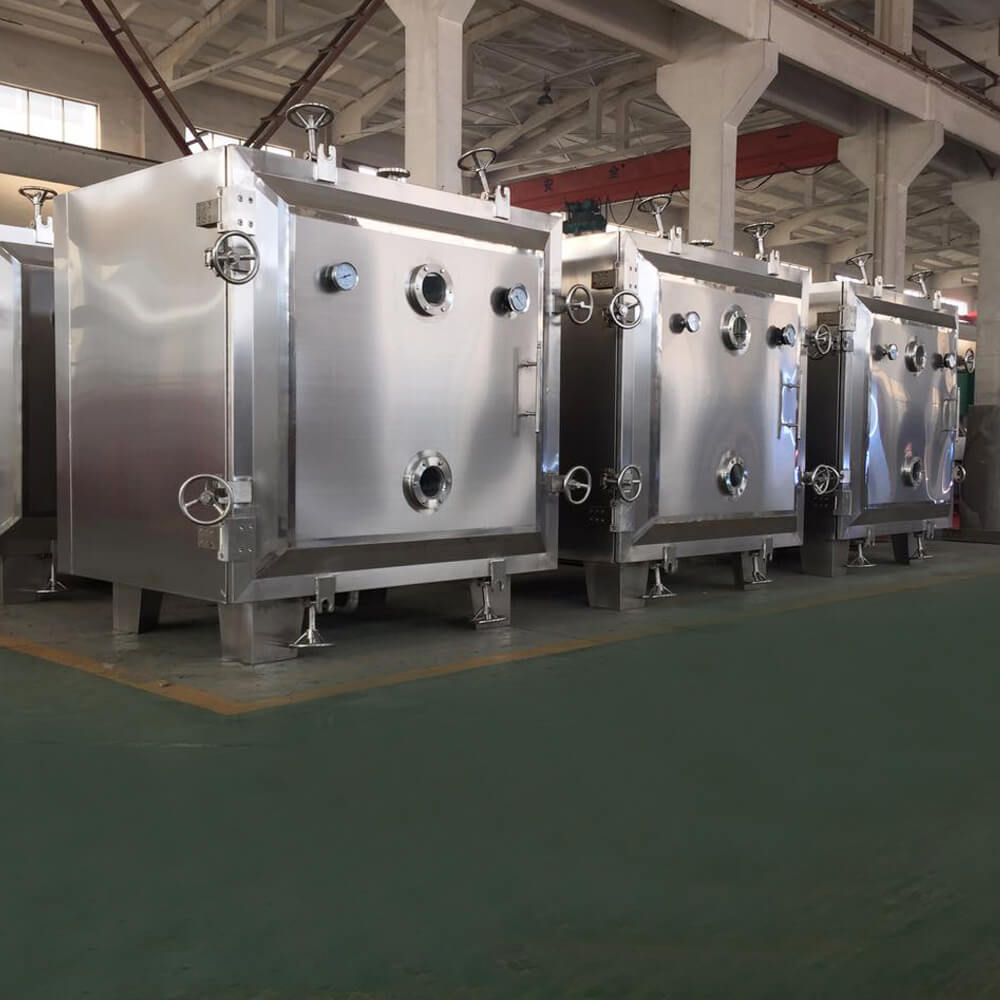
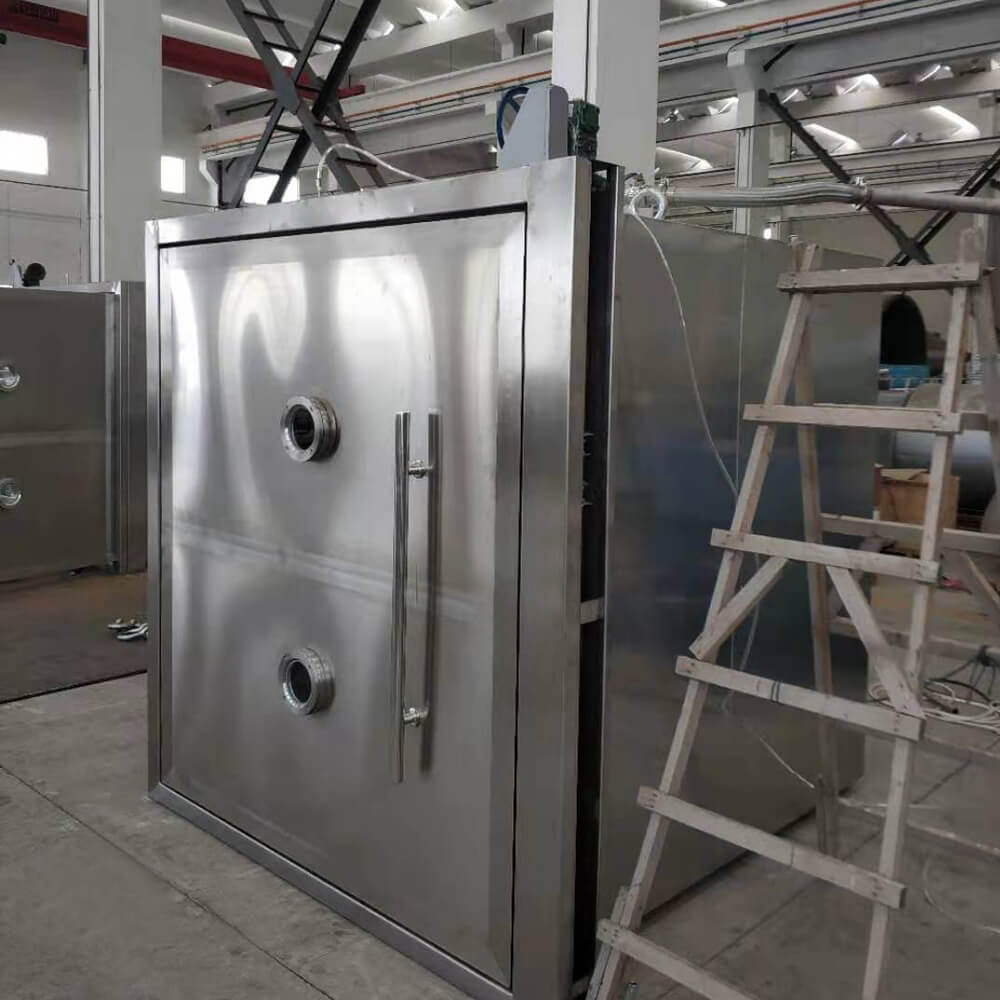
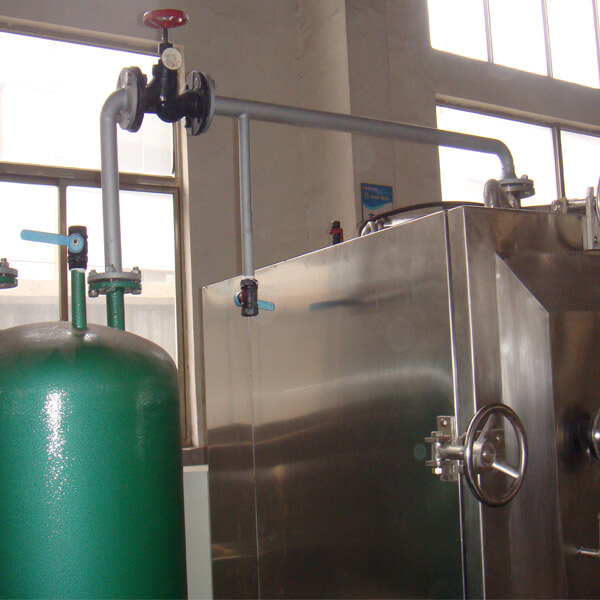
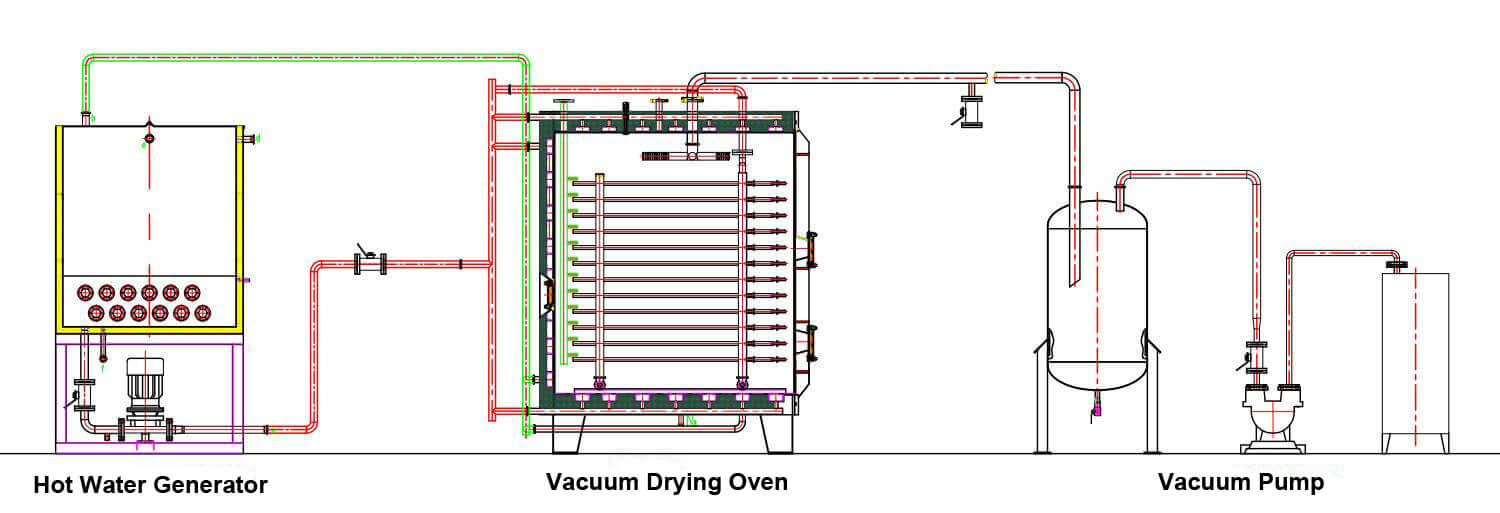
Vacuum Oven Drying Flow Chart
Technical Parameters
| ITEM | Specification | ||
| FZG-10 | FZG-15 | FZG-20 | |
| Interior size of the chamber (mm) | 1500×1060×1220 | 1500×1400×1220 | 1500×1800×1220 |
| Exterior size of the chamber (mm) | 1924×1720×1513 | 1513×1924×2060 | 1924×2500×1513 |
| Layers of baking shelf | 5 | 8 | 10 |
| Interval of the baking shelf (mm) | 122 | 122 | 122 |
| Baking tray size (mm) | 460×640×45 | 460×640×45 | 460×640×45 |
| Number of baking trays (pcs) | 20 | 32 | 48 |
| Drying capacity (kg) | 50 | 80 | 120 |
| Permitted pressure inside the pipe of the baking shelf (Mpa) | ≤0.784 | ||
| The operation temperature of the baking support | ≤150℃ | ||
| Weight (kg) | 1400 | 2100 | 3200 |
Configuration Detail
1. Drying Oven | |
Outer Wall | δ1.5mm SUS304 |
Inner Wall | 6mm SUS304, top curved |
Standard Tray | 640×460×45(mm) |
Flange Sight Glass | Φ140×20mm |
Door Hinge | FZG-20/15 SUS304 |
Door Press | FZG-20/15 SUS304 |
2. Heat Exchange System | |
Drying Rack | Main pipe: Φ57×2mm SUS304 |
Sub-pipe: Φ18×2mm SUS304 | |
3. Control System | |
Control Cabinet | Q235 Steel |
Electrical Component | Siemens |
Temperature Instrumentation | |
4. Auxiliary System | |
Insulation Material | Aluminum silicate fiber |
Vacuum Port | DN 80 SUS304 |
Safety Valve Interface | 6 |
Sealing Material | Silicone rubber |
Hot Water Inlet & Outlet | DN40 SUS304 |
Discharge Port | DN40 SUS304 |
Cleaning Interface | DN20 SUS304 |
Bimetal Thermometer | WSS-401 |
Vacuum Gauge | YZ60 |
Water Inlet Valve | DN40 SUS304, Temperature control valve switch |
BATCH VACUUM DRYING
How a Vacuum Drying Oven Works
A vacuum drying oven combines a sealed chamber, heated shelves or trays and a vacuum system. Lower chamber pressure can reduce the boiling temperature of removable liquid, allowing suitable materials to be dried at a controlled product temperature. The actual cycle is established from the material, loading arrangement, vapor load and final moisture requirement.
1. Load the Trays
Distribute the batch at a defined depth and loading density so the proposed shelf area and heat-transfer path can be evaluated.
2. Apply Vacuum
Reduce chamber pressure according to the liquid properties, product behavior and vacuum-system capability.
3. Supply Controlled Heat
Heated shelves transfer energy to the trays while temperature and pressure are controlled for the material.
4. Remove Vapor and End the Batch
Vapor is routed to the specified vacuum and condensation arrangement until the confirmed endpoint is reached.
ENGINEERING INPUTS
Vacuum Drying Oven Selection Requirements
Material and Moisture
Composition, physical form, initial and target moisture, thermal sensitivity, batch mass, bulk density and product-contact requirements.
Loading and Cycle
Tray dimensions, fill depth, number of trays, loading method, allowable product temperature, vacuum profile and drying-time target.
Vapor and Safety Review
Water or solvent identity, vapor load, boiling behavior, flammability, toxicity, materials compatibility, condenser or recovery needs and area classification.
Utilities and Quality
Heating medium, cooling water, electrical supply, vacuum source, controls, cleaning method, documentation and installation country.
Request a Vacuum Oven Application Review
Send your material, batch, moisture, temperature, solvent and utility data for a configuration discussion.
TECHNICAL QUESTIONS
Vacuum Drying Oven FAQs
What materials can be evaluated for vacuum oven drying?
Vacuum oven drying can be evaluated for heat-sensitive powders, granules, pastes, components and other batch-loaded materials when lower-temperature moisture removal or reduced oxygen exposure is important. Suitability depends on the material, solvent, loading depth and required final condition.
How does a vacuum drying oven work?
Material is loaded on heated shelves or trays inside a sealed chamber. Reduced chamber pressure lowers the boiling temperature of removable liquid, while controlled shelf heat supplies energy for evaporation. The vacuum and vapor-handling system then removes the generated vapor.
Can a vacuum drying oven handle solvent-containing material?
Only after the solvent, vapor load, flammability, toxicity, materials compatibility, condensation or recovery method and applicable area classification have been reviewed. A standard water-service configuration must not be assumed suitable for combustible or hazardous solvent duty.
What data is needed to select a vacuum drying oven?
Provide material composition, initial and target moisture, batch mass, bulk density, tray loading depth, allowable product temperature, drying-time target, liquid or solvent properties, vacuum requirement, heating medium, cleaning needs, utilities and installation country.