
Industrial Food Drying Equipment and Process Selection
Select the drying route from the material and finished-product target—not from a machine name alone. Griffin helps food processors compare spray, fluid-bed, belt, batch hot-air and vacuum routes using feed form, moisture target, heat sensitivity, throughput and site utilities.
Define the feed and the result before choosing equipment
A liquid concentrate, a wet granule and a fruit slice behave differently in a dryer. A useful engineering review begins with representative material data and a clearly stated finished-product target. The final configuration remains project-specific and may require sample testing.
Feed form
Solution, suspension, emulsion, wet granule, free-flowing particle, slice, piece, paste, filter cake or batch-loaded product.
Product target
Required final moisture, powder or piece form, bulk-density objective, handling behavior, color or aroma sensitivity and downstream process.
Production context
Hourly or batch capacity, campaign pattern, cleaning strategy, available heat source, electrical standard, installation space and delivery schedule.
Food dryer selection by feed form
The table is a starting point for discussion, not a performance guarantee. Material trials and engineering confirmation may change the recommended route.
| Typical feed situation | Route to evaluate | Why it may fit | Inputs to confirm |
|---|---|---|---|
| Pumpable solution, suspension or emulsion | Spray drying systems | Converts a pumpable feed into collected particulate through atomization and hot-gas contact. | Solids content, viscosity, atomization behavior, temperature limit, powder target and collection requirements. |
| Wet granules or free-flowing particles | Fluid-bed drying systems | Provides intensive gas-to-particle contact when the material can fluidize reliably. | Particle-size distribution, density, moisture, fluidization behavior, attrition risk and exhaust treatment. |
| Slices, pieces or formed products for continuous duty | Continuous mesh-belt dryer | Supports staged continuous conveying and controlled residence through drying zones. | Piece dimensions, loading depth, belt behavior, residence time, temperature sensitivity and discharge target. |
| Multiple products or flexible batch loading | Hot-air circulating oven | Offers tray-based batch operation for products that can be loaded and handled manually or semi-automatically. | Tray loading, batch size, airflow path, drying time, cleaning changeover and labor plan. |
| Heat-sensitive or oxidation-sensitive batch duty | Vacuum drying systems | May enable drying at a lower operating temperature under reduced pressure. | Material behavior under vacuum, boiling or foaming risk, batch size, condenser duty and required endpoint. |
Examples of systems used in food-process evaluations
These are existing Griffin equipment categories. An image or category link does not establish suitability for every food material; the supplied scope must be selected and validated for the specific project.
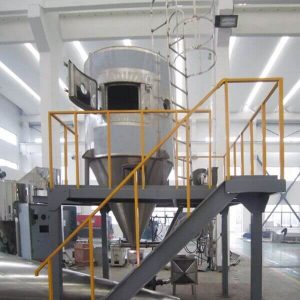
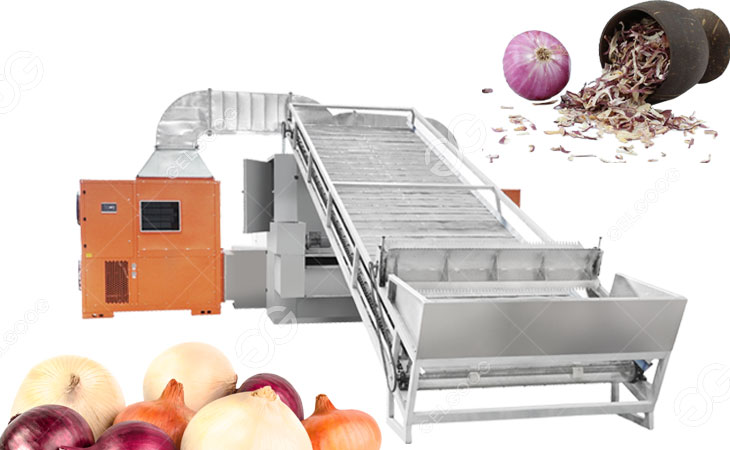
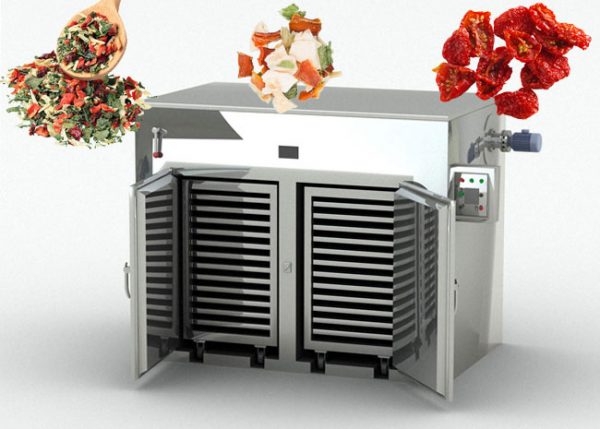
Media reused from Griffin’s existing public English pages. Replace only with approved, rights-cleared project media.
What Griffin needs to review a food-drying project
Continue to the closest material category
Use these pages when the project is specifically about fruit, meat or vegetables. This hub remains the broader comparison page for materials and processes that do not fit one category.
Food drying equipment FAQ
How do I choose an industrial food dryer?
Start with the feed form, initial and target moisture, throughput, temperature limit and desired finished-product form. These inputs narrow the feasible routes; representative material testing may still be required before the final equipment configuration is confirmed.
What information is needed for a food drying test?
Provide a representative sample, composition and safety information, feed form, particle or piece size, moisture test method, heat sensitivity, target product and required capacity. Griffin can then define whether a trial and additional measurements are needed.
Can Griffin guarantee final moisture from the website information?
No. Final moisture depends on the material, feed variability, loading, residence time, temperature, airflow or vacuum conditions and the measurement method. It must be agreed from project data and, where appropriate, validated through testing.
Which dryer is suitable for heat-sensitive food materials?
Lower-temperature vacuum drying, controlled belt or batch hot-air drying, and carefully designed spray or fluid-bed routes may be evaluated. The correct route depends on the feed form, acceptable product temperature and required output.
What utility information should be included in an enquiry?
State the available heat source, fuel or steam conditions where relevant, electrical voltage and frequency, ambient conditions, exhaust limitations, installation country and space constraints. These items affect the engineering scope and quotation.
Request a food drying solution
Send enough project data for a useful first review:
- material name and feed form
- initial and target moisture
- hourly or batch capacity
- temperature and quality limits
- available heat source and electrical standard
- installation country, space and required schedule