
Anonymous engineering study · proposal-stage design basis
Algae Feed Spray Drying: Engineering Study
A practical framework for evaluating feed properties, centrifugal atomization, thermal exposure, powder recovery, cleaning and acceptance criteria before equipment selection.
Start with the actual feed, not the material label
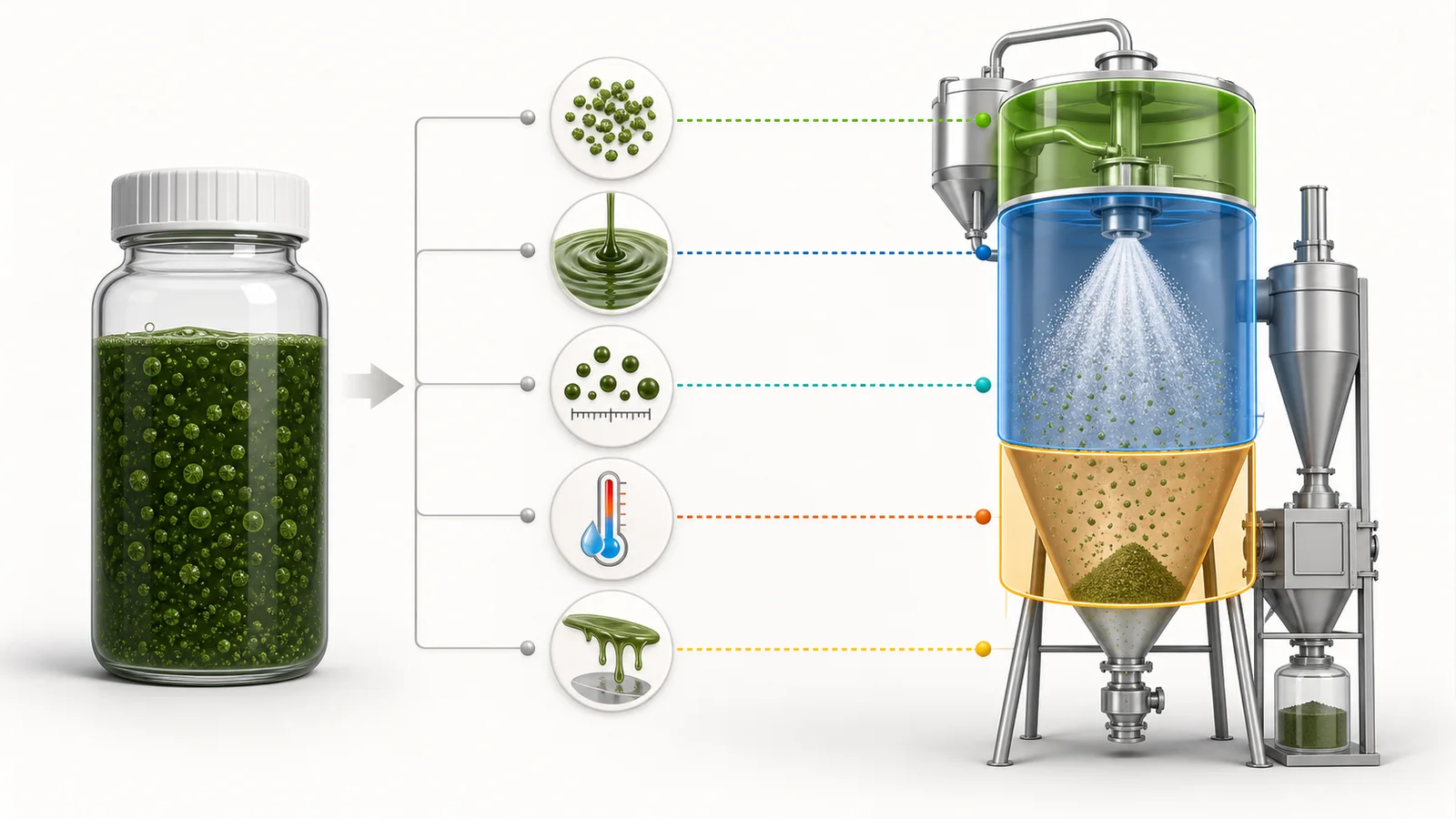
The phrase “algae solution” does not provide enough information to size a spray dryer. A feed may be a true solution, suspension, slurry, extract or emulsion. It may contain intact cells, fine suspended solids, salts, proteins, carbohydrates, oils, pigments or carrier ingredients. These properties affect pumping, atomization, droplet formation, wall deposition, thermal exposure and powder collection.
Before selecting equipment, define:
- feed composition and whether the material is a solution, suspension, slurry or emulsion;
- total solids and the dissolved-to-suspended solids relationship;
- density, viscosity, temperature and flow behavior;
- particle or cell size and the risk of settling or agglomeration;
- sensitivity to temperature, oxygen and residence time;
- initial liquid condition and target powder moisture;
- target particle size, bulk density, solubility, color and flowability;
- production schedule, cleaning frequency and downstream packaging.
Representative feed testing is especially useful where stickiness, atomizer behavior, color change, degradation or powder recovery is uncertain.
Design question 1: Is centrifugal atomization suitable?
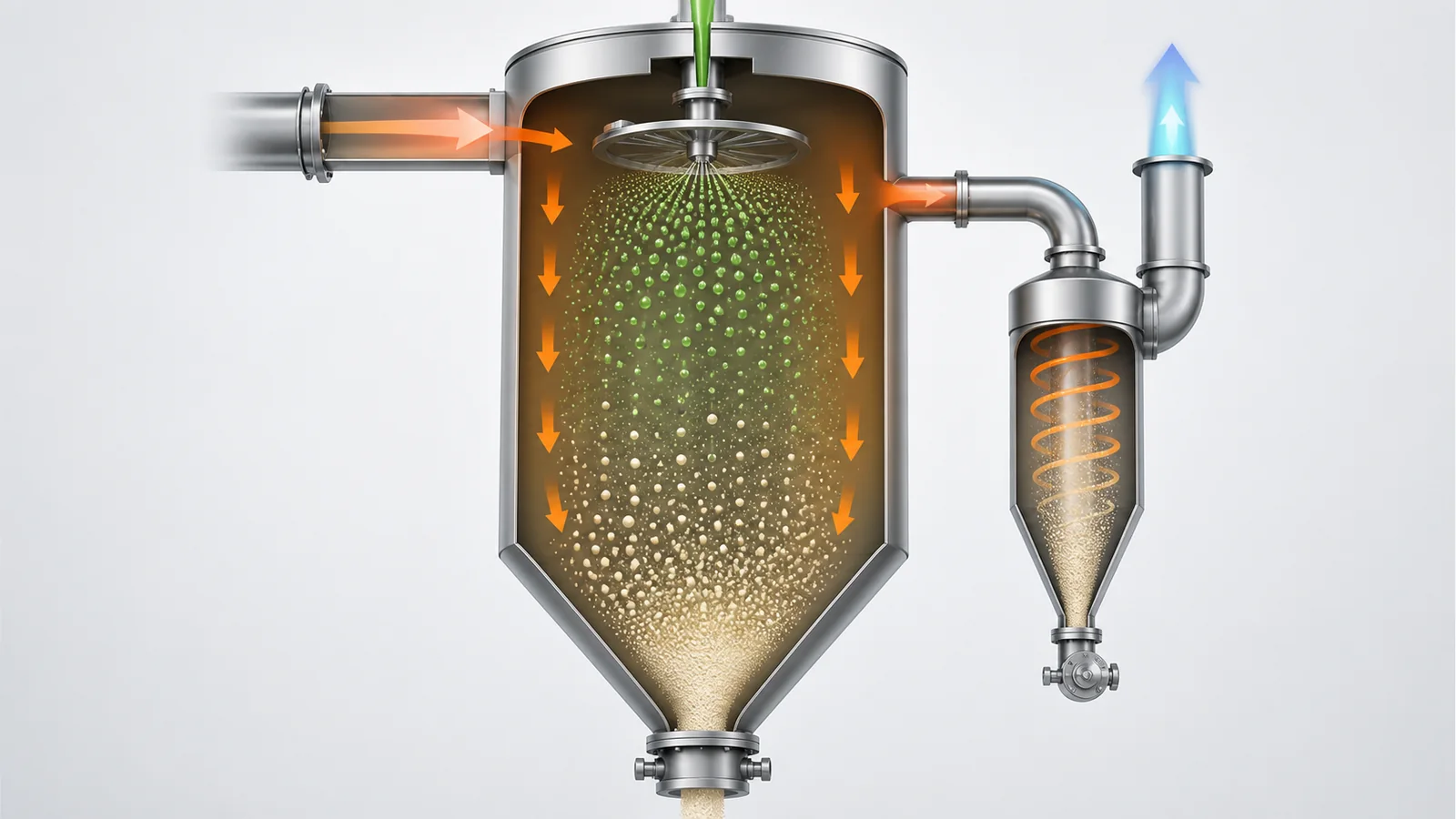
Centrifugal atomization can be evaluated for pumpable feeds when a rotating disc can create a useful droplet distribution across the required operating range. It avoids the high-pressure nozzle used by a pressure atomizer, but it is not automatically the best choice for every algae or extract feed.
Selection should consider:
- viscosity and how it changes with temperature or solids;
- suspended-particle size and abrasion;
- required droplet and powder particle distribution;
- turndown and expected feed variation;
- atomizer access, cooling, cleaning and maintenance;
- acceptable wall deposition and fines generation.
The reviewed proposal considered centrifugal atomization with co-current hot-air contact. That is a proposal-stage route, not proof that it achieved a specified powder result.
Design question 2: How can thermal exposure be controlled?
In co-current spray drying, hot gas and atomized feed enter in the same general direction. Evaporative cooling can limit initial droplet temperature while water is being removed, but product temperature still depends on feed properties, air conditions, residence time, chamber behavior and endpoint.
A “heat-sensitive” label does not establish safe temperatures. The project should define measurable quality limits such as color, pigment retention, solubility, biological activity or another agreed property. Inlet and outlet conditions are then developed around the representative material and validated operating window.
Design question 3: What causes wall deposition and low recovery?
Wall deposition may increase when droplets remain tacky at the chamber wall, when feed solids or carrier strategy are unsuitable, when droplet size is poorly matched to the chamber, or when temperature and airflow do not support drying before contact. Fine particles may also leave the chamber with exhaust gas and depend on the collection train.
The engineering review should evaluate:
- feed solids, glass-transition or stickiness behavior and possible carrier strategy;
- atomizer operating range and droplet distribution;
- chamber geometry, airflow and residence-time basis;
- inlet, outlet and product-temperature limits;
- cyclone or other powder-separation duty;
- final particulate or exhaust-treatment requirement;
- cooling, conveying and packaging conditions that may affect moisture pickup.
The proposal package considered cyclone separation, a final wet dust-control stage and optional centralized powder receiving. Exact stages and performance must remain project-specific because the source versions differ and contain no verified commissioning data.
Design question 4: How should cleaning be defined?
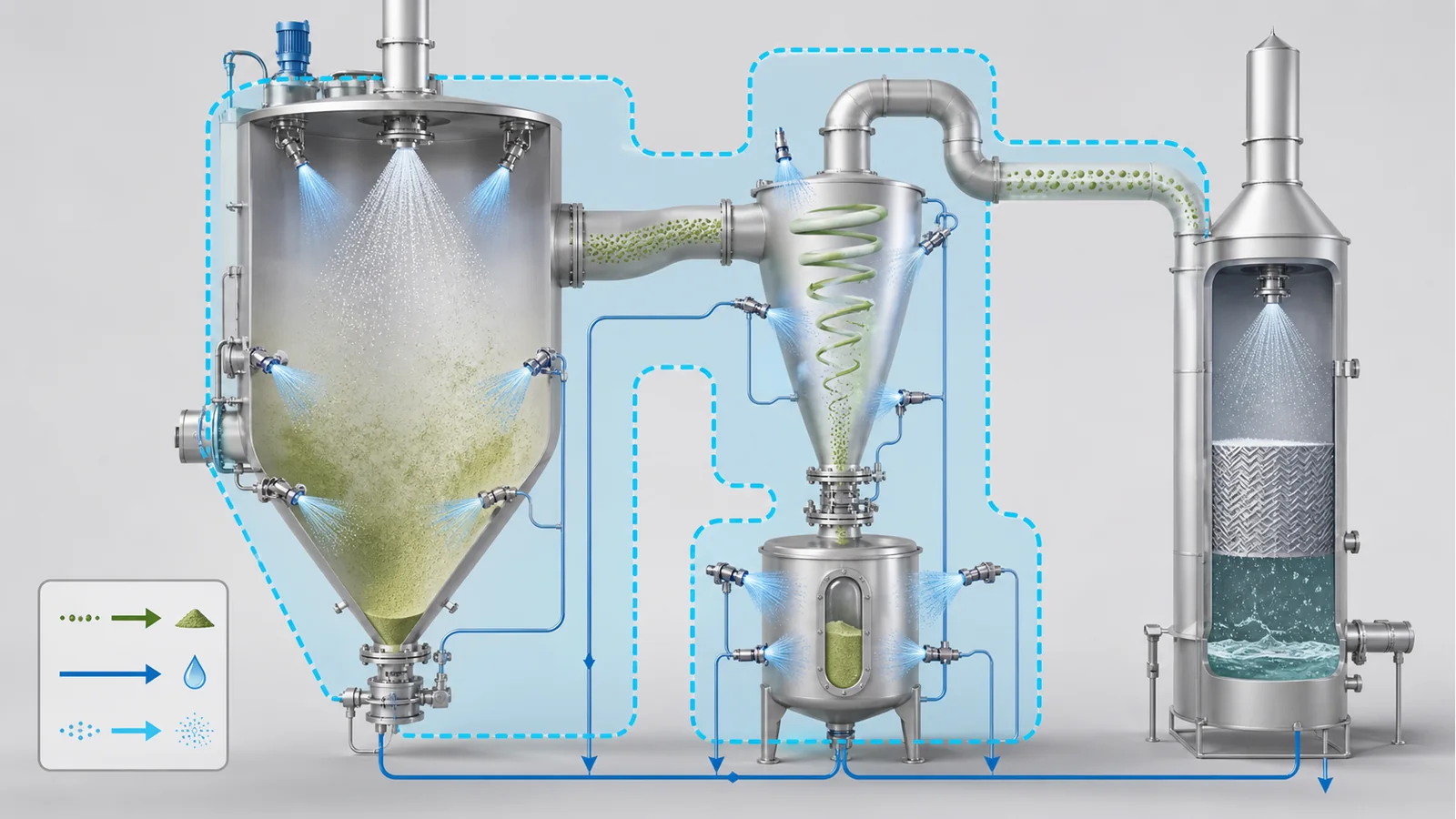
Cleaning scope must follow the actual product, changeover and hygiene requirement. “CIP” does not by itself prove cleanability or food compliance. A cleaning design should identify the boundary, spray coverage, chemistry, time, temperature, drainage, inspection access, residue acceptance and verification method.
Product-contact materials, surface finish, weld treatment, gaskets, valves and drainability should be agreed for the supplied scope. If pigments, proteins, salts or sticky residues are present, representative cleaning trials or inspection criteria may be required.
The later proposal version considered CIP and additional powder-receiving options; an earlier version specified manual cleaning. Public content therefore describes cleaning as a decision to be engineered, not a delivered feature.
Proposed engineering architecture
The proposal-stage route can be explained as six interacting areas:
- Feed preparation and metering – maintain a stable, pumpable feed and control the feed rate.
- Air filtration and heating – provide the confirmed air quality and thermal duty.
- Centrifugal atomization – form droplets within the tested operating range.
- Co-current drying chamber – provide the required contact and residence-time basis.
- Powder separation and receiving – recover powder and manage fines or final exhaust treatment.
- Controls and cleaning – monitor key conditions and implement the approved cleaning boundary.
This architecture is a selection framework. It is not a guarantee of capacity, moisture, recovery, particle size, color, nutrient retention or energy consumption.
Project-data table
| Input group | Data required | Why it matters |
|---|---|---|
| Feed identity | Composition, feed form, solids, density, viscosity, temperature, suspended particle or cell size | Supports pumping, atomization and deposition assessment |
| Powder target | Moisture, particle distribution, bulk density, solubility, color, activity and flowability | Defines measurable product acceptance |
| Production duty | Feed or evaporation basis, operating hours, turndown and changeover | Supports system sizing and control range |
| Thermal limit | Product-temperature limit and measurable degradation criteria | Guides air-condition development and testing |
| Recovery | Required yield basis, fines handling, emissions and powder cooling/packaging | Defines separation and exhaust scope |
| Cleaning | Product changeover, chemistry, drainage, inspection and verification | Defines cleaning boundary and hygienic detail |
| Utilities and site | Heat source, power, air, water, room, exhaust and local requirements | Confirms interfaces and installation limits |
| Acceptance | Trial, calculation, FAT/SAT and performance criteria | Separates design assumptions from contractual outcomes |
Testing and scale-up plan
Testing should be considered when droplet formation, wall stickiness, powder quality, recovery, thermal degradation or cleaning remains uncertain. A useful test plan records feed preparation, solids, viscosity, atomizer settings, air conditions, run duration, powder collection locations and mass balance.
Acceptance criteria may include:
- target powder moisture and sampling method;
- particle-size or bulk-density range;
- color, solubility or another material-specific quality measure;
- mass-balance and recovery definition;
- acceptable wall deposition after a defined run;
- exhaust or particulate requirement;
- cleaning inspection and residue criteria;
- stable control and safety-interlock checks.
Do not convert a short laboratory result directly into a production guarantee without a justified scale-up basis.
Frequently asked questions
Can an algae feed be spray dried?
A pumpable algae feed can be evaluated for spray drying when its solids, viscosity, suspended matter, thermal sensitivity, stickiness and powder targets are defined. Feasibility and operating conditions require representative material data and often testing.
Why consider centrifugal atomization for an algae feed?
Centrifugal atomization may provide a useful droplet range for a pumpable algae feed without a high-pressure nozzle. Suitability depends on viscosity, suspended particles, abrasion, target particle size, turndown, maintenance and cleaning requirements.
What causes algae powder to stick to a spray dryer wall?
Wall deposition can result from sticky feed solids, unsuitable carrier strategy, droplet size, incomplete drying before wall contact, airflow or temperature conditions and moisture pickup. The cause should be evaluated from representative feed behavior and operating data.
Does CIP make an algae spray dryer food-safe?
No. CIP is a cleaning method, not an automatic food-safety certification. Cleaning boundaries, coverage, chemistry, drainage, inspection, verification, product-contact construction and the applicable hygiene standard must be defined for the project.
What data is needed for an algae spray dryer proposal?
Provide feed composition and form, solids, viscosity, density, temperature, suspended particle size, feed or evaporation duty, target powder moisture and properties, thermal limits, recovery and emissions targets, cleaning requirements, utilities and installation conditions.
Can this study guarantee recovery or final moisture?
No. This study contains no verified commissioning results. Recovery and final moisture depend on the feed, atomization, thermal conditions, chamber behavior, collection system, controls and operating procedure, and must be agreed and validated for the specific project.
Project evaluation
Request an Algae Feed Evaluation
Send representative feed information, solids, viscosity, temperature, suspended-particle data, production duty, powder target, thermal limits, recovery requirements, cleaning scope and site utilities. Griffin can review atomization, chamber, powder collection, controls and acceptance criteria as one project-specific spray-drying system.
Publication review: Confirm the approved feed term and complete engineering, safety and cleaning review before publishing. This study does not report a commissioned installation or verified production result.